

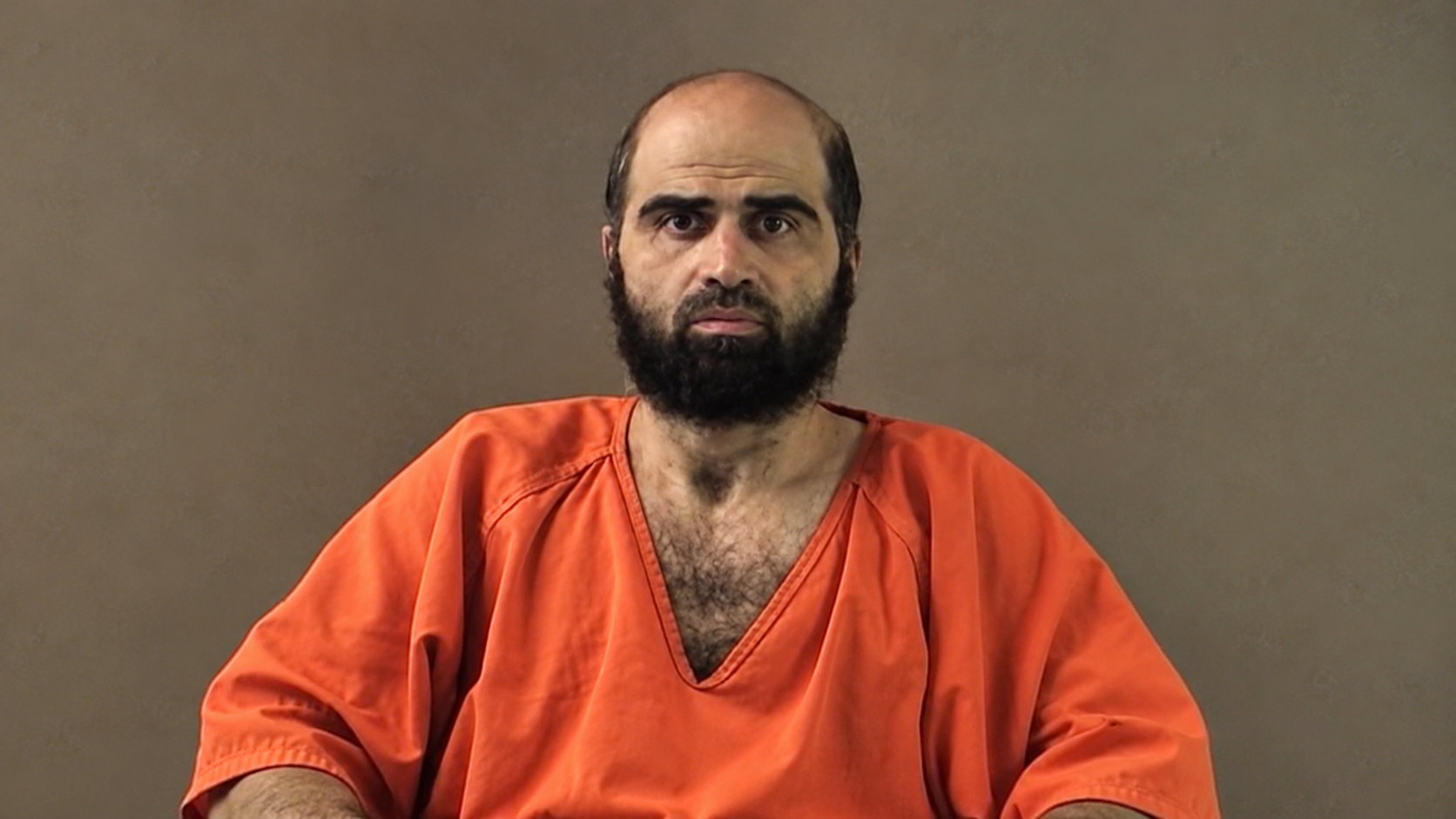
Trump has officially shut down plans to livestream the execution of convicted Fort Hood mass shooter Nidal Malik Hasan, reversing a proposal from Defense Secretary Pete Hegseth that sparked outrage across the country. However, the death sentence itself remains in place, with Hasan scheduled to face a military firing squad in Texas on December 3, 2026.
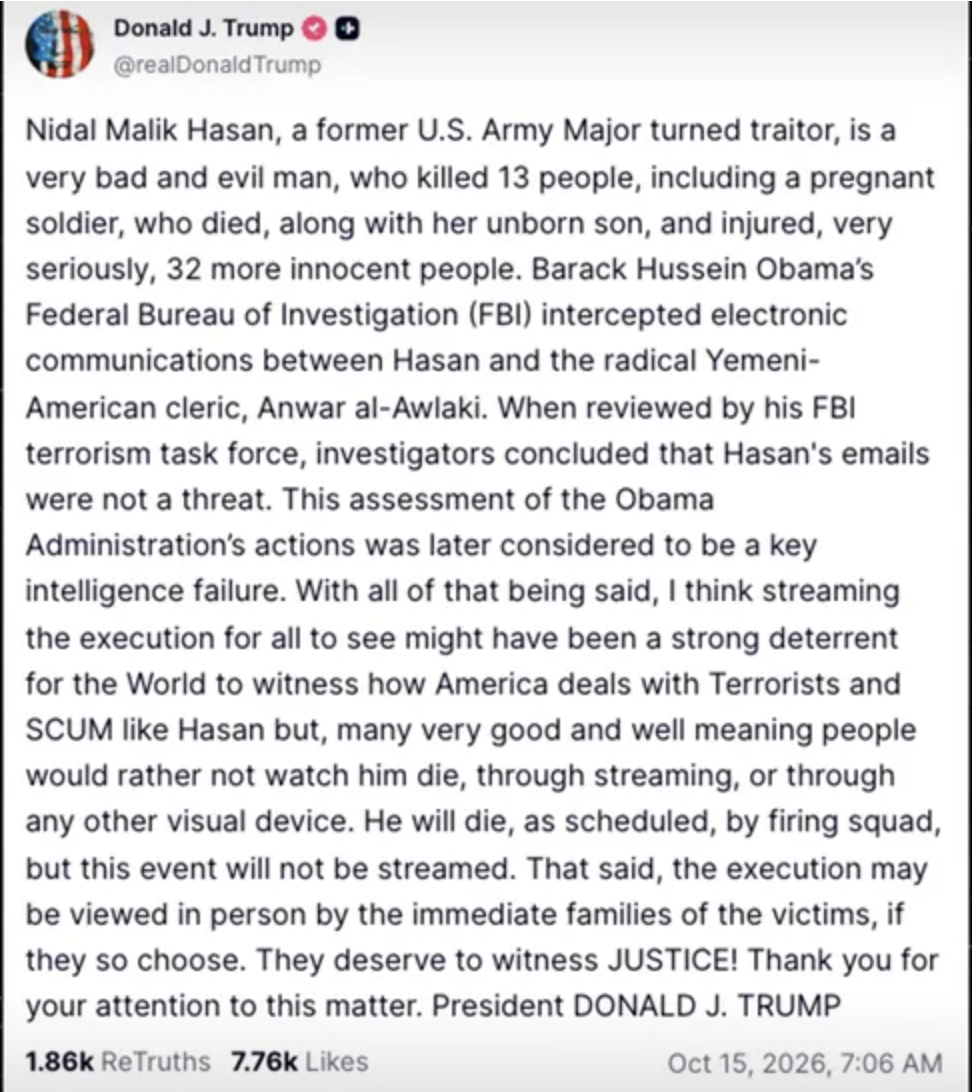
In a Thursday, October 15, statement on Truth Social, Trump acknowledged that broadcasting the execution could have sent a warning to potential attackers. He suggested it might have been a “strong deterrent,” before conceding that “many very good and well-meaning people would rather not watch him die, through streaming, or through any other visual device.”
The administration’s change in direction does not mean Hasan has been spared. Trump made clear that the planned execution would remain a military proceeding rather than an event broadcast for the public.
“He will die, as scheduled, by firing squad, but this event will not be streamed,” he declared.
Trump added that the execution could still be witnessed “by the immediate families of the victims, if they so choose.” His announcement gives relatives the opportunity to attend without subjecting the wider public to the images of Hasan’s death.
Just one week earlier, Hegseth had promoted an entirely different approach. During an October 8 interview with conservative commentator Jack Posobiec on Real America’s Voice, he confirmed plans to make the execution accessible to viewers. The Pentagon subsequently said it intended to broadcast the event live.
Hegseth argued that people needed to see what happens to those responsible for attacks like the one at Fort Hood. His proposal immediately opened a national debate over whether livestreaming an execution would demonstrate accountability or turn a deadly tragedy into public entertainment.
Even prominent Republicans questioned the decision. JD Vance said he would not watch a broadcast and expressed doubt that it would actually happen. Republican Senator Thom Tillis condemned the idea, warning that public executions were associated with oppressive governments, not American justice.
The opposition extended beyond Washington. Archbishop Timothy Broglio, who oversees Catholic ministry for U.S. military personnel, criticized the proposed livestream and urged Catholic service members assigned to a firing squad to request exemption. Dozens of retired military leaders also objected, raising concerns about the military’s reputation and the possibility that extremists could exploit the footage as propaganda.
Some people personally affected by the shooting expressed similar worries. Lelia Hunt Willingham, whose brother was among those killed, told CBS Texas that the families do not all agree about attending the execution. Still, she said several relatives believe the event should remain private and objected to politicians speaking on their behalf.
Other survivors have expressed a desire to be physically present when the sentence is carried out, showing how differently those who lived through the attack understand justice and closure. Trump’s revised plan allows immediate family members of those killed to attend, although details on witness arrangements have not yet been made public.
Public opinion also weighed heavily against televising Hasan’s death. An ABC News/Washington Post/Ipsos poll released October 15 found that 80% of Americans opposed livestreaming the execution. At the same time, 52% supported executing Hasan, underscoring the difference between supporting a death sentence and wanting that punishment shown online.
Hasan, a former Army major and psychiatrist, was convicted for the November 5, 2009, shooting at Fort Hood, Texas. He opened fire inside a soldier processing center as service members prepared for deployment, killing 13 people and wounding 32 others. Among those killed was civilian employee Michael Grant Cahill.
During his 2013 court-martial, Hasan acknowledged carrying out the shooting and claimed he was acting to prevent American troops from killing Muslims overseas. A military jury sentenced him to death. The attack remains one of the deadliest shootings in the history of a U.S. military installation.
The Army announced that Hasan’s execution was scheduled for 1 p.m. Central Time on December 3 at Fort Hood after Trump approved the death sentence earlier this month. If carried out, it would be the first U.S. military execution since 1961, when the Army executed Private John Bennett by hanging. The military has not used a firing squad for an execution since 1945.
Despite the date being set, legal questions remain. Hasan has completed the military appellate process, but he can still seek review in civilian federal court, potentially delaying the execution. As it stands, Trump has closed the door on broadcasting the planned killing, not on carrying out the sentence.
The shift puts the focus back on the families and survivors who have waited nearly 17 years for the case to reach this stage, rather than on the audience the Pentagon once intended to attract.
