

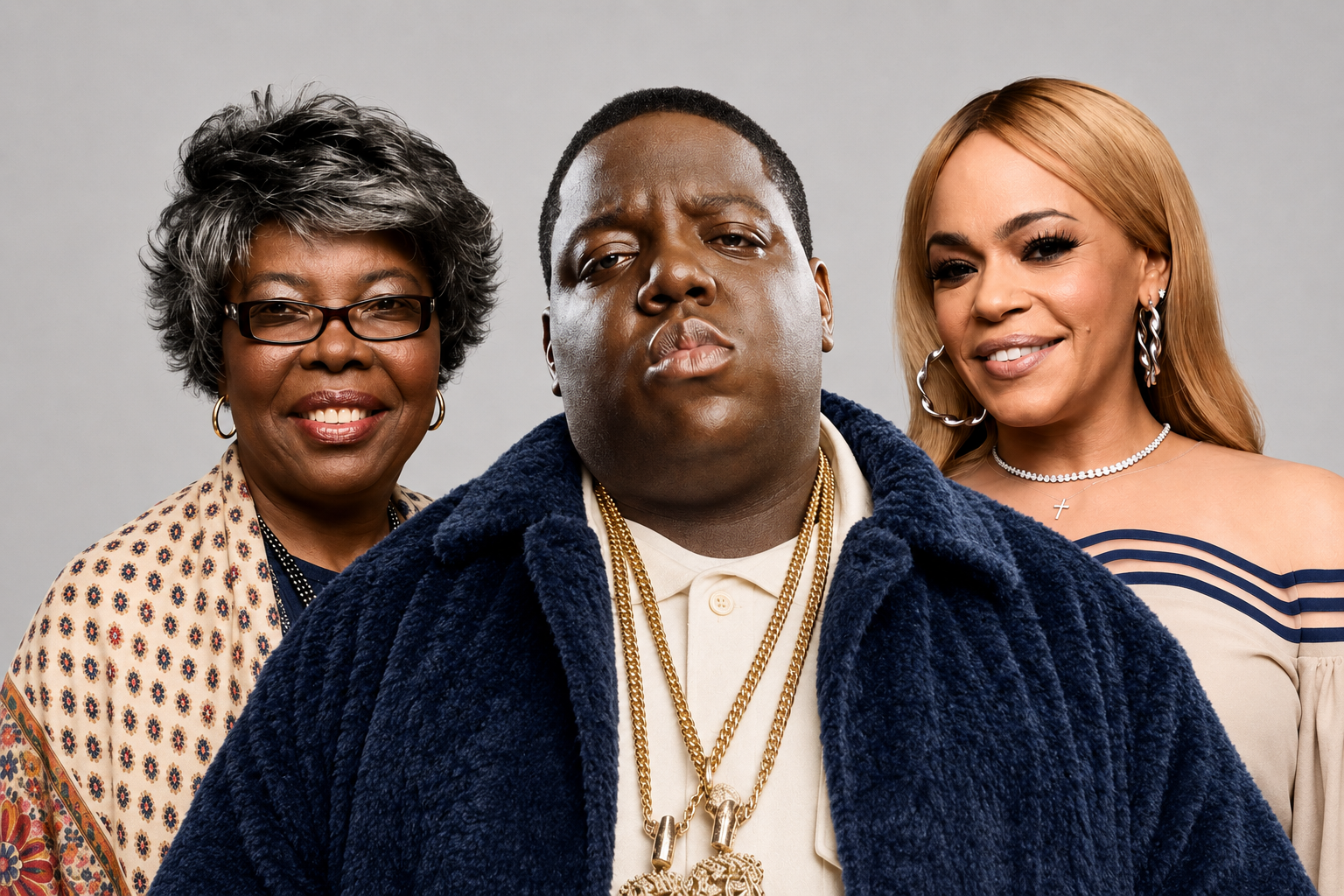
The Biggie estate fight has delivered Wayne Barrow, the rapper’s ex-manager, a major court victory against Faith Evans, although the ruling does not settle every legal question surrounding the late rapper’s business legacy.
According to the Delaware Court of Chancery, Chancellor Kathaleen St. J. McCormick granted summary judgment in Barrow’s favor on two claims, ruling that the Voletta Wallace Revocable Trust is a member of Notorious B.I.G., LLC and is entitled to the rights that come with that membership.
Court records show Voletta Wallace and Evans formed Notorious B.I.G., LLC in 2007 to manage intellectual property connected to Christopher Wallace, better known as The Notorious B.I.G. Under a 2023 operating agreement detailed by the court, Voletta and Evans each owned 50 percent of the company’s membership units. Each woman also assigned half of her distribution interest to Biggie’s children, Ty’anna Wallace and Christopher Jordan Wallace, known as C.J., leaving Voletta, Evans, Ty’anna and C.J. each entitled to 25 percent of company distributions.
McCormick opened her ruling on the Biggie estate dispute with a reference that immediately connected the courtroom fight to Biggie’s own music.
“In the song ‘Ten Crack Commandments’ from The Notorious B.I.G.’s posthumously released Life After Death album, Christopher Wallace presciently cautioned: ‘Keep your family and business completely separated.’ After Wallace’s tragic death, however, his mother and widow did exactly the opposite—forming Notorious B.I.G., LLC (the ‘Company’) under Delaware law to manage the late rapper’s intellectual property. This litigation was perhaps the inevitable result.”
At the center of the case is a decision Voletta made shortly before her death. According to the court’s opinion, Voletta amended her trust on February 6, 2025, removing C.J. Wallace and longtime friend Carol Sampson as successor trustees and leaving Barrow as the sole trustee. She also changed her will so Barrow became the sole executor of her estate. Voletta died on February 21, 2025, and Barrow accepted his appointment as successor trustee the following month.
After Voletta’s death, court records state that Evans became the sole manager of Notorious B.I.G., LLC and stopped making distributions to the trust. The judge wrote that Evans, “presumably angered” over the removal of her son, took the position that the company agreement did not allow Voletta’s membership units to transfer to the amended trust. Barrow filed suit in July 2025, setting up the Delaware portion of the Biggie estate battle.
The judge rejected that argument. According to the ruling, the company agreement specifically identified the Voletta Wallace Revocable Trust as a permitted transferee. McCormick concluded that amending the trust did not create an entirely new legal entity and therefore did not strip it of that status. The court also found that Barrow had properly assumed Voletta’s rights and obligations under the company agreement. Summary judgment was entered for Barrow on the first two counts, while Evans and the company’s opposing counterclaim was dismissed.
The stakes became even larger after Biggie’s business interests entered a new chapter. According to Variety, the estate partnered with Primary Wave in March 2025, shortly after Voletta’s death. The partnership involved Biggie’s catalog, publishing and publicity rights. The Delaware decision now strengthens the trust’s position in receiving the share of distributions tied to Voletta’s former interest.
Barrow’s attorney Jay W. Freiberg celebrated the Biggie estate ruling in a statement to Rolling Stone.
“Wayne is feeling vindicated. We obtained a total victory in a dispute that never should have happened,” Freiberg said. “Wayne goes back with the family for decades, and Mama Wallace wanted Wayne to steward the legacy of the Notorious B.I.G. after she was gone, and he now will be able to do that. He knows it’s a very important task, and he’s looking forward to fulfilling Mama Wallace’s wishes in that regard.”
Still, Barrow’s Delaware victory is not the final word. C.J. filed a separate case in Pennsylvania challenging Barrow’s authority as trustee and executor, alleging Voletta was “improperly influenced” before making the changes to her estate plan. That case remains pending. The Delaware court refused to delay its own case while that challenge plays out, noting that Barrow currently has authority to act for the trust.
For now, the estate ruling gives Barrow a significant legal win and confirms the trust’s place inside the company managing one of hip hop’s most valuable legacies. Whether Barrow keeps that authority in the long term could ultimately depend on what happens next in Pennsylvania.
