
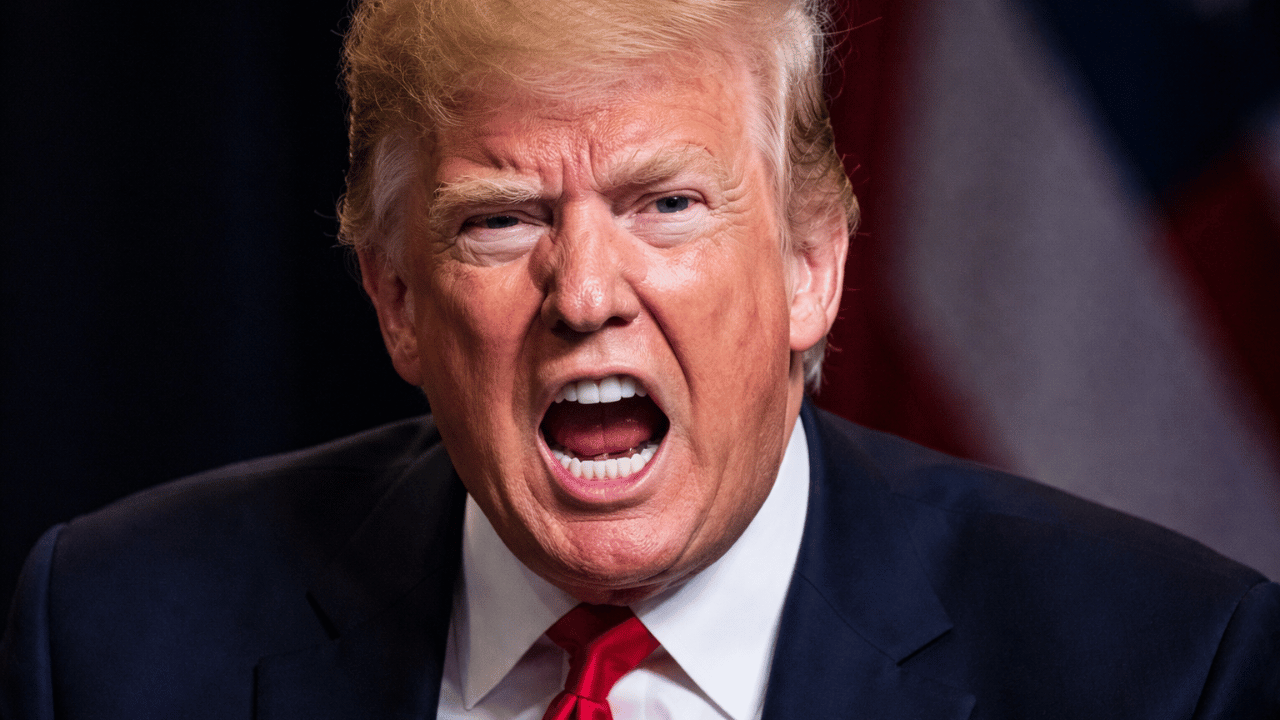
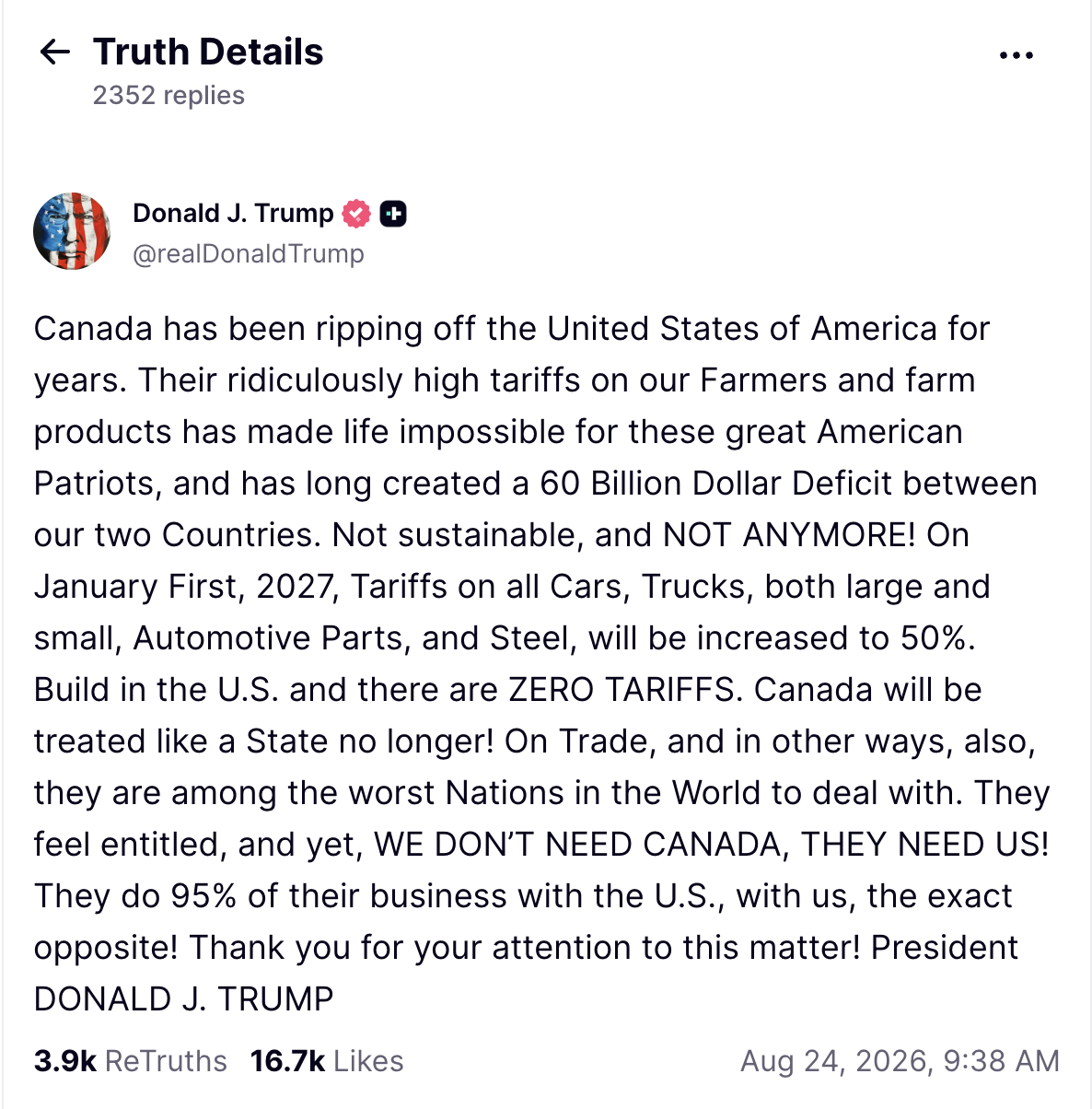
Donald Trump is turning a bitter trade standoff with Canada into a much bigger test for the North American auto industry. Trump announced Monday that tariffs on cars, trucks, automotive parts and steel would rise to 50% beginning January 1, 2027, escalating the Trump-Canada tariffs fight just days after negotiations between Washington and Ottawa fell apart. The threat reaches far beyond another political clash between Trump and Canadian Prime Minister Mark Carney. If implemented as described, it could reshape how vehicles and parts move across a supply chain that has spent decades operating across the U.S., Canada, and Mexico.
Trump made his message to manufacturers clear.
“Build in the U.S., and there are ZERO TARIFFS. Canada will be treated like a State no longer!” Trump wrote.
Then he went directly at Canada.
“On Trade, and in other ways, also, they are among the worst Nations in the World to deal with. They feel entitled, and yet, WE DON’T NEED CANADA, THEY NEED US!”
The announcement came after a surprisingly fast collapse in negotiations that had appeared close to producing a deal. Days earlier, officials were discussing a framework that could have lowered the existing U.S. tariff on Canadian-built vehicles from 25% to roughly 15%, while Canada was seeking an even lower rate. Steel and aluminum relief was also on the table. Canadian Trade Minister Dominic LeBlanc said Thursday the two countries were “very close” to an agreement. By Friday, the deal was dead.
The breakdown triggered another round of retaliation.
The United States moved ahead with 50% tariffs covering roughly $20 billion in Canadian goods after the talks failed. Carney responded by suspending negotiations and announcing that Canada would impose dollar-for-dollar retaliatory tariffs on U.S. products beginning September 8.
So why is Trump pushing the fight this far?
The administration has repeatedly framed tariffs as a tool for forcing more manufacturing into the United States while pressuring trading partners to give American products greater market access. U.S. Trade Representative Jamieson Greer has accused Canada of discriminating against American exports through policies affecting vehicles, dairy products and alcohol. The administration has also pushed for North American vehicles to contain more U.S.-made components rather than simply meeting broader regional-content requirements.
That fits Trump’s larger manufacturing strategy. His administration declined in July to extend the U.S.-Mexico-Canada Agreement under its existing terms, seeking changes designed to increase domestic production and reduce trade deficits. The trade pact remains in force, but Washington’s decision set up continuing reviews and potentially years of renegotiation.
Cars sit right in the middle of that battle.
The White House argues that Canada’s treatment of U.S.-made vehicles unfairly favors other countries. In a July proclamation, Trump said U.S. motor-vehicle exports to Canada dropped from approximately $25.9 billion to $20.3 billion when comparing April 2025 through March 2026 with the equivalent year-earlier period. The administration used Section 338 of the Tariff Act of 1930 to authorize additional duties targeting what it called discriminatory Canadian trade practices.
Canada has been moving in another direction at the same time.
Carney’s government has made diversifying Canadian trade beyond the United States an explicit goal. One major move came with China. Beginning March 1, Canada replaced its 100% surtax on a limited number of Chinese electric vehicles with a 6.1% tariff for an annual quota initially capped at 49,000 vehicles. Ottawa says the strategy could help attract investment while creating new export opportunities in other Canadian industries.
That shift matters because Trump has argued that the United States does not need Canadian or Mexican vehicle production, even though automakers have spent decades building a deeply connected North American manufacturing system. Major auto groups representing companies including General Motors, Ford, Toyota, Tesla, Hyundai and others have pushed Washington to preserve the USMCA framework, warning that breaking apart regional production could weaken U.S. competitiveness against Asian and European manufacturers.
The tension is hard to miss. Trump wants manufacturers to treat the U.S. border as a reason to bring more factories home. Automakers have built their businesses around treating North America more like one production network.
Now Canada is promising retaliation, Washington is threatening another major tariff increase, and a trade relationship that once centered on lowering barriers is moving rapidly in the opposite direction.
January 1 is still months away, which leaves room for another negotiation before Trump’s threatened 50% rate takes effect. But after talks went from “very close” to collapsed in roughly a day, neither side is signaling much trust.
And this time, the fight is landing directly on an industry where crossing the border has long been part of how the product gets built.