

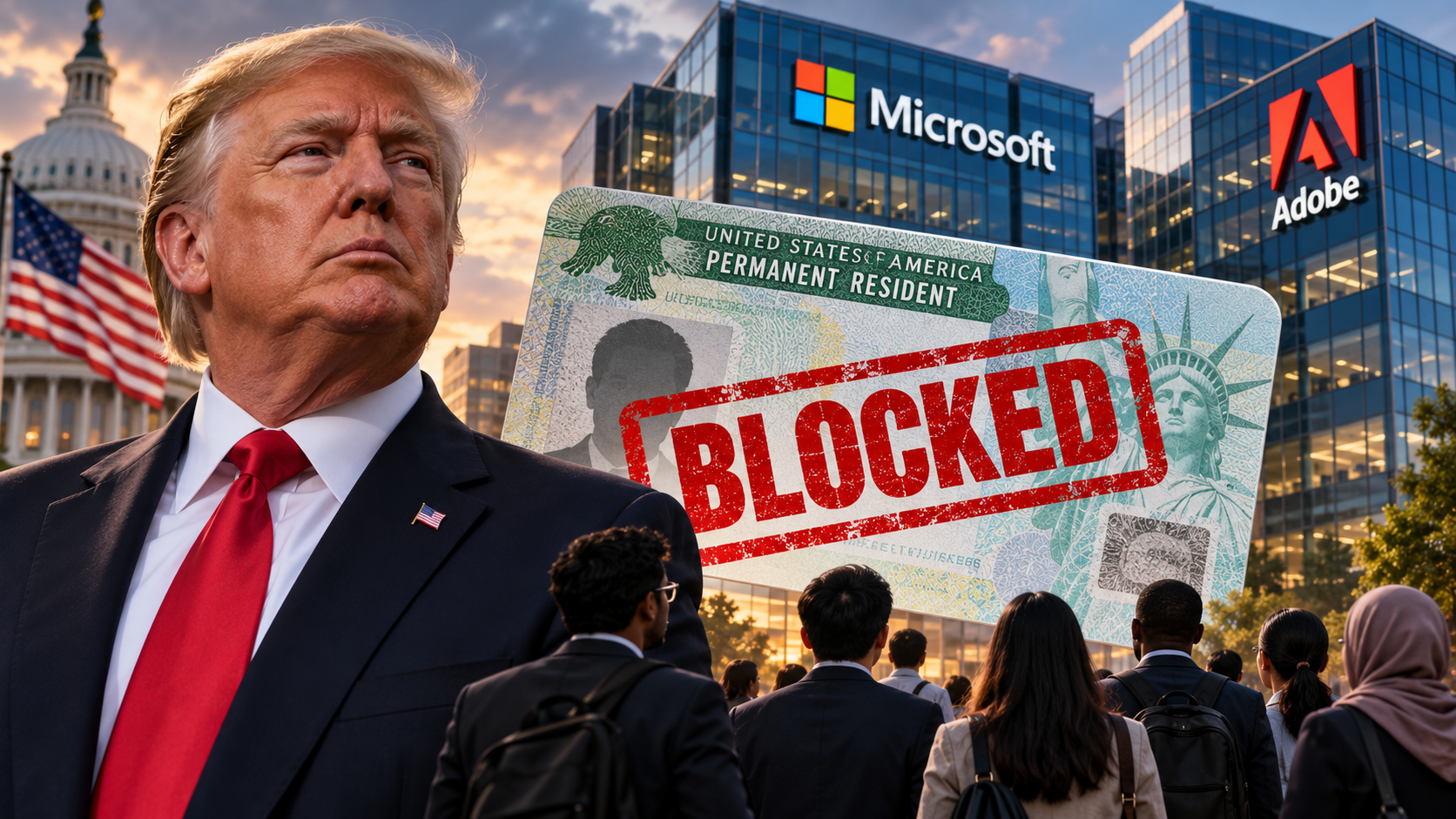
Microsoft, Adobe, and several of the world’s largest technology companies are facing a major immigration crackdown after the Trump administration announced it would block them from a federal program that helps skilled foreign workers secure green cards.
The decision, announced Thursday, October 8, 2026, targets eight major technology and IT services companies over allegations that they have misused employment immigration programs while American workers struggle to find jobs.
According to Reuters, JD Vance and Labor Secretary Keith Sonderling announced the restrictions as part of an effort to address alleged immigration fraud and protect employment opportunities for U.S. workers.
The companies affected include Microsoft, Adobe, Cognizant, Infosys, Tata Consultancy Services, Wipro, HCL Technologies, and Capgemini.
The move puts some of the biggest players in the technology industry under federal scrutiny and could create significant uncertainty for foreign professionals who have spent years building careers in the United States.
During Thursday’s announcement, Vance directed a pointed message toward Microsoft, making it clear that the administration wants major American corporations to prioritize domestic hiring.
“Our message to Microsoft is: You’re a great American company, but you’ve got to hire great American workers,” Vance said, according to Reuters.
The crackdown specifically targets the Permanent Labor Certification Program, commonly known as PERM, which plays a critical role in helping foreign employees become lawful permanent residents.
Under the new restrictions, the Department of Labor will not accept new permanent labor certification applications from the affected companies or move forward with pending applications covered by the suspension, according to Reuters.
That distinction matters because the policy is not a blanket ban on foreign workers or a cancellation of the H-1B visa program. Instead, it blocks a major employment pathway that allows companies to sponsor workers for permanent residency.
For employees already working in the United States, the consequences could be serious, particularly for those whose long-term immigration plans depend on company sponsorship.
The U.S. Department of Labor explains that PERM is a federal labor certification process designed to help employers permanently hire foreign workers when qualified American workers are not available for specific positions.
The process has been governed by a modernized regulatory framework since 2005 and serves as an important step in many employment-based green card applications.
Before sponsoring a foreign employee through PERM, an employer generally must establish that the position is legitimate, obtain an official prevailing wage determination, and conduct recruitment efforts to determine whether qualified U.S. workers are available.
Employers must also demonstrate that hiring the foreign worker will not negatively affect the wages or working conditions of similarly employed American workers.
These requirements are intended to prevent companies from bypassing qualified U.S. applicants or using immigration programs to drive down compensation.
The Department of Labor reviews the certification application, but it does not issue the green card itself. After receiving certification, the employer generally proceeds through the immigration petition process administered by U.S. Citizenship and Immigration Services.
This makes PERM an essential part of the journey toward permanent residency for many foreign professionals working in technology, engineering, finance, and other specialized industries.
The green card program also differs from the H-1B visa system, although the two frequently intersect.
H-1B visas allow employers to hire qualified foreign professionals temporarily for specialty occupations, often requiring specialized education or expertise. PERM, meanwhile, is commonly used when those employers want to sponsor eligible employees for permanent residency.
As Axios explained, Thursday’s restrictions do not automatically invalidate existing H-1B visas. However, they could disrupt green card sponsorship opportunities for employees at the affected companies.
That means someone may still have authorization to work in the United States while facing new uncertainty about their ability to establish permanent residency through their employer.
Microsoft is not staying silent as the administration questions how the company uses immigration programs.
In a statement provided to TechCrunch, a Microsoft spokesperson defended the company’s hiring practices and argued that the overwhelming majority of its U.S. workforce consists of American employees.
“We believe in the strength and talent of the American workforce,” the spokesperson said. “That is why the vast majority of Microsoft employees in the United States are Americans. We look forward to providing the Administration with additional information. For example, of the approximately 6,000 H-1B visa applications we submitted in the last fiscal year, 80% percent were to extend or change the status of existing Microsoft employees.”
The company emphasized that many of its visa filings involve people already working for Microsoft, rather than new employees being brought into the country.
“These were not to hire new people. The remaining filings for new employees were for individuals already legally in the United States who decided to come work for us, and they equal only 1% of our U.S. workforce. They are not new arrivals to our country.”
Microsoft also maintained that it files H-1B petitions only for workers who meet the visa program’s “rigorous standards” and that it compensates those employees the same as “other employees doing comparable work.”
The company’s response highlights a major disagreement over how immigration data should be interpreted.
While the administration has pointed to the volume of foreign worker applications as evidence of problems within the system, Microsoft argues that those figures do not accurately represent the number of new workers entering the country.
It is also important to distinguish between allegations and proven misconduct. Federal officials have raised concerns about potential abuse, but the announcement does not establish that every affected company committed fraud.
As of Thursday’s reporting, Adobe had not publicly responded to TechCrunch’s request for comment.
The decision arrives amid ongoing debate over whether large corporations rely too heavily on foreign labor while American technology workers face layoffs and hiring challenges.
According to Reuters, Sonderling said the affected companies collectively sought nearly three million foreign workers and received more than 230,000 H-1B approvals and 100,000 permanent labor certifications since 2009.
Those figures cover years of immigration activity and do not, by themselves, establish that the applications were fraudulent.
The administration has nevertheless argued that additional oversight is necessary to ensure American workers are given fair opportunities for jobs.
For immigrant professionals, the stakes extend beyond their current employment.
Many skilled foreign workers pursue permanent residency through employer sponsorship after living and working legally in the United States for years. A disruption to that process can complicate career decisions, family planning, and long-term stability.
The crackdown could also affect companies that depend on specialized global talent to fill technical positions, particularly in industries where employers say certain skills are difficult to recruit domestically.
The central question is whether stricter enforcement will produce more opportunities for American workers without creating additional obstacles for legally employed immigrants and businesses operating under federal immigration rules.
The administration’s immigration enforcement push is not limited to major technology companies.
According to STAT, federal officials also announced investigations into nine universities over allegations that they improperly used the J-1 exchange visitor visa program to bring international researchers into the country.
The institutions under investigation include Harvard, Yale, Stanford, Brown, the Massachusetts Institute of Technology, the California Institute of Technology, Arizona State University, the University of Pittsburgh, and the University of California, Davis.
The J-1 program is different from PERM and is commonly used by international researchers, scholars, and other exchange visitors participating in approved educational and cultural programs.
Vance alleged that certain universities were taking advantage of the system to obtain less expensive foreign labor rather than relying on American researchers.
The allegations remain subject to investigation, and the announcement itself does not establish wrongdoing by the universities.
The simultaneous scrutiny of major technology companies and prominent research institutions signals a broader effort to reshape how employers and universities use federal immigration programs.
For now, Microsoft and the other affected firms face new restrictions on employment-based green card sponsorship, while foreign professionals whose immigration futures depend on those companies confront unanswered questions about what happens next.
