
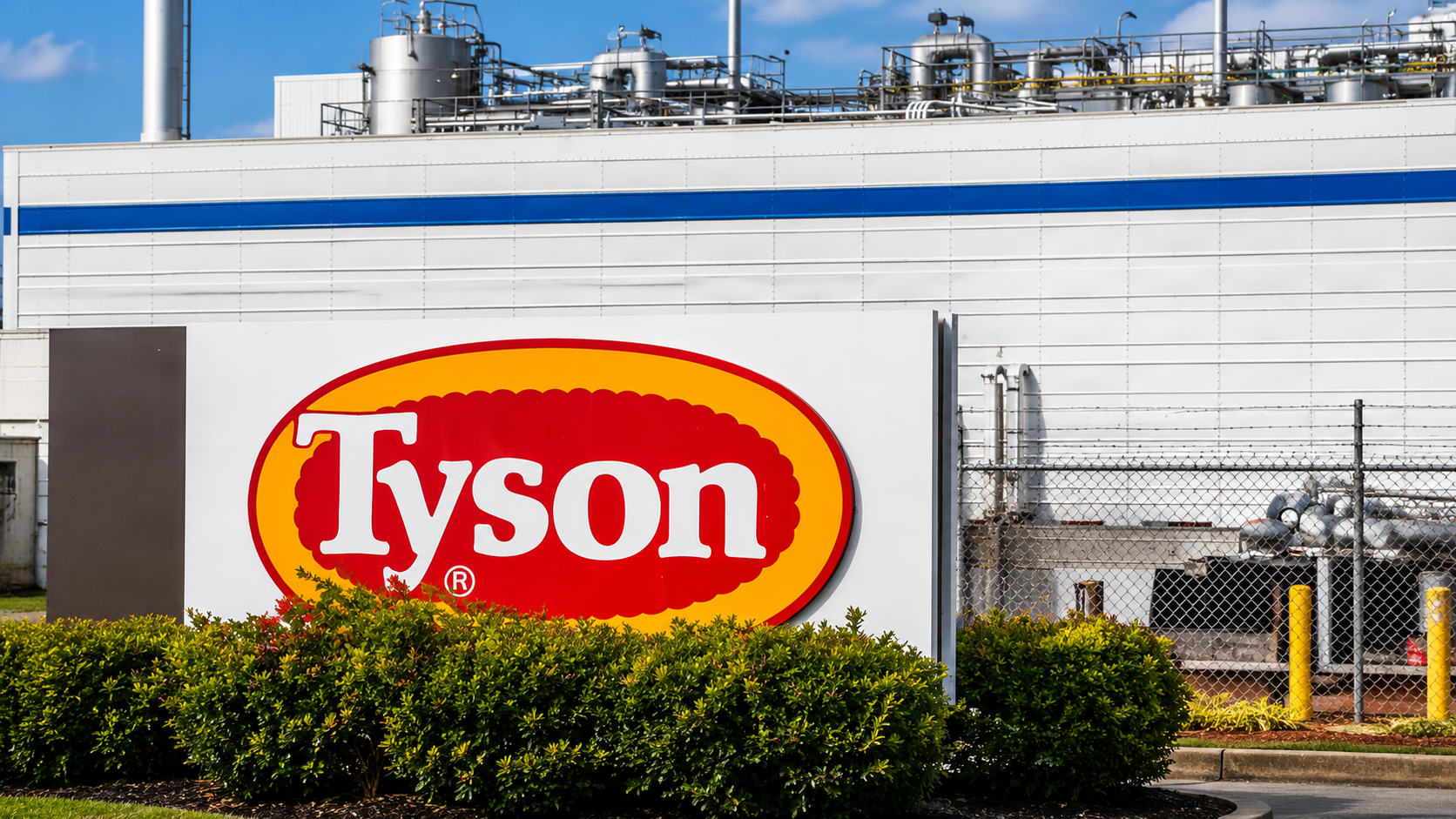
The Tyson plant closure in Joslin, Illinois erased about 2,500 union jobs in a single afternoon, and most of the people who worked there found out the same day it happened. Tyson Foods sent a letter to employees on August 13 telling them their duties would end that Thursday or Friday, with pay running through October 12. A local news crew filmed a line of cars pulling out of the lot roughly thirty minutes after the announcement. One woman who had been on the line for eleven years said she was stunned to be told with no warning at all.
Video
Tyson framed the shutdown as a strategic move. The company said it is reshaping its beef operations because the United States is in the middle of one of the worst cattle shortages in its history, with the national herd at its smallest size in about 75 years. Tyson pointed to federal cattle inventory data showing limited heifer retention. In plain terms, a heifer is a young female cow that has not had a calf yet. Ranchers can either send her to slaughter now for cash or hold onto her to breed and grow the herd. When ranchers are not holding onto them, it means the herd is not rebuilding, and the shortage is going to stick around for years rather than months.The Joslin plant was processing roughly 3,000 head of cattle a day before the doors closed. The same announcement covered a case-ready beef and pork facility in Eagle Mountain, Utah, and Tyson said it would try to sell its plant in Pasco, Washington. What is left of the beef business will be anchored around three facilities in the center of the country, in Dakota City, Nebraska, Holcomb, Kansas, and Amarillo, Texas, with the Amarillo plant going back up to two shifts as cattle become available.
This Tyson plant closure is not the first one this year, and that is the part that gets lost in the headlines. Tyson shut its Lexington, Nebraska plant earlier in 2026, cutting 3,212 jobs, and dropped the Amarillo facility to a single shift, which eliminated another 1,761. A University of Nebraska Lincoln analysis estimated the ripple effect of the Lexington closure alone at around 7,000 lost jobs across the town and surrounding counties, with Tyson workers losing an estimated $241 million a year in pay and benefits. Add Joslin, and Tyson has cut roughly a third of its beef processing capacity in one year.
The company is bleeding on the beef side. Its beef segment posted a record loss of $1.135 billion in fiscal 2025, and Tyson has told investors to expect an operating loss somewhere between $500 million and $650 million this year.
Now here is the timeline that has people heated. In October 2025, Trump floated the idea of buying beef from Argentina to bring grocery prices down, saying he liked Argentina’s leader and that helping the country was worth it. Around the same time, the Treasury Department moved to organize roughly $40 billion in currency swaps, loans, and other financial support for Argentina’s government, building on a $20 billion bailout announced weeks earlier.
Then in February 2026, Trump signed an executive order titled “Ensuring Affordable Beef for the American Consumer” that quadrupled how much Argentine beef can come into the country at a low tariff rate. A tariff rate quota works like a discount window. A set amount of a product gets in cheaply, and everything past that amount gets hit with a much higher tax. Argentina’s window had been 20,000 metric tons a year. The order added another 80,000 metric tons of lean beef trimmings for 2026, released in four quarterly batches starting February 13, all of it handed to Argentina. That is enough beef for close to 700 million quarter-pound patties. Argentina’s foreign ministry called it an unprecedented expansion and put the value at an additional $800 million in Argentine beef exports.
American cattle groups did not take it quietly. The National Cattlemen’s Beef Association said the move undercuts family ranchers and pointed out that over the previous five years Argentina shipped more than $800 million worth of beef into the United States while buying only $7 million worth of American beef. Eight House Republicans from cattle states sent their own letter to the administration asking how the decision was being made and what inspection standards would apply. Democrats Shontel Brown and Jim Costa sent a separate letter calling the whole approach a pattern of putting Argentina’s producers ahead of America’s.
The prices have not budged in the direction anyone promised. Ground beef hit an average of $6.69 a pound in December 2025, the highest the Labor Department had recorded since it began tracking in the 1980s. By June 2026, lean and extra lean ground beef reached a record $8.65 a pound, and the average retail beef price peaked at $9.64 in April.
Illinois State Senator Li Arellano Jr. said the closure gutted multiple communities almost overnight and that the families depending on that plant are “being completely uprooted.” His statement noted these are 2,500 people who woke up with a job and a plan and went to bed wondering how to feed their families.
In June, the Agriculture Department announced $60 million in funding for small and very small meat and poultry processors as part of a plan to rebuild the domestic beef industry. That is less than a tenth of what Tyson expects to lose on beef this year alone, and it arrived two months before 2,500 people in Rock Island County were sent home.