
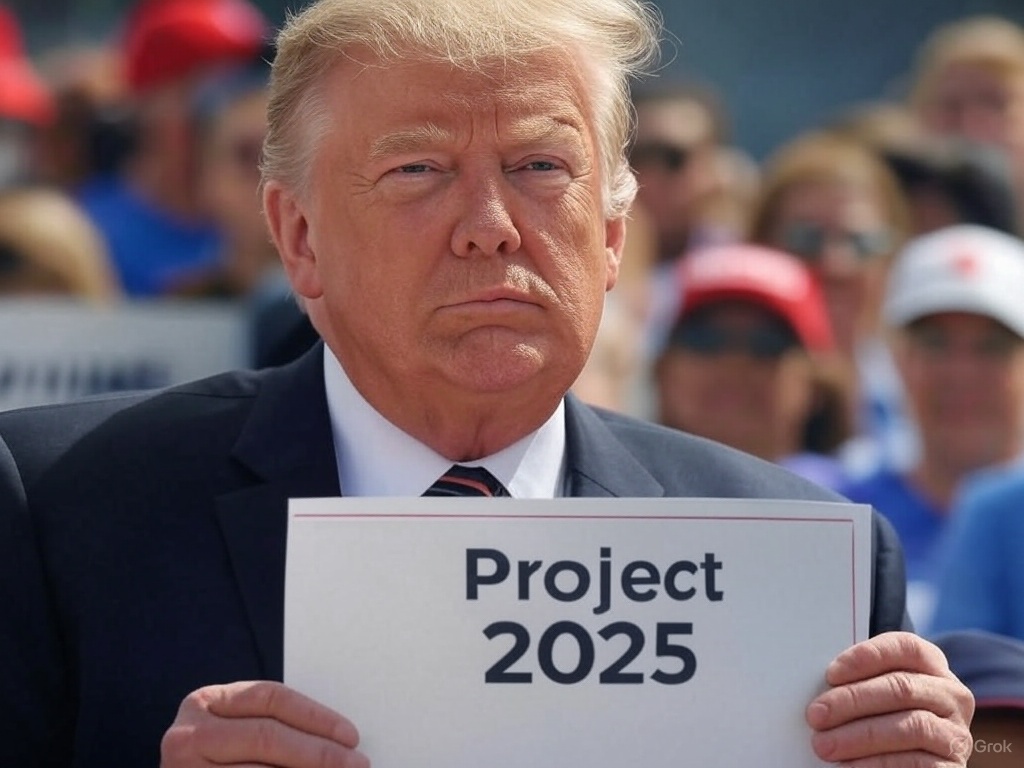
Project 2025 is now more than halfway implemented, and the pieces that moved first are the ones that show up in a grocery cart, a light bill, and a Medicaid renewal letter. A newly compiled implementation audit, built off a live tracker of 321 objectives pulled from the Heritage Foundation’s 900 page blueprint, counts 141 objectives completed, 70 in progress, and 110 with no verified action at all as of early September 2026.
That works out to a literal completion rate of 43.9 percent. The higher number people keep quoting, 54.8 percent, comes from counting every in progress item as half finished. If you simply ask how many objectives have been touched in any way, the answer is 65.7 percent. If you take the strictest possible view and throw out everything a court has blocked, the score drops to 51.4 percent. The Heritage Foundation, which wrote the thing, put out its own assessment in June 2026 claiming 53 percent implemented. A separate and more granular tracker that counts 532 individual administrative recommendations across 20 agencies had logged 283 as initiated or completed by February 2026.
So the honest headline on Project 2025 is not 100 percent and it is not zero. It is roughly half, and the half that got done was not chosen at random.
Before getting into what that half contains, the part that needs saying out loud. Through the entire 2024 campaign, we posted about Project 2025 over and over. We broke down the chapters. We told our readers this was not a rumor, not a meme, and not something invented by Democrats to scare people, because the document was public, it was 900 pages, and it had names attached to it. The comment sections filled up with people calling it a hoax. Coordinated accounts flooded the posts. Trump himself said publicly that he knew nothing about Project 2025 and disagreed with parts of it, and that line got repeated back to us hundreds of times as proof that we were lying. Celebrities lined up behind the campaign anyway. We took the hits for reporting it accurately.
Now the tracker exists, the Federal Register entries exist, the Congressional Budget Office scores exist, and the argument is over.
Start where it hits hardest, which is food. Congress passed Public Law 119 dash 21 on July 4, 2025, and that law is where a large piece of Project 2025’s nutrition agenda stopped being a proposal and became math. The law imposed stricter work requirements on SNAP, the program most people still call food stamps. The Congressional Budget Office estimates the SNAP work rule alone produces an average reduction of 2.4 million people participating in the program in any given month.
The same law capped the Thrifty Food Plan. The Thrifty Food Plan is the government’s calculation of what it costs to feed a family a minimally adequate diet, and it is the formula that sets your benefit amount. Capping it means benefits stop keeping pace the way they were going to. CBO projects the average monthly SNAP benefit lands at $213 in 2034 instead of $227 under the old baseline, with the two lines splitting apart starting in 2027. That is a permanent structural cut to the food budget of every household on the program, applied quietly through a formula rather than through a headline.
Two more provisions do the same thing in smaller increments. The law ended automatic qualification for the standard utility allowance based only on receiving energy assistance, for households that do not include an elderly or disabled member. The standard utility allowance is the piece of the SNAP formula that credits you for what you spend on heating and cooling, and a bigger utility credit means a bigger food benefit. CBO estimates that change cuts about $100 a month in benefits for roughly 3 percent of households on average between 2026 and 2034. A second change excludes internet costs from the shelter calculation, cutting about $10 a month for roughly 65 percent of households.
The Project 2025 tracker labels one of these items “restrict LIHEAP,” and the audit corrects that. LIHEAP, the Low Income Home Energy Assistance Program, was not abolished by this law. What changed is the link between receiving LIHEAP and automatically qualifying for the higher food benefit. Anyone claiming the law shut off heating assistance is overstating it, and this coverage is not going to do that.
The last piece of the food story arrives in 2028, when states start picking up a share of SNAP costs. CBO expects that cost shift to push states collectively to reduce or eliminate benefits for roughly 300,000 people in an average month, and to cut child nutrition subsidies for about 96,000 children.
Health coverage moved on the same track. The July 2025 law also imposed Medicaid work requirements, and the Congressional Research Service reports the CBO estimate at an average of 4.5 million additional uninsured people per year across fiscal years 2027 through 2034. The requirement applies no later than December 31, 2026, and states are allowed to start earlier, which means the paperwork is already landing in some mailboxes. Whether a specific household loses coverage depends on state exemptions, how well a state’s reporting system works, and whether anyone sues. What is not in question is the direction.
Housing is where Project 2025 has one completed action and two loaded proposals. The completed one is the end of Housing First, the federal approach that put people experiencing homelessness into permanent housing before requiring treatment or sobriety, and limited HUD money to programs that follow that model. That policy is done and the funding priorities have shifted.
The two that are not done yet are the ones to watch. HUD has a draft rule that would put a two year time limit on both tenant based and project based rental assistance, which in plain terms means Section 8 vouchers and subsidized units would come with a clock. The Center on Budget and Policy Priorities estimates that if a two year limit applied immediately to households without an elderly or disabled member, 3.3 million people including 1.7 million children could lose assistance. CBPP also warns HUD may not have the legal authority to do this without Congress. HUD’s own fiscal year 2026 plan confirms the department is moving toward state administered rental assistance grants and a heavier emphasis on work, but that plan does not itself impose the cap. The second proposal would bar mixed status families, meaning households where some members are citizens and some are not, from living in any federally assisted housing. Both are proposed rules, not final ones, which means the comment period and the courts are still ahead.
On health care access, three completed items in Project 2025 reach directly into exam rooms. HHS rescinded the guidance instructing hospitals that federal law requires them to perform an abortion when it is needed to save a pregnant woman’s life. The underlying statute, EMTALA, still exists and courts have ruled on it, so the legal duty did not vanish. What vanished is the federal government telling hospitals in writing what that duty means, which in states with restrictive abortion laws leaves a pregnant woman with a life threatening complication depending on how her particular hospital’s lawyers read the situation at 3 in the morning. HHS also rescinded the Office of Refugee Resettlement policy providing abortion access for pregnant unaccompanied immigrant minors in federal custody. The Department of Veterans Affairs finalized a rule barring the VA from covering abortion services, including in cases of rape and incest, which lands on women veterans and VA covered dependents.
Childhood vaccines sit in the in progress column and deserve precision, because this one gets exaggerated in both directions. CDC’s January 2026 framework keeps three recommendation categories and states that every currently recommended vaccine stays covered without cost sharing. What KFF documented is that the routine for everyone schedule shrank from vaccines covering 17 diseases down to 11, and from 13 routine vaccines down to 7. Rotavirus, COVID-19, influenza, hepatitis A, hepatitis B and meningococcal vaccines were moved into narrower or shared decision categories. Nobody lost insurance coverage for a shot. What changed is how strongly the federal government recommends it, which affects school requirements, pharmacy practice, what your pediatrician leads with, and eventually how many kids in a given zip code are protected.
Head Start is also in progress rather than completed, and the audit is careful about this. The documented action so far is a rollback of Head Start regulations, not the elimination of the program or its meal service. The objective in the blueprint is elimination. The action on the record is smaller than the objective.
Immigration is the area where Project 2025 ran fastest, because immigration policy runs on executive authority. Temporary Protected Status designations were repealed, ending work authorization and deportation protection for people from Cuba, Haiti, Nicaragua and Venezuela. For our readers, that is Haitian families in South Florida, in New York, in Boston and in Atlanta losing the legal right to work, which means losing income, employer health coverage, and in a lot of cases the ability to make rent. ICE detention capacity was expanded. Local police departments were authorized to participate in federal immigration enforcement. A revival of the public charge rule, which penalizes immigrants for using public benefits like SNAP, WIC or school meals, is in progress as a proposal, and a rule like that historically scares eligible families out of programs their citizen children qualify for before it ever takes effect.
There is also a Justice Department push, currently partially blocked in court, to use federal prosecutorial resources against state and local governments, universities, corporations and private employers that run diversity initiatives. That one is aimed directly at every corporate supplier diversity program, every scholarship pipeline, and every hiring initiative that Black professionals and Black owned businesses have been building against for two decades.
Then there is the pipeline, and this is where the audit is more useful than the panic. Of the 110 objectives with no action at all, 50 require an act of Congress. Fifty two are rated very high difficulty. Only 11 could plausibly show movement within six months, 42 within six to eighteen months, and 57 sit beyond eighteen months. That list includes turning Medicaid into a block grant or capping it per person, which would mean a fixed pot of federal money instead of coverage that expands when need expands. It includes lifetime limits on how long a low income person can receive Medicaid. It includes ending broad based categorical eligibility for SNAP, the rule that lets states enroll families who already qualify for other assistance without a second asset test. It includes eliminating the Community Eligibility Provision, the policy that lets high poverty schools feed every student free without collecting forms, and a separate item barring schools from grouping together to use it. It includes enforcing the Comstock Act to restrict mailing abortion medication, reversing FDA approval of mifepristone or banning telehealth prescriptions for it, loosening child labor rules so teenagers can work in jobs classified as dangerous, and letting states opt out of federal overtime and minimum wage law. It includes weakening infant formula regulations and breaking up NOAA.
None of that has started. The audit’s own language is that these belong on a watchlist, not a countdown. Every one of the 141 completed and 70 in progress objectives had at least one verifiable source attached to it. Only one of the 110 untouched objectives did. The evidence is strong on what has happened and thin on what comes next, and anyone telling you they know the order of the next 110 is guessing.
The courts are the other reason to slow down before treating “completed” as “operating.” Twenty objectives in the dataset carry a court posture. When the audit ran its strict recount, it removed 3 completed items and 16 in progress items that are blocked in whole or in part. The list of what is currently blocked or partially blocked includes the Title IX rollback, the effort to weaken federal employee unions, the abolition of the Consumer Financial Protection Bureau, the ban on critical race theory and gender ideology in public school curriculum, the termination of Public Service Loan Forgiveness, the cap on university indirect cost rates, the defunding of Planned Parenthood, the restoration of religious and moral exemptions to the contraception requirement, the privatization of TSA screening, Remain in Mexico, and the conditioning of FEMA grants on immigration cooperation. Public Service Loan Forgiveness is the one to say plainly: teachers, nurses, social workers and public defenders who structured a decade of their lives around that program are still in it because a judge said so, not because the objective was abandoned. Blocked does not mean dead. Appeals exist. One refugee admissions item that was blocked had its block lifted in March 2025 and is now operative.
The pattern across all of Project 2025 is the same when you sort it by category. Objectives about controlling the executive branch itself are 75 percent complete. Immigration, national security and foreign affairs are 54.8 percent complete. Energy, environment and land are 52.5 percent complete. But health, education, housing, nutrition and veterans, the cluster with the most objectives at 92, is only 33.7 percent complete, and economic and independent regulatory objectives are 24.2 percent complete. A president can move fast through executive orders, agency guidance, grant conditions, enforcement decisions and personnel. Rewriting mandatory spending, abolishing an agency created by statute, or changing an independent commission takes Congress, takes notice and comment rulemaking, or takes a court’s permission, and all three are slow.
The single item the audit rates as critical rather than high is not domestic. It is the cut to International Disaster Assistance funding for Yemen, Syria and Afghanistan. The Associated Press reported that the specific cuts at issue would end lifesaving food assistance for 2.4 million people and halt nutritional care for 100,000 children, with roughly $560 million in Afghanistan aid affected covering food, malnutrition treatment, medical care and clean water. The World Food Programme’s 2025 funding model projected resources 34 percent below 2024 and up to 16.7 million people losing emergency food assistance. Urgent food aid was restored in other countries and not in those two.
Twenty five of the 321 objectives, 7.8 percent, meet the audit’s threshold for a direct material pathway to food, shelter, essential medical care, utilities, disaster protection, workplace safety, detention conditions or subsistence income. Thirteen of those 25 are already completed. That is the number that matters more than the 54.8 percent everyone is arguing about, because it is the count of things that reach a household rather than a flowchart.
What to watch over the next year is not cable news. It is the Federal Register, where proposed and final rules get published, and it is appropriations text. Specifically: whether HUD publishes the two year time limit as a formal proposed rule with an exemption list, whether USDA publishes a rule ending broad based categorical eligibility for SNAP, whether legislation appears with actual Medicaid block grant funding formulas, whether the Labor Department names which hazardous occupations teenagers would be allowed to work, and whether a court order modifies or terminates the Flores settlement that sets minimum standards of care for immigrant children in custody. Each of those converts a line in a 900 page document into something with a compliance date.
We said in 2024 that the document was the plan. The plan is 43.9 percent done, 65.7 percent started, and the parts that reached households first were food benefits, health coverage, housing assistance and emergency care.