

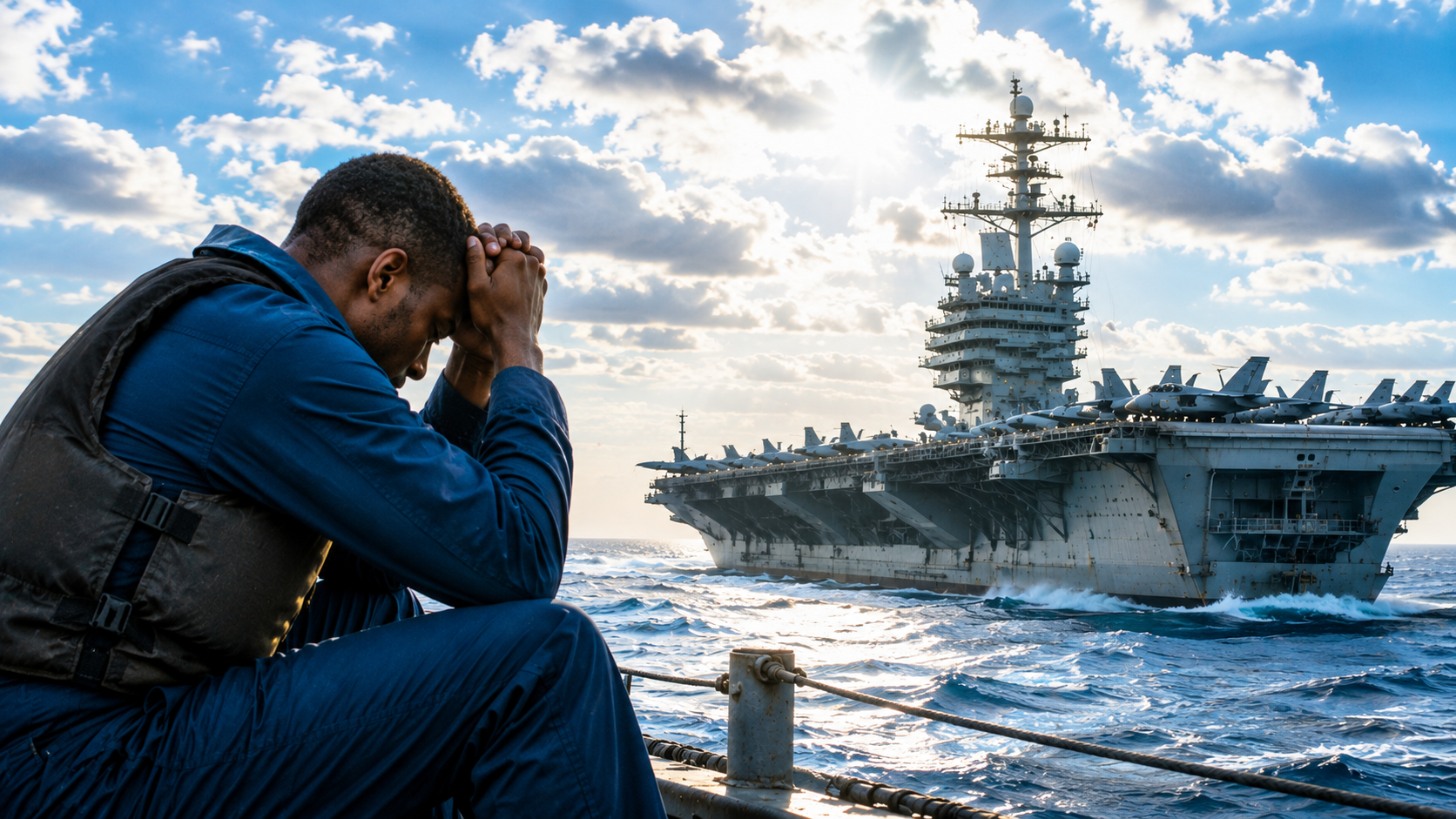
Families of sailors aboard the USS Abraham Lincoln say multiple crew members have tried to go overboard during a deployment that has now stretched past 250 consecutive days at sea, and the Navy still has not told them when the ship is coming home.
Video
The aircraft carrier left San Diego on November 21 for what was supposed to be a routine Pacific deployment. It was redirected to the Middle East and arrived in January to support American operations in the war with Iran, which is now in its sixth month. Roughly 5,000 sailors and Marines are aboard. Their expected return date was May. That date came and went, and the deployment has been extended with no public end point, with officials citing operational security, meaning the Navy says it will not announce troop movements in advance for safety reasons.What families describe is a crew that has been pushed past the limit. Military Times reported that at least two sailors aboard the USS Abraham Lincoln attempted to go overboard during the deployment. One spouse, Annabelle Loma, said her husband was burnt out when he made an attempt and is now afraid the incident will end more than a decade of service with a dishonorable discharge, which is the most serious way the military can separate someone from the service and one that strips away benefits. Another spouse, Maria Rodriguez, said her husband physically stopped a shipmate who was preparing to go over the side. Stars and Stripes separately reported that watchstanders, the sailors assigned to monitor the deck and the water, intervened in an incident that was then announced to the entire ship.
The Navy says it has not identified any increase in reported suicidal thoughts or attempts aboard the ship. In a statement, the service said leadership is running continuous assessments to monitor the psychological readiness of every sailor and that the health and wellbeing of the crew is a priority.
Family members were not satisfied with that answer. About 200 of them packed a banquet room at Naval Air Station North Island in San Diego last Thursday to confront acting Secretary of the Navy Hung Cao, Vice Adm. Douglas Verissimo, who leads Naval Air Forces, and Vice Adm. Joseph Cahill, who commands Naval Surface Forces. A second meeting was held virtually that same night. According to two people who attended and to recordings reviewed by MS NOW, the meetings turned combative fast.
One spouse told the room she had received a message from her husband that same day saying he hoped he would not wake up the next morning. A mother said her daughter believes she will die on the ship and never make it back. Another woman told the officials outright that leadership had broken the trust between the Navy and the families in the room. Cahill acknowledged the strain the extended deployment is putting on service members and their families and on the long term health of the force. Officials did not respond directly to the individual accounts of suicidal thinking. They said sailors aboard the USS Abraham Lincoln have access to mental health workers, chaplains and doctors, and that the Navy is working to send additional mental health professionals to the carrier.
The mental health concerns are layered on top of months of complaints about basic conditions. Families have raised food shortages, water contamination and safety on the flight deck. Democratic Rep. Mike Levin of California said this week that sailors have gone without basic hygiene supplies and have been dealing with moldy showers and broken toilets. There is also the mail. An indefinite suspension of deliveries to military ZIP codes has left care packages sent by families stuck in transit for months, which means the small comforts that normally get people through a long deployment are not arriving at all.
The Navy has pushed back on parts of this before. In April, the Office of the Chief of Naval Operations publicly called reports of food shortages aboard the USS Abraham Lincoln and the USS Tripoli false, saying both ships had sufficient food and that every crew member was receiving fully portioned, nutritionally balanced meals.
At the San Diego meeting, Cao told families the Navy is preparing another carrier strike group, the USS Theodore Roosevelt, to head to the Middle East and relieve the Lincoln. A carrier strike group is the full package that travels with a carrier, including destroyers and aircraft. Cao would not say when that relief would arrive.
There is one more piece of news that landed on these families at the same time. When the ship finally does come back, it is not staying in San Diego. The USS Abraham Lincoln is being reassigned to a new home port in Bremerton, Washington, and Navy officials told families they will have a 58 day window to relocate after the carrier returns. Households that have spent nine months holding down jobs, schools and children alone are now looking at a cross country move on a two month clock.
Several Democratic lawmakers are now demanding answers from the Navy about conditions aboard the ship and about how long the deployment will run. So far the only firm number anyone has been given is the one nobody wanted, which is the number of days at sea, and it keeps going up.
If you or someone you know is struggling, the 988 Suicide and Crisis Lifeline is available by call or text. Veterans and service members can press 1 after dialing 988 to reach the Veterans Crisis Line.
