

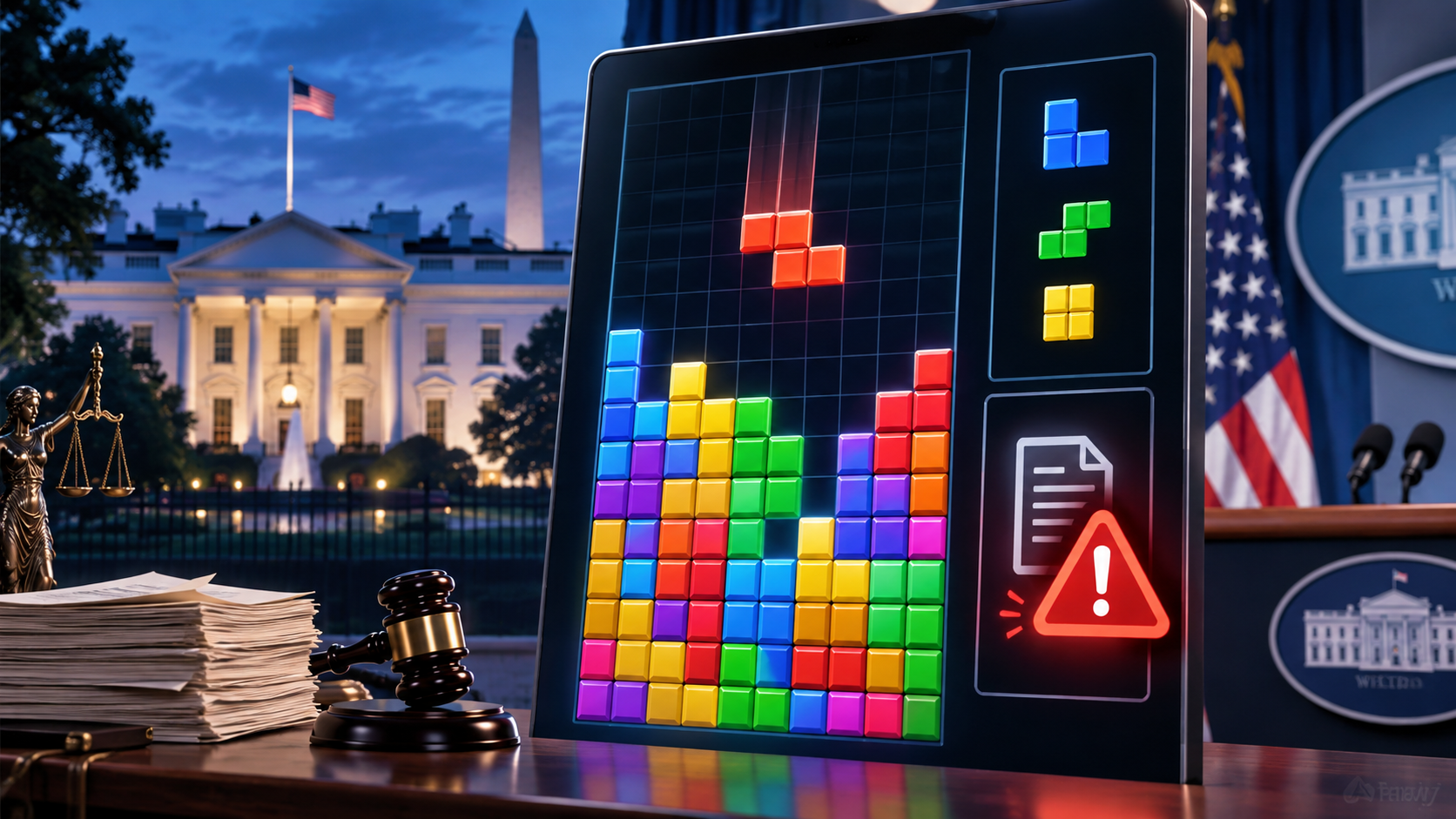
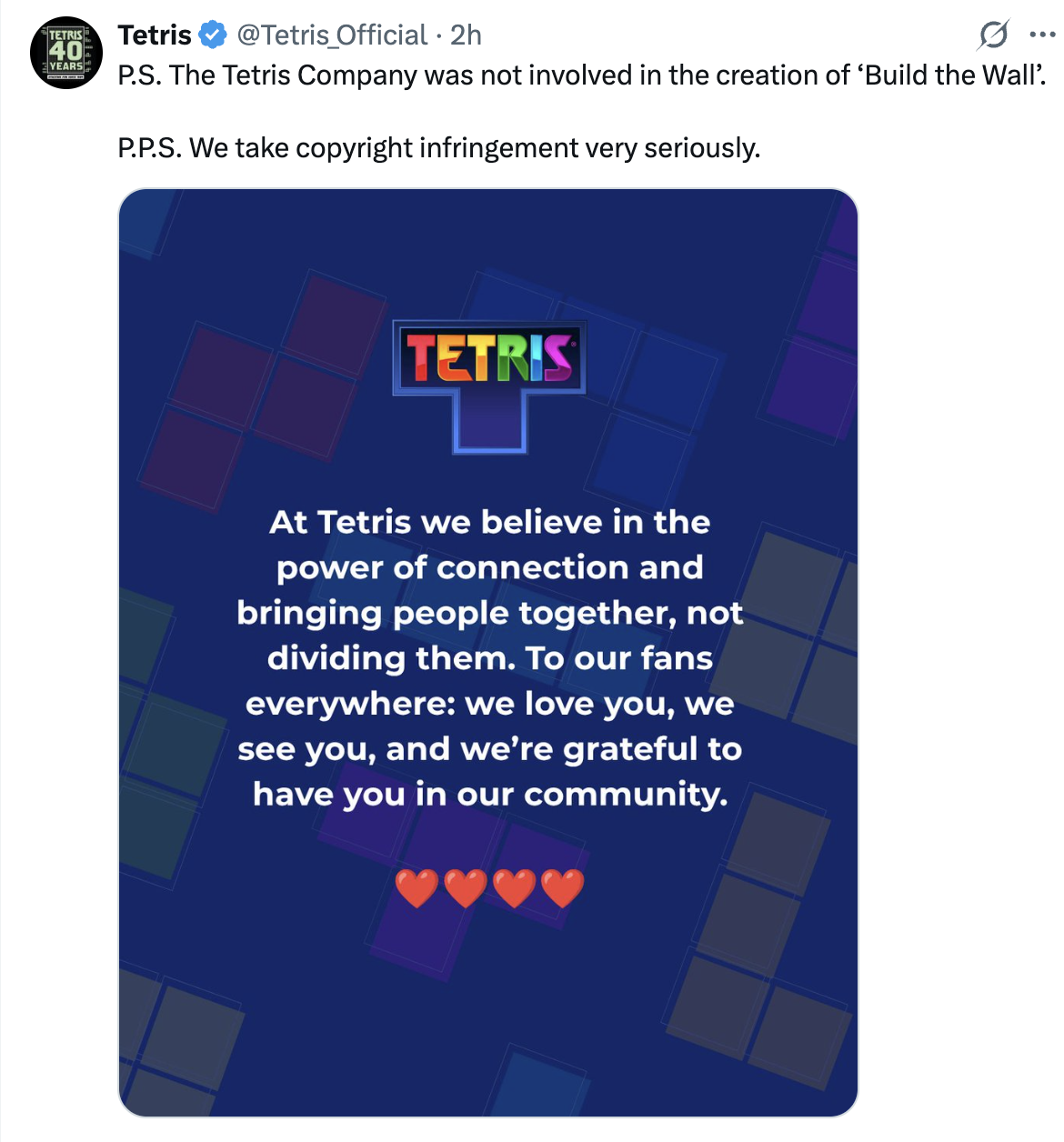
The Tetris Company put out a statement Friday distancing itself from the White House Tetris knockoff on the government’s new arcade website, ending with a line that read like a warning: “We take copyright infringement very seriously.”
The company posted it to X and Instagram. The message said flatly that the Tetris Company had nothing to do with creating Build the Wall, and it came attached to a graphic saying that Tetris believes in connection and in bringing people together rather than dividing them, with a note thanking its fans.The game in question went live Thursday when the White House launched Arcade, a set of five browser games hosted at arcade.gov and also reachable through whitehouse.gov, which is the main federal site run by the Office of Digital Strategy. Build the Wall is the White House Tetris clone. Players stack falling blocks into a border wall while figures rush toward it; the instructions say to protect the border from the coming horde, and the subtitle on the game screen reads Zombie Border Siege.
Let the blocks stack too high or let enough figures through, and the words Border Breached flash across the screen. Tetris is not the only company with a claim to make here. Rio Run is Snake with a suited figure collecting people along the Rio Grande. Trump Savings Tycoon runs on Duck Hunt mechanics. Flappy Bill is Flappy Bird with a bald eagle. The promotional posts went further than the games did, parodying the loading screens of the Xbox 360, the GameCube and PlayStation, and turning the Sega logo into MAGA with the company’s startup chime altered to match. Tetris is simply the first one to say something out loud.
What Tetris did not say is whether it plans to do anything about it. The company would not tell Newsweek if legal action is coming, and it has not announced a lawsuit or confirmed sending a cease-and-desist letter, which is the formal notice a rights holder sends demanding that someone stop using their property before a case ever reaches a courtroom.
There is a reason the Tetris statement carries more weight than a normal brand complaint. Game rules and mechanics are generally not protected by copyright, which is why the world is full of legal block stacking games. But in 2012, a federal court in New Jersey ruled that the specific look of Tetris, meaning the shapes of the pieces, the playing field, the way it all appears on screen, is protected expression, and it shut down a mobile clone that had copied that look while arguing it had only borrowed the idea. That ruling is the reason the Tetris Company has been able to police imitators for over a decade, and it is the reason a White House Tetris lookalike is a bigger problem than a generic puzzle game would be.
Christopher Buccafusco, an intellectual property professor at Duke University School of Law, told Newsweek that some of the games in the arcade come close to the rights of well-known game companies, and that pieces of the promotion were clearly built to track famous trademarks like the Sega logo and its jingle. He said the parody defense, the argument that a copy is legally protected because it is making fun of the original, would probably not save the White House here, because the only apparent reason to use those marks was to attract attention, and trademark law almost never allows that.Copyright and trademark are two different things, and both are in play. Copyright covers the creative work itself, the art and the code and the way a game looks. Trademark covers the identifiers a company uses to tell buyers who made something, like the Sega logo or the sound a console makes when it boots. Tetris raised the copyright half. The console logos in the promo posts are the trademark half, and Microsoft, Nintendo and Sega have not publicly said anything yet.
Asked about the arcade, a White House official told Newsweek the administration is focused on new ways to tell the story of what Trump has accomplished in a way that connects with people.Tetris has been around since 1984. Alexey Pajitnov, the Soviet programmer who built it, is still involved with the brand; more than 520 million copies have sold worldwide, and its licensing network includes Nintendo and Sega, two of the same companies whose branding turned up in the White House promotional posts.
The company that owns one of the most licensed properties in gaming just told the federal government, in public, that it takes infringement seriously. Whether that turns into a letter, a lawsuit, or nothing at all is the part nobody has answered yet.
