
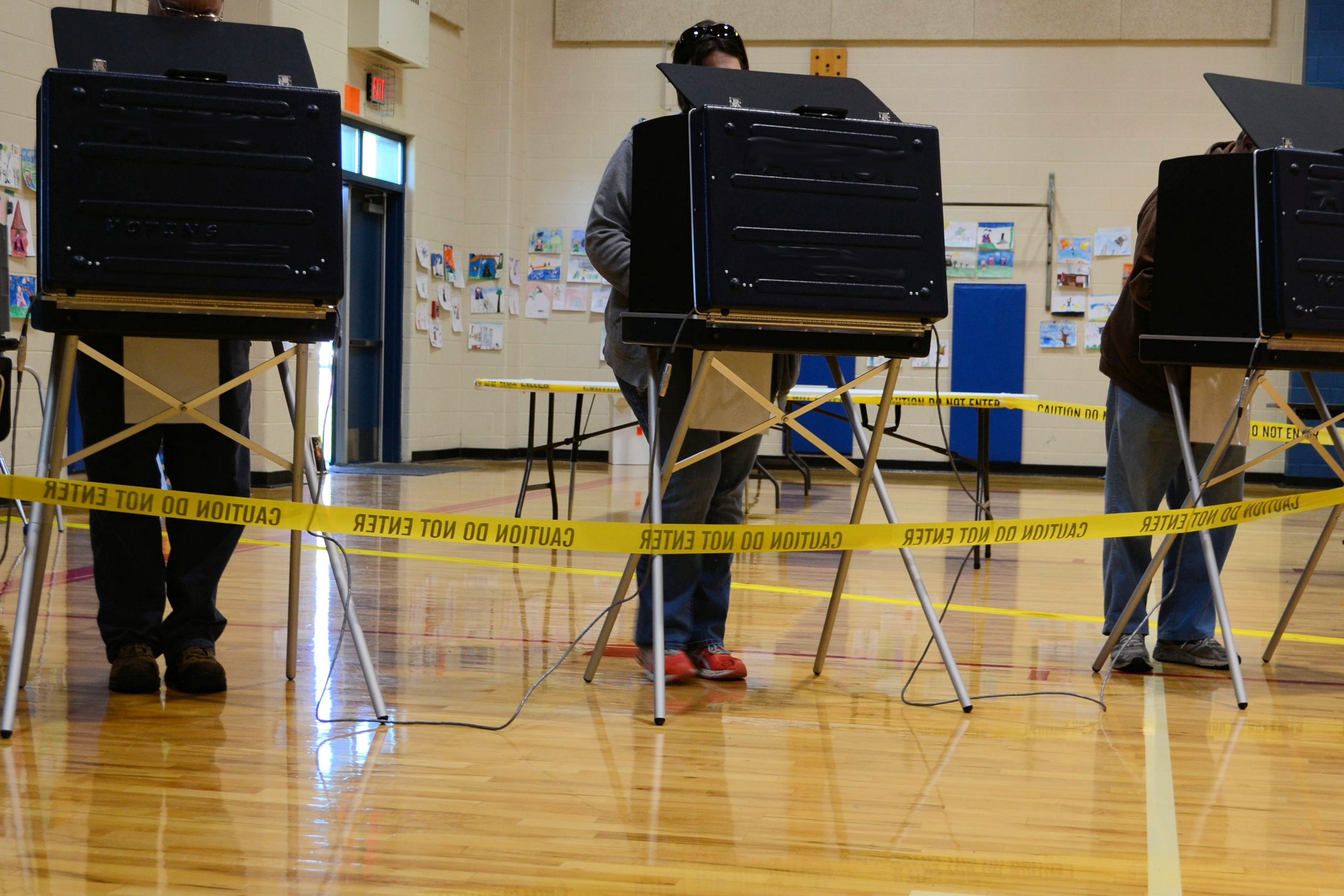
Black voter turnout is emerging as one of the most closely watched political stories in the South after a major Supreme Court ruling changed how federal voting protections apply to congressional redistricting.
According to VoteHub, primary election data from Black Belt counties shows significantly higher participation in several Southern states that voted after the Supreme Court issued its April 29 decision in Louisiana v. Callais. VoteHub analyzed 78 counties and found that 77 shifted toward Democratic primary participation compared with Kamala Harris‘ share of the 2024 presidential vote, while the median county shifted 12.3 percentage points in that direction.
The numbers are drawing attention because they arrived during a rapidly changing redistricting fight across the South. In Louisiana v. Callais, the Supreme Court ruled 6 to 3 that the Voting Rights Act did not require Louisiana to create the additional majority Black congressional district at issue in the case. The Court concluded that race could not justify Louisiana’s use of that districting plan under the circumstances presented. The decision substantially narrowed how Section 2 of the Voting Rights Act can support race conscious redistricting claims, according to the Supreme Court opinion published by Cornell Law School’s Legal Information Institute.
That distinction matters. Section 2 still exists. The Justice Department’s Civil Rights Division explains that the provision prohibits voting practices or procedures that discriminate based on race, color, or membership in certain language minority groups. Congress amended Section 2 in 1982 so plaintiffs could establish a violation by showing, under the totality of the circumstances, that an electoral practice resulted in minority voters having less opportunity to participate politically. The Callais ruling narrowed that framework in the redistricting context rather than deleting Section 2 from federal law.
What happened next turned the legal ruling into an immediate election story.
Republican officials in several states moved quickly after Callais to reconsider congressional districts ahead of the November midterms. Louisiana suspended its congressional primary while lawmakers worked on a new map. Alabama officials pursued changes involving districts created during earlier Voting Rights Act litigation. Florida lawmakers approved new congressional lines, while Tennessee officials moved toward changing a district centered around Memphis. Georgia officials said changes would not happen before the 2026 election because voting was already underway.
The political response appears to have coincided with a sharp increase in Black voter turnout in several places, although the available data cannot prove that redistricting was the sole cause.
VoteHub compared North Carolina and Mississippi, which held primaries before the Callais ruling, with Louisiana, South Carolina, Alabama, and Georgia, which held theirs afterward. In the two earlier states, majority Black counties averaged 18.8 percent turnout compared with statewide turnout of 17.7 percent, a difference of 1.1 percentage points. Across the four states voting after Callais, majority Black counties averaged 32 percent turnout compared with an overall average of 26.1 percent. That produced a 5.9 point gap, more than five times the difference observed in the earlier contests.
Alabama produced some of the most striking Black voter turnout figures.
VoteHub found that Greene County exceeded 50 percent participation in the primary, putting its turnout 27.6 percentage points above the statewide figure. Bullock, Lowndes, Macon, and Montgomery counties also attracted attention because they make up significant portions of Alabama’s Second Congressional District, where redistricting became part of the fight over Democratic Rep. Shomari Figures’ seat. Bullock County posted the third largest positive turnout difference in Alabama, while Montgomery still exceeded the state turnout rate by 7.4 points, according to the analysis.
The broader political activity around Alabama had already drawn national attention. The Associated Press reported from Montgomery in May that thousands gathered in the city for a voting rights demonstration following the Supreme Court ruling and the new redistricting push. The location carried historical significance because Montgomery was central to the Civil Rights Movement and the campaign that helped lead to passage of the Voting Rights Act in 1965.
Louisiana offered another important example. VoteHub reported that 30.9 percent of registered Black voters participated in the state’s primary, which was 3.2 percentage points higher than the rate among registered white voters. Black voters represented 35.7 percent of the primary electorate while accounting for about 32.1 percent of Louisiana’s population, according to the organization’s analysis of state election data.
Those numbers make Black voter turnout particularly significant heading toward November, but they should not be treated as a prediction of the general election.
VoteHub itself cautioned that partisan primary participation is not a perfect predictor of November results. Primary turnout can be affected by candidate competition, local races, campaign spending, election rules, voter registration patterns, and other state specific factors. The comparison also involves different states rather than the same electorate voting before and after the Supreme Court decision. The data therefore shows a notable relationship between the timing of Callais, the redistricting battles that followed, and increased turnout in majority Black counties, but it cannot establish that the ruling caused every increase.
Still, the scale of the change is difficult to ignore. VoteHub found that 77 of the 78 Black Belt counties it studied moved toward greater Democratic primary participation compared with their 2024 presidential voting patterns. The organization also found that the turnout advantage for majority Black counties expanded substantially in states voting after the ruling.
The story also fits into a much larger battle over who controls congressional mapmaking before the 2026 elections. The All About Redistricting tracker at Loyola Law School recorded new map activity in multiple states following Callais, including Louisiana’s adoption of an amended congressional map in May and continued litigation involving Alabama’s districts. The Associated Press separately reported that Trump had encouraged Republican officials in several states to pursue redistricting as the party sought to protect its House position, while Democratic officials in some states have pursued map changes of their own.
That makes Black voter turnout more than another primary statistic. It is now one of the variables that could determine whether newly drawn districts perform politically the way their architects expect.
Redistricting can change district boundaries, move communities between congressional seats, and alter the partisan makeup of individual races. What it cannot determine in advance is who actually shows up. The early 2026 numbers suggest that Black voters across parts of the South are participating at rates that political strategists on both sides will have to factor into every calculation heading toward November.