

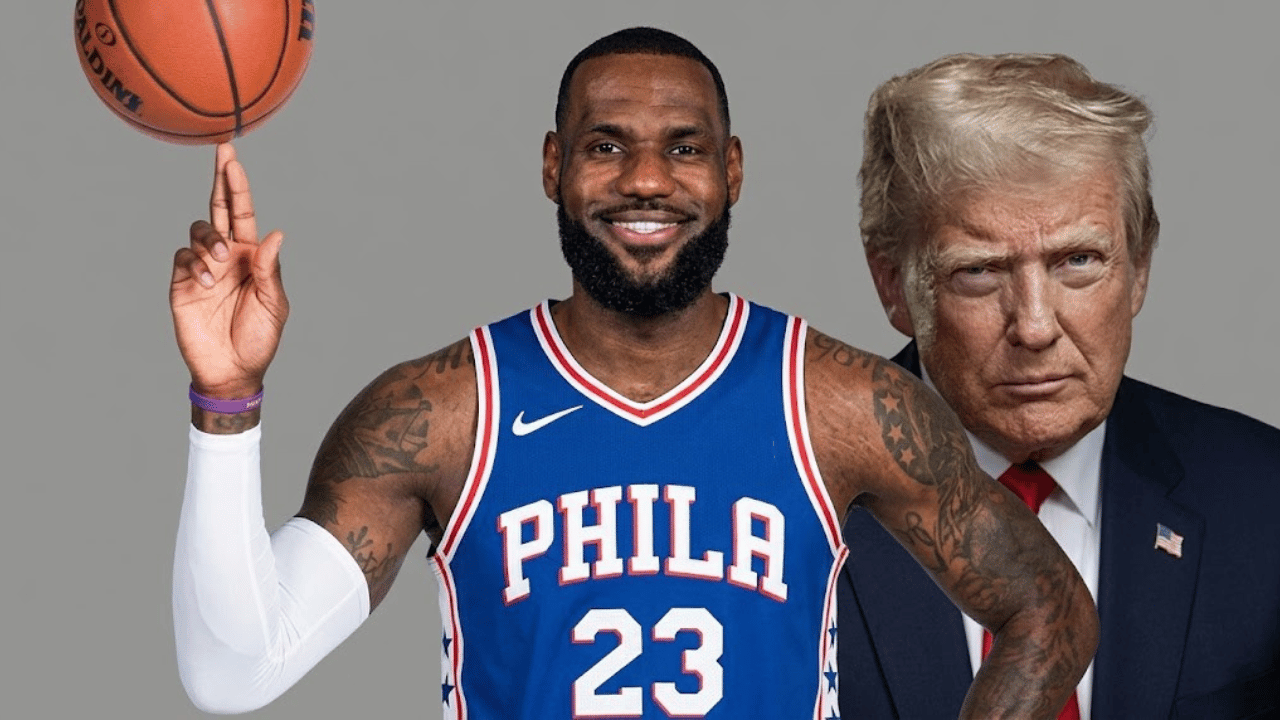
The Donald Trump and LeBron James feud returned to the spotlight Friday after a basketball question quickly became a conversation about politics, personal loyalty, and who Trump believes deserves his support.
Trump was informed about LeBron James’ decision to join the Philadelphia 76ers before being asked to choose between James and Michael Jordan as basketball’s greatest player. A video of the exchange showed Trump selecting Jordan while making a personal accusation against James.
“Well, Michael Jordan’s a friend of mine, play golf with him. He’s a really good guy,” Trump replied. “And I think LeBron is maybe he’s a racist, but maybe he doesn’t like Trump. I only like people who like me. So I would say Michael Jordan all the way.”
The comment sounded like an answer to the endless Jordan and James debate, but Trump’s own explanation made basketball accomplishments almost secondary. His reasoning centered on friendship, golf, and whether someone personally liked him. The Trump LeBron feud turned one of sports culture’s favorite arguments into a public loyalty test.
The timing also made the exchange bigger than another random debate about rings, scoring records, or eras. James announced Friday that he would join Philadelphia for the final chapter of his NBA career and a record extending 24th season.
Reuters reported that ESPN identified the agreement as a two year, $8 million contract containing a player option. James, who earned more than $50 million during his final season with the Los Angeles Lakers, said his move was motivated by the opportunity to pursue another championship rather than another major payday.
The 41-year-old James will join a Philadelphia roster featuring Joel Embiid, Tyrese Maxey, and Jaylen Brown. James averaged 20.9 points, 6.1 rebounds, and 7.2 assists across 60 games last season while earning a league record 22nd consecutive All Star selection.
The Trump LeBron feud, however, began long before Philadelphia became James’ fourth NBA destination. James has spent years using his platform to discuss elections, race, education, voting access, and the responsibilities that come with public leadership.
In a 2016 opinion piece published by Business Insider, James connected his endorsement of Hillary Clinton to the children and families served by the LeBron James Family Foundation in Akron, Ohio.
“I don’t want to see any of them fall through the cracks. That easily could have happened to me,” James wrote. “When I look at this year’s presidential race, it’s clear which candidate believes the same thing. Only one person running truly understands the struggles of an Akron child born into poverty. And when I think about the kinds of policies and ideas the kids in my foundation need from our government, the choice is clear. That candidate is Hillary Clinton.”
James’ position was never limited to simply disliking a political personality. His original endorsement focused on poverty, educational opportunities, community support, health care, and what government policies could mean for children growing up in circumstances similar to his own.
James later supported Joe Biden in the 2020 election and endorsed Kamala Harris in 2024. During the 2024 campaign, James posted a video addressing rhetoric involving minorities and immigrants and wrote that his decision was based on how his children and family would grow up.
That history explains why the latest Trump LeBron feud cannot be separated from James’ political record. Trump framed James’ opposition as evidence that the NBA star might be racist. James has framed his own political choices around racial rhetoric, children, families, and communities that he believes government decisions directly affect.
The Michael Jordan portion of Trump’s answer also deserves a closer look because the public record is more complicated than the idea that Jordan naturally belongs on Trump’s side of the conflict.
Jordan publicly defended James in August 2018 after Trump questioned James’ intelligence following an interview with Don Lemon. That interview discussed the opening of the I Promise School, which James’ foundation helped establish in Akron.
“I support LJ. He’s doing an amazing job for his community,” Jordan said through a spokesperson, according to Reuters.
Jordan’s statement matters now because Trump used their alleged friendship as part of the reason he chose Jordan. Yet when the Trump LeBron feud previously pulled Jordan directly into the argument, Jordan’s clearest public response was not an attack on James. It was support for James and his community work.
The basketball case for either player does not need political help. Jordan finished his career with six NBA championships, six Finals Most Valuable Player awards, five regular season Most Valuable Player awards, ten scoring titles, and 14 All Star selections.
ames is the NBA’s career scoring leader, a four time champion, and a four time league Most Valuable Player. His longevity has now carried him into a 24th season, a mark no other NBA player has reached.
Fans can continue arguing about Jordan’s perfect Finals record, James’ unprecedented longevity, their different styles, their competition, and the eras in which they played. Those are basketball conversations with enough evidence to last for generations.
Trump’s answer did not seriously engage with any of that. It revealed that, for him, the deciding category was personal allegiance. The Trump LeBron feud may have been disguised as a GOAT debate this time, but the exchange was ultimately about who likes Trump, who challenges him, and how quickly political conflict can take over even the simplest sports question.
