

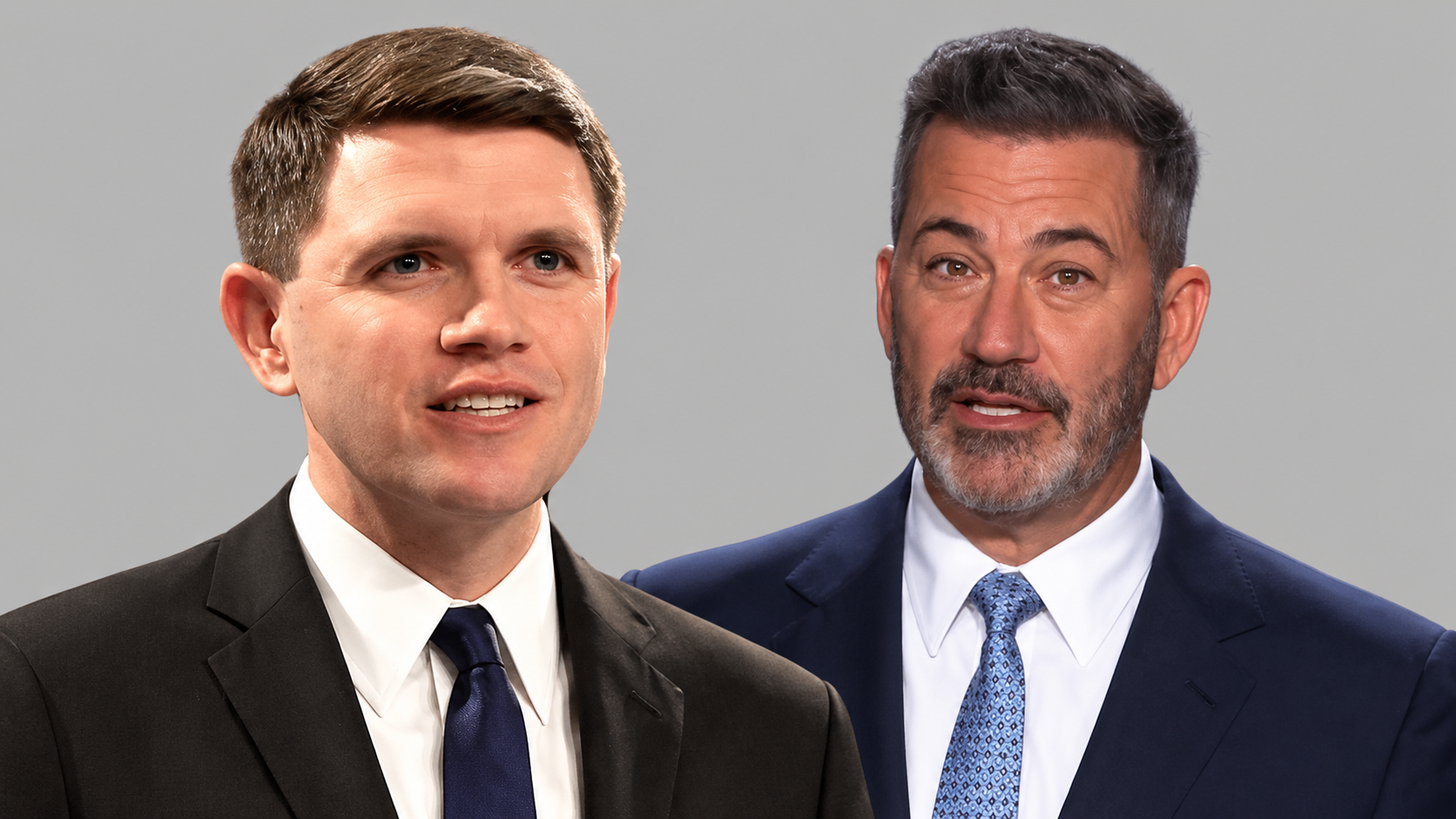
Jimmy Kimmel announced during his Wednesday monologue that his James Talarico interview will not air on ABC, saying the Federal Communications Commission under Donald Trump has threatened him, his show, his network, and the local stations that carry it. The conversation with the Texas Democratic Senate candidate tapes Thursday and will go up on the Jimmy Kimmel Live YouTube channel instead of television.
Video:
Kimmel laid out the situation for his audience before explaining what he was doing about it. He pointed out that for more than twenty years his show has booked Americans running for office without any issue, the same way David Letterman, Jay Leno, and Arsenio Hall did before him. He has interviewed Hillary Clinton. He has interviewed Ted Cruz. He interviewed Donald Trump in 2015 while Trump was running, and Trump came back for a second sit down before he became the nominee in 2016. Something changed, Kimmel said, and he cannot figure out what. Now the FCC has threatened his show over what he called “simple traditional editorial decisions” and guest bookings the commission apparently does not like.
His stated reason for pulling the James Talarico interview off the air was not about himself. Kimmel said he made the call out of consideration for local stations, particularly ABC affiliates in Texas, who would be the ones left to handle the fallout. Affiliates are the independently owned local channels that carry a national network’s programming, and they hold the broadcast licenses the FCC controls.
That is where the leverage sits. The FCC is the federal agency that hands out and renews the licenses that allow television stations to broadcast over the airwaves. Without a license, a station cannot transmit. A commission willing to hold up or scrutinize renewals has enormous power over what a network is comfortable putting on air, even without ever issuing a formal order.
There is also a specific rule in play. The equal time rule requires broadcasters who put a qualified political candidate on the air to give comparable airtime to that candidate’s opponents if they ask for it. For decades, late night shows were treated as exempt, which is why hosts could book candidates freely. FCC Chair Brendan Carr issued new guidance signaling that late night would no longer enjoy that protection, which means booking one Senate candidate could obligate a network to hand the same platform to everyone else in the race.
What has been confirmed and what has not is worth separating clearly. Kimmel’s account of being threatened is his own characterization of the pressure on ABC. No reporting has surfaced an FCC order specifically prohibiting the network from airing the James Talarico interview, and the commission has maintained that its review of ABC stations is a legitimate regulatory process involving public interest obligations and discrimination allegations. Disney, which owns ABC, is fighting the FCC in court over an early renewal review of eight ABC owned stations, arguing the process is retaliation. The FCC has asked a federal judge to throw that lawsuit out.
None of this is new territory for Talarico. In February, Stephen Colbert revealed that CBS lawyers had advised against airing his own interview with the candidate over the same equal time concerns, with the network wanting Jasmine Crockett booked as well. Colbert taped it anyway and put it on YouTube. It has drawn roughly 9.5 million views, more than four times the audience it would have reached on CBS. Talarico’s campaign said it raised $2.5 million in the 24 hours that followed, the biggest single fundraising day it had seen. Less than three weeks later, he beat Crockett in the Democratic Senate primary, and coverage at the time credited the national attention from the blocked interview as one of the late factors that moved the race.
So the James Talarico interview being pushed off broadcast for a second time carries an obvious irony. Both attempts to keep him off television delivered him a bigger audience than television could.
The stakes in Texas are real. Talarico is running against state Attorney General Ken Paxton in a race that has been close, and no Democrat has won a national seat in Texas in more than thirty years. Every point of exposure matters in a contest that tight, which is part of why the booking became a fight in the first place.
Kimmel closed the segment by telling viewers where to find the interview and why. The full conversation will be on his YouTube channel in its entirety, and as he put it, that is “the best that we can do until November.”
What Kimmel described Wednesday night is a regulator applying pressure to broadcasters over who they put in front of a camera during an election year. The workaround is YouTube, where there is no license to threaten and no affiliate to punish. Colbert made that trade in February and reached four times the people. Kimmel is making the same trade now, and the audience that follows him there will be watching an interview that a federal agency’s posture pushed off the air.

What a coward! Kimmel I mean (we know Trump is a 3rd class Coward-no class ), but Kimmel capitulating to those
threats is pathetic. Have some spine! A green light for Trump and his FCC (there are good words for these initials)
to go ahead with their violation of freedom of speech.
Michael M.
Tacoma, Washington