


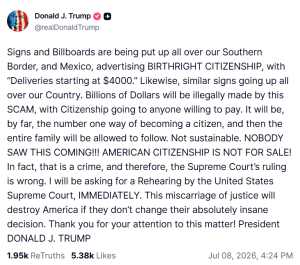
Donald Trump is not letting the birthright citizenship ruling go. In a Truth Social post on July 8, he called the Supreme Court’s decision a miscarriage of justice and said he will ask the Court for a rehearing, immediately. The post is his most direct shot at the justices since they ruled against him, and it doubles down on a fight he has already lost once at the highest court in the country.
Here is what he is reacting to. On June 30, in a case called Trump v. Barbara, the Supreme Court voted 6 to 3 to uphold birthright citizenship and strike down the executive order Trump signed on the first day of his second term. That order tried to deny automatic citizenship to babies born in the United States to parents who were here illegally or on temporary visas. Every lower court that looked at it had already called it unconstitutional, and the birthright citizenship ruling made that final.
Chief Justice John Roberts wrote the majority opinion, joined by Justices Sotomayor, Kagan, Barrett, and Jackson. He grounded the decision in the Fourteenth Amendment and the 1898 case United States v. Wong Kim Ark, which established that nearly everyone born on American soil is a citizen. Roberts described citizenship as the right to have rights, and wrote that children born to parents who are in the country unlawfully or temporarily are citizens at birth. Justice Kavanaugh agreed the order was invalid but rested his view on federal statute rather than the Constitution, and suggested Congress could try to write new exceptions. Justices Thomas, Alito, and Gorsuch dissented.
Trump’s July 8 post about the birthright citizenship ruling did not engage with any of that legal reasoning. Instead, he claimed that signs and billboards are going up along the southern border and across the country advertising birthright citizenship with deliveries starting at $4000, and he framed the whole system as a scam that would let anyone buy citizenship and then bring their family. It is worth being clear here. Trump offered no evidence for the billboard claim, and there is no independent confirmation that any such signs exist. This is not the first time his statements on this issue have not matched the facts. After the oral arguments, he claimed the United States is the only country in the world that allows birthright citizenship, when more than 30 countries offer it.
What is real is the demand. Trump says he will petition the Supreme Court for a rehearing, calling the ruling wrong and warning that it will destroy the country if the justices do not change it. The problem for him is that the Court almost never grants rehearings, and the votes are not close to being there. Even John Eastman, the former Trump lawyer who built much of the case against birthright citizenship and is now disbarred, acknowledged that there were five votes affirming the constitutional mandate, and that the only realistic paths are a rehearing petition or a future case. House Speaker Mike Johnson has said Congress will take up birthright citizenship, which tracks with the door Kavanaugh left open, but that is a legislative fight, not a quick reversal from the bench.
For the culture, the deeper story is what the Fourteenth Amendment actually is and where it came from. It was written after the Civil War specifically to overturn Dred Scott, the notorious ruling that said people of African descent could not be citizens. Its first line guarantees citizenship to everyone born here, a promise built to make sure formerly enslaved people and their children could never again be told they did not belong. That history sat underneath this entire case. Justice Ketanji Brown Jackson, in her concurrence, warned that the reasoning in the dissents pits Black Americans against immigrants, treating a protection won through Black struggle as something to be narrowed.
Advocates made the same connection outside the Court. Rod Adams of the New Justice Project said the amendment was never just legal language, describing the promise as purchased with Black blood, Black courage and Black resistance. The ACLU’s Cecillia Wang, who argued the case, called the ruling a celebration and pointed out that the rule is one of the most basic in American life. Ask most people what the citizenship rule is, Wang has said, and they will tell you that if you are born here, you are a citizen, the same as everyone else.
So where does that leave things. As of now, the birthright citizenship ruling stands, the executive order is dead, and anyone born on American soil remains a citizen the way they have been for more than a century. Trump’s rehearing request can be filed, but it faces long odds, and the more serious threat that legal analysts have flagged is not this decision but the dissents, which several described as a road map for a future attempt through Congress or the courts. For now, the promise Roberts pointed to, the one written into the Constitution after the Civil War, is still intact.
Donald Trump is not done fighting birthright citizenship. After the Supreme Court voted 6 to 3 to uphold it and strike down his executive order, he went to Truth Social calling the decision a miscarriage of justice and vowing to ask the Court for a rehearing immediately. He also claimed billboards are advertising citizenship deliveries for $4000, with no evidence to back it up. Here is what the ruling actually said, and why a reversal is a long shot.
