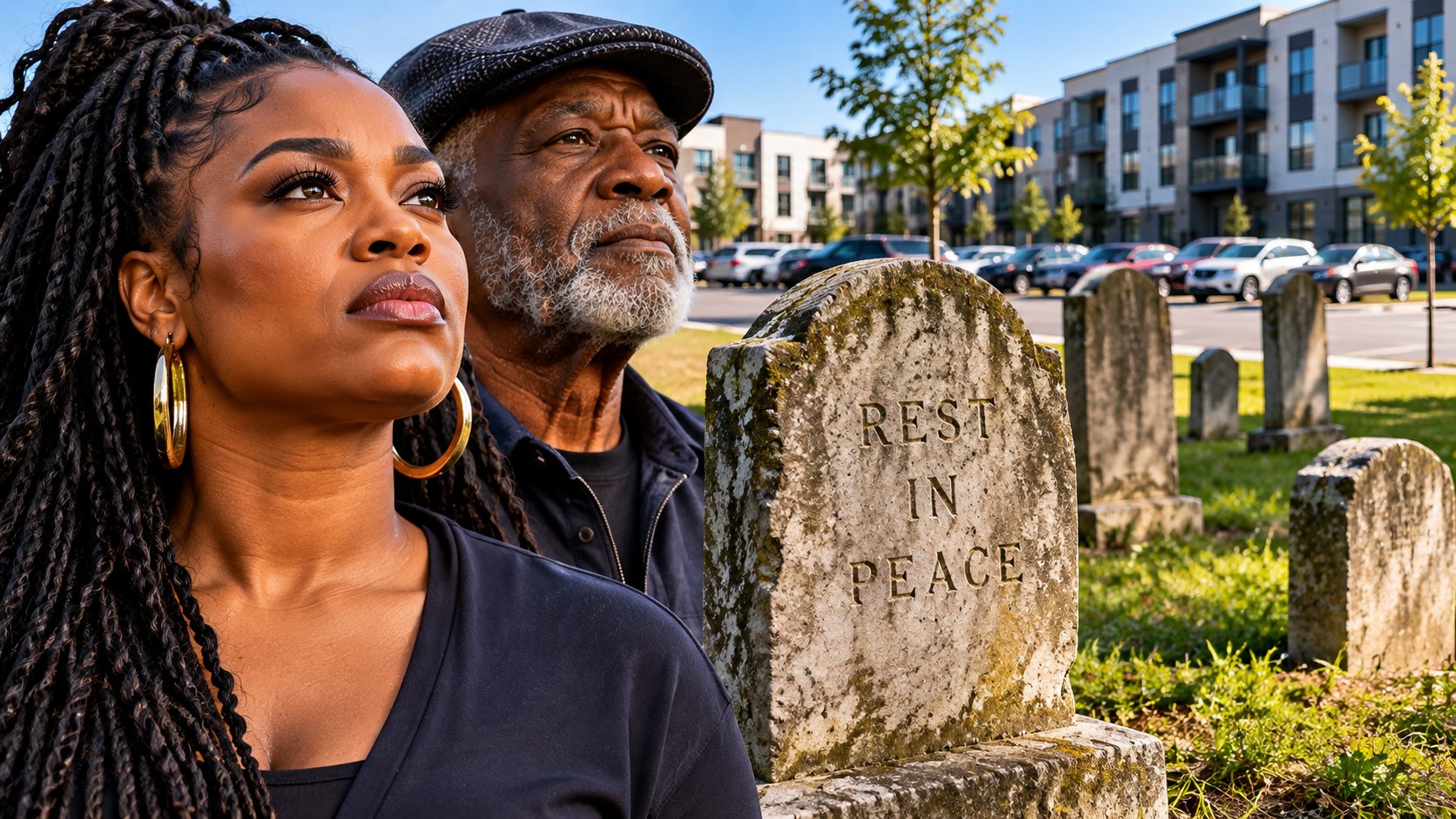
Imagine discovering that your great-great-grandmother’s final resting place is sitting underneath an apartment complex, parking lot, or business. No headstone, no flowers, and no sign that somebody’s loved one was ever buried there.
For generations of Black families across America, that nightmare has become reality.
Historic Black cemeteries are being rediscovered beneath buildings, highways, and other developments, exposing a disturbing chapter of American history. Many of these burial grounds once served Black communities that were denied access to segregated white cemeteries. Decades later, descendants are fighting property owners, developers, and government agencies to make sure their ancestors are not forgotten all over again.
And the discoveries suggest the problem is bigger than anyone realized.
A 2026 archaeological study examining burial grounds in Central Florida identified 56 historically Black cemeteries that remained unregistered in state records in 2025. Researchers found that approximately one-quarter of the Black burial grounds they documented were missing from the state’s official cemetery inventory.
That means entire pieces of Black history were missing from the records meant to help protect them.
One of the most troubling examples is Tampa’s Zion Cemetery, established in 1901 as one of the city’s earliest burial grounds for African Americans.


Made to order and shipped to your door.
The cemetery served Black residents during segregation, including teachers, laborers, business owners, and other members of the community. However, portions of the property were sold for development during the 1920s. Homes, businesses, and public housing eventually occupied land where people were still buried.
The cemetery’s history resurfaced in 2019 after investigative reporting and archaeological work uncovered evidence of hundreds of burials.
For descendant Jeraldine Williams, the discovery became deeply personal. Researchers identified her great-great-grandmother among those buried at Zion.
Speaking during a 2025 historical marker ceremony, Williams told WUSF that her ancestor’s grave had been desecrated for approximately a century.
The fight has produced results. In April 2026, Tampa officials approved a land agreement intended to help preserve the cemetery. The proposed memorial project is expected to cost more than $8 million, demonstrating how expensive correcting generations of neglect can become.
But Tampa is far from alone.
In Bethesda, Maryland, descendants and community advocates have spent years fighting over the historic Moses Macedonia African Cemetery, where enslaved and formerly enslaved African Americans and their families were buried.
Parts of the historic burial area were covered by development, including parking facilities. The Bethesda African Cemetery Coalition has challenged development plans and demanded greater protection for the site.
Coalition president Marsha Coleman-Adebayo has helped lead the campaign, which has involved protests, historical research, and court proceedings.
According to The Guardian, advocates have also pushed for the land to be recognized through a memorial or museum honoring those buried there.
The controversy raises a painful question: How can communities protect their ancestors when burial grounds are treated as ordinary real estate?
Part of the answer involves understanding how these cemeteries became vulnerable.
Many historic Black burial grounds were established by churches, mutual aid societies, and formerly enslaved communities. Over time, segregation, displacement, changing property ownership, incomplete records, and limited financial resources left some sites vulnerable to abandonment or redevelopment.
When surrounding Black neighborhoods disappeared, the people responsible for maintaining the burial grounds were sometimes displaced, too.
And without visible grave markers or reliable records, later property owners might not even know what was beneath their land.
The problem extends to St. Petersburg, Florida, where University of South Florida researchers have investigated Black burial grounds associated with Evergreen, Oaklawn, and Moffett cemeteries, including locations affected by a stadium parking lot and interstate construction.
Their work includes oral histories, death certificates, genealogical records, and interviews with descendants to restore identities to people whose resting places were obscured.
However, some families are winning their preservation battles.
In Atlanta, descendants fought to protect historic Piney Grove Cemetery, a burial ground containing more than 300 graves, including those believed to belong to enslaved individuals.
After a legal dispute involving a homeowners association, a Fulton County judge ruled in October 2025 that the cemetery had to be maintained and remain accessible. A subsequent settlement established obligations intended to protect the grounds.
The case showed that legal action can force property owners to honor cemetery protections when preservation responsibilities are ignored.
Lawmakers have also started responding.
In 2022, Congress established the federal African-American Burial Grounds Preservation Program, authorizing up to $3 million annually through fiscal year 2027 for eligible preservation, documentation, and restoration projects. Authorization, however, does not guarantee that the full amount will be appropriated or distributed.
Florida followed with a Historic Cemeteries Program in 2023, placing particular emphasis on identifying abandoned African American cemeteries and helping descendants locate their relatives.
Still, government programs cannot replace the knowledge held by families and communities.
Old funeral programs, church registers, family Bibles, oral histories, historical maps, and death certificates can help identify forgotten burial sites. Researchers can then use archaeological methods, including ground-penetrating radar, to investigate possible graves without immediately disturbing the ground.
For families, this fight goes far beyond protecting old headstones.
These cemeteries contain generations of Black Americans whose lives helped build communities, cities, and industries. Their burial grounds preserve stories that might otherwise disappear from the historical record.
Families are not asking for special treatment. They want the dignity, respect, and protection that any final resting place deserves.