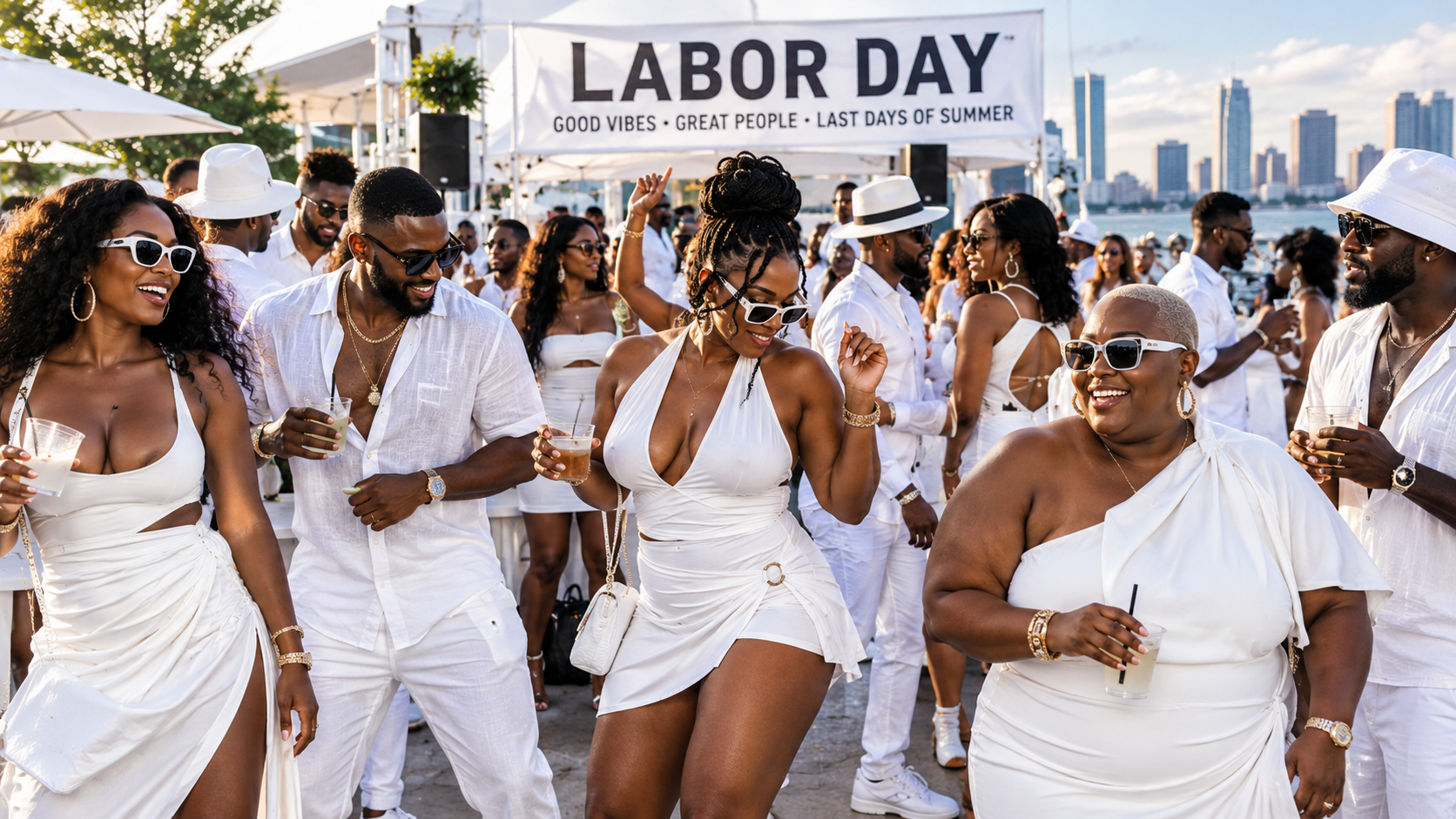
For generations, Labor Day came with an unofficial fashion warning almost as familiar as the holiday itself: once the first Monday in September arrived, the white clothes were supposed to disappear. But somewhere between old-money etiquette, Black party culture, and a generation determined to dress by its own rules, the message got flipped. Today, the all-white party has become a familiar summer ritual in many Black social circles, and Labor Day weekend is one of its natural stages.
The funny part is that the original rule had very little to do with Black culture at all.
The exact origin of “no white after Labor Day” remains disputed. Fashion historians generally trace the custom to the late 19th and early 20th centuries, when wealthy Americans treated white clothing as part of a seasonal lifestyle. Affluent families left hot cities for places such as Newport and the Hamptons, where lightweight white dresses, linen suits, and resort clothes became visual shorthand for summer leisure. When vacation ended, the whites went away and darker fall wardrobes returned.
Labor Day simply offered a convenient finish line.
Congress made Labor Day a federal holiday in 1894, and because it fell at the unofficial end of summer, the holiday eventually became tied to the wardrobe change. There was some practicality involved. White and lightweight fabrics made sense in summer heat, while muddy streets and colder weather made pale clothing less convenient. Still, historians have also pointed to something less innocent: class.
Valerie Steele, director of the Museum at the Fashion Institute of Technology, has explained that fashion rules could help insiders recognize one another while forcing social climbers to prove they knew the code. By the middle of the 20th century, “no white after Labor Day” had hardened into etiquette even though famous rule breakers, including Coco Chanel, ignored it.
Then the rule started losing its grip.
And in Black social culture, white took on a very different energy.
It would be inaccurate to claim Black Americans invented dressing in white or created the all-white party. White clothing carries traditions across numerous cultures, religions, and social groups. What can be documented, however, is that Black communities developed highly visible traditions of coordinated dress, social gatherings and communal celebration that made the all-white aesthetic a natural fit.
The broader Black party tradition has deep roots. Smithsonian historians trace Black block and neighborhood gatherings through the Great Migration, when millions of Black Americans moved into Northern, Midwestern and Western cities. Churches, neighborhoods and social groups hosted gatherings centered on food, music, fellowship and community. By the 1970s, that tradition helped provide the setting where hip-hop developed through Bronx block parties. Style was never just background scenery. It was part of showing up.
By the late 1990s, all-white parties were gaining another level of cultural visibility.
One of the biggest accelerators was Sean Combs, then widely known as Puff Daddy. In 1998, Combs hosted his first famous White Party at his East Hampton home during Labor Day weekend. Guests were required to wear white, and the gathering mixed hip-hop artists and Black entertainment figures with Hollywood celebrities and members of the Hamptons social scene. Contemporary accounts describe the event as a striking collision between rising hip-hop wealth and an enclave historically associated with old money.
That setting made the imagery hit differently.
Here was one of hip-hop’s biggest businessmen throwing an extravagant gathering in the Hamptons, with Black celebrities and cultural power players arriving dressed head-to-toe in the same color that earlier generations of elite Americans had surrounded with rules about when it could and could not be worn.
Combs did not invent the all-white party. Black promoters elsewhere were throwing their own versions, and all-white events existed in other communities long before his. But his celebrity-filled parties from 1998 through 2009 gave the aesthetic enormous pop-cultural visibility. Andscape has reported that Black partygoers and event organizers credit those events with helping give all-white parties a sense of luxury and status during the 2000s.
Soon, the look traveled far beyond the Hamptons.
All-white brunches, yacht parties, rooftop events, birthday celebrations, Greek events, and holiday-weekend functions became fixtures across cities with large Black social scenes. The appeal was simple but effective: everybody follows the same color rule, but the outfits still leave plenty of room to stunt. White linen can read relaxed. A white suit can read expensive. A fitted dress can turn the same color code into something completely different.
That may be why the tradition stuck.
The old rule used white to separate seasons and, according to one historical interpretation, separate people who knew elite etiquette from those who did not. The modern all-white party uses the uniformity itself as part of the spectacle. Everybody matches, but nobody has to look the same.
And Labor Day adds one last layer of irony.
The weekend once told fashionable America, essentially, this is your last chance to wear white. Black social culture helped turn that deadline into an occasion to wear as much white as possible.
Nobody had to officially repeal the rule.
The party did it for them.