
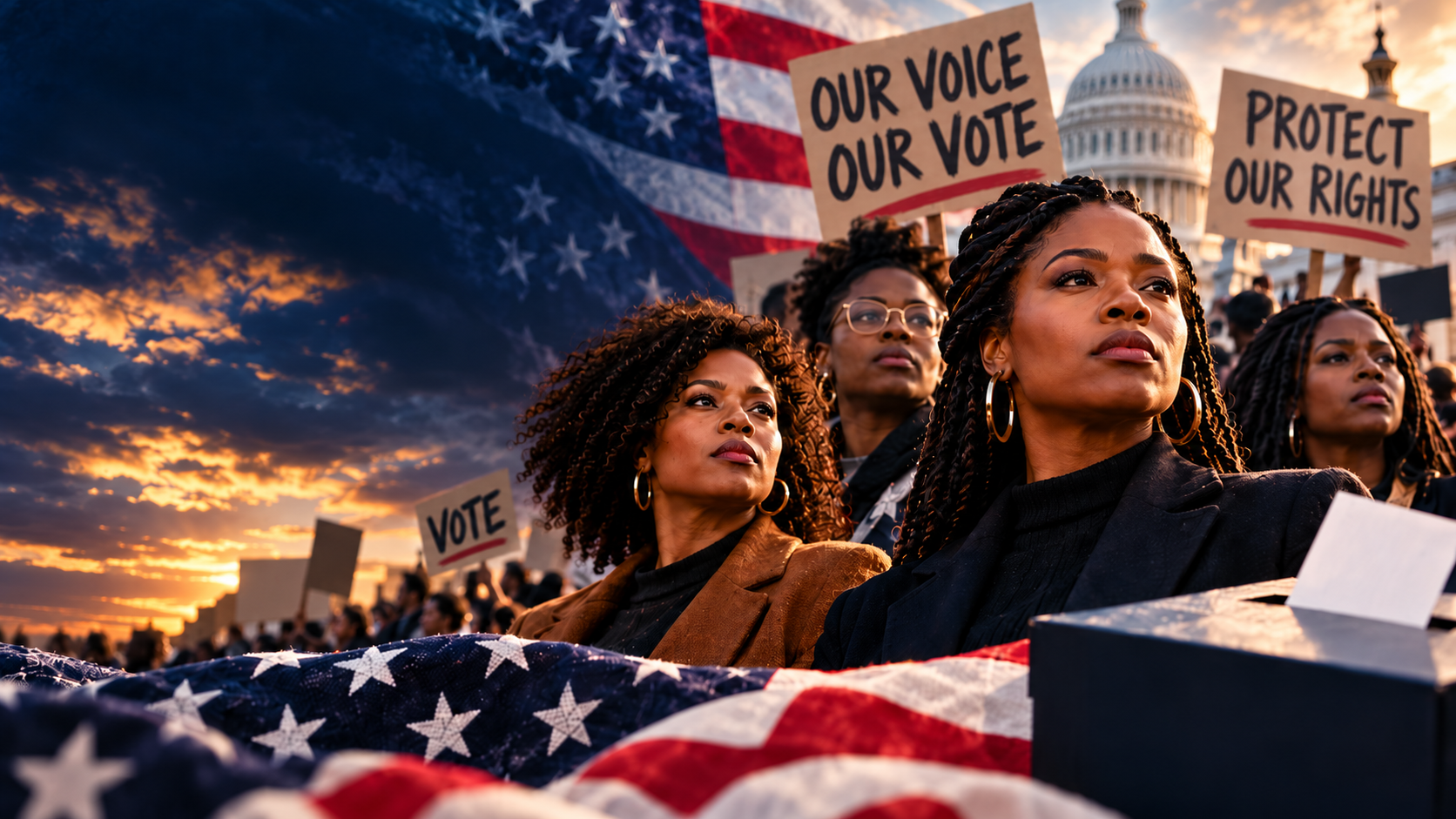
Black women are making it clear that they are not happy with the direction of the country, and a new national poll suggests their frustration is shaping how they approach the 2026 midterm elections.
Research shows that 92% of Black women surveyed expressed dissatisfaction with America’s current direction, while 77% said they were motivated to participate in the November 3 election. The findings offer a closer look at how political decisions, financial pressures, and concerns about civil rights are influencing one of the country’s most politically engaged voting groups.
The findings come from a national survey titled “The Fulfillment Gap,” conducted by The Highland Project in partnership with brilliant corners Research & Strategies. Researchers surveyed 700 African American women between August 30 and September 10, 2026.
What makes the results particularly noteworthy is the motivation behind that political engagement. According to the researchers, Black women are not approaching this election with the same optimism that characterized Barack Obama’s historic presidential campaigns. Instead, concerns about protecting their families, communities, and economic stability are taking center stage.
Cornell Belcher, a national pollster and president of brilliant corners Research & Strategies, compared the level of interest to the political energy surrounding Obama’s presidential victories.
“You see an enthusiasm and potential to mobilization this election that I hadn’t seen, quite frankly, since going back to the Obama era,” Belcher told theGrio.
However, he emphasized that the reasons behind the enthusiasm have changed.
“There is a very big difference,” Belcher explained. “In 2008 [and] 2012, they were being mobilized around hope and optimism. Today, the chief driver of their mobilization is the idea that we got to protect the community.”
That comparison carries historical significance. According to the U.S. Census Bureau, Black voter turnout reached 66.2% during the 2012 presidential election, exceeding the 64.1% turnout rate among non-Hispanic white voters. It marked the first time Black participation surpassed white participation since the agency began publishing comparable voting rates for eligible citizens in 1996.
The new Black women voters poll does not establish whether that historic turnout level will be repeated. However, researchers say the reported motivation reflects the importance respondents place on the upcoming election.
One major concern involves changes to federal voting rights protections.
According to the Highland Project survey, 87% of respondents said changes affecting voting rights made them more motivated to vote. Another 61% described the upcoming midterms as more important than previous elections.
Those concerns follow a major Supreme Court decision involving congressional representation.
On April 29, 2026, the Supreme Court ruled in Louisiana v. Callais that Louisiana’s creation of a second majority Black congressional district violated constitutional restrictions on racial gerrymandering.
According to the Supreme Court’s ruling, the majority concluded that the Voting Rights Act did not require Louisiana to create the additional district and that the state’s use of race in drawing the map was therefore unconstitutional.
The decision also changed the legal standards governing certain claims of racial vote dilution under Section 2 of the Voting Rights Act.
Supporters of the decision argued that it reinforced constitutional limits on race-based districting. Civil rights advocates, however, warned that the ruling would make it harder for minority communities to challenge electoral boundaries that weaken their voting influence.
According to Reuters, the ruling created significant new obstacles for legal challenges involving minority voting representation and intensified disagreements over congressional redistricting.
Beyond voting rights, the survey suggests financial stability and employment remain major issues for Black women.
The Highland Project found that 21% of women surveyed reported being affected by federal layoffs. That finding reflects the experiences of respondents and should not be interpreted as the national percentage of Black women who lost federal employment.
The poll also identified dissatisfaction with the economy, rising living expenses, and the need for greater accountability from elected officials as recurring themes.
Gabrielle Wyatt, founder and CEO of The Highland Project, told theGrio that respondents were expressing frustrations extending beyond any single election or political party.
“They’re not satisfied with leadership. They’re not satisfied with the direction of the country, and they’re naming with extreme precision that it’s not only what’s at stake; it’s already about what has been lost,” Wyatt said.
She continued, “It’s naming that institutions and their leaders, party agnostic, are falling short on things that matter most to Black women.”
That frustration is central to what researchers call “The Fulfillment Gap.”
The survey measured the difference between the importance Black women placed on their needs and how effectively they believed institutions and leaders were addressing those priorities.
Across categories including education, public safety, voting rights, and health care, researchers identified an average gap of 5.7 points.
The results suggest respondents perceive a significant disconnect between the issues affecting their everyday lives and the solutions being delivered by those in power.
“African American women see that they’re making investments in this country, but the leaders and institutions of this country aren’t holding their end of the bargain,” Belcher said.
Still, one of the survey’s most revealing findings has little to do with elections themselves.
Researchers also asked Black women what they considered essential to experiencing joy and living fulfilling lives.
According to the poll, 94% identified having time to prioritize their mental health as an important component of joy. Another 92% pointed to having enough money, while 91% emphasized loving relationships.
Healthy eating was important to 89% of respondents, followed by having a rewarding job at 87% and having time for hobbies at 81%.
Those findings broaden the discussion beyond voting preferences and political dissatisfaction. They show that respondents are also focused on the ability to experience financial breathing room, maintain meaningful relationships, and enjoy life outside of work and other responsibilities.
Wyatt argued that policymakers and community leaders need to consider those priorities when discussing economic opportunity and quality of life.
“We’ve got to move past band-aid solutions,” she said.
She also emphasized that conversations about affordability should include broader questions about personal well-being.
“I think in a world in which we’re having all of this important conversation around affordability, we also have to have important conversations about: are we well?” Wyatt told theGrio.
The survey offers a reminder that Black women’s political concerns cannot be reduced to a single issue or candidate. The women surveyed identified interconnected priorities involving economic opportunity, civil rights, education, health, safety, and personal fulfillment.
It is also important to distinguish enthusiasm from actual participation. The results measure what respondents said about their intentions and priorities, not how many people will ultimately cast ballots. The publicly reported findings also do not establish that all Black women share the same views.
Nevertheless, the data presents a significant snapshot of political sentiment ahead of November.
With less than a month remaining before the 2026 midterms, the Black women voters poll shows that dissatisfaction with national leadership is accompanied by a strong desire for greater economic security, institutional accountability, and protections for their communities.
For the women represented in this survey, the conversation extends beyond who holds political office. It is also about whether the people and institutions making decisions can deliver meaningful improvements to their everyday lives.