

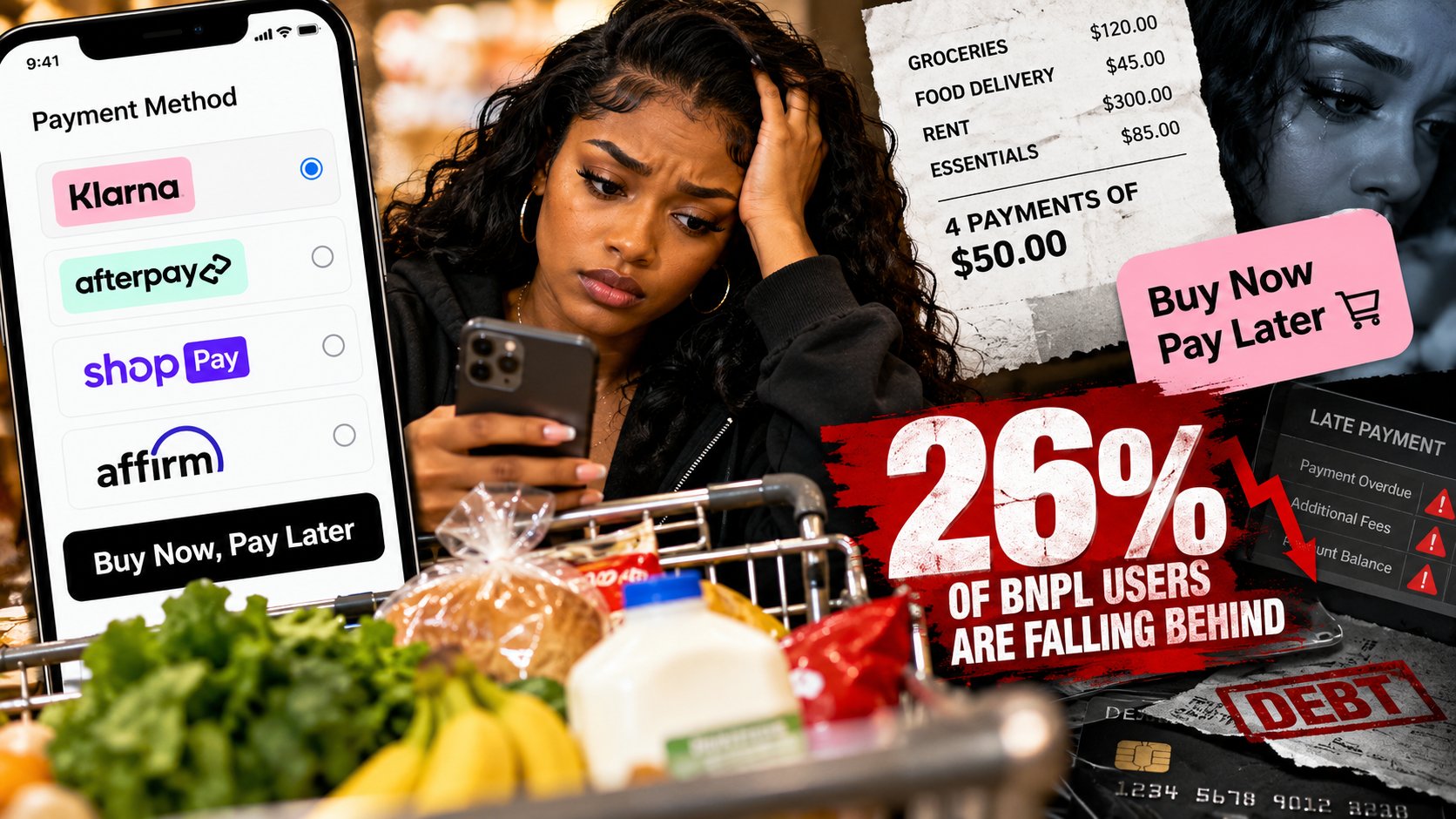
Buy now, pay later used to feel like a cheat code at checkout. Instead of dropping $400 at once, shoppers could split the bill into smaller payments and walk away with what they wanted immediately. But as Americans increasingly use the loans for necessities, the bigger question is getting harder to ignore: Are buy now, pay later loans helping people survive expensive times, or quietly making their financial lives worse?
According to The New York Times’ “The Daily”, buy now, pay later, commonly called BNPL, has expanded far beyond clothes, electronics, and other discretionary purchases. Americans are increasingly turning to the loans for necessities such as groceries and rent as rising costs squeeze household budgets.
That shift changes the conversation.
BNPL loans typically allow a consumer to divide a purchase into several installments, often four payments, instead of paying the entire amount upfront. Approval can be fast, and many traditional pay-in-four products advertise no interest. That combination has helped make the loans an attractive alternative for consumers who do not want to put another purchase on a credit card.
But easy access to money is still access to debt.
According to the Federal Reserve’s 2026 report on the economic well-being of U.S. households, 16 percent of adults used BNPL during 2025, up from 10 percent when the Fed first began asking about the loans in 2021. More than one quarter of BNPL users, 26 percent, reported making a late payment. Among users earning less than $25,000 annually, that figure jumped to 40 percent.
The racial differences are also difficult to overlook. According to the Federal Reserve, 29 percent of Black adults and 26 percent of Hispanic adults reported using BNPL in 2025, compared with 12 percent of White adults and 11 percent of Asian adults. The Fed said those differences remained sizable even after accounting for factors including income and age.
That makes the rise of BNPL especially relevant for communities already dealing with wealth gaps, higher borrowing costs and fewer financial cushions.
The Federal Reserve found that 29 percent of BNPL users said their main reason for using the product was that it was the only way they could afford the purchase. Among users with family incomes below $25,000, that number climbed to 40 percent. The Fed also found that one in five BNPL users had used the product for groceries or food delivery during the previous year.
For consumers struggling to stretch a paycheck, splitting a necessary expense can offer real breathing room. The problem begins when tomorrow’s paycheck already has several claims against it before it arrives.
The Federal Reserve reported that 11 percent of BNPL users had a payment trigger an overdraft or nonsufficient funds fee during 2025. Among users who paid late and were charged extra, 38 percent also experienced an overdraft or nonsufficient funds fee connected to a BNPL payment.
Then there is the mental health question.
A December 2025 study published in JAMA Health Forum examined BNPL use and symptoms associated with depression, anxiety, and post-traumatic stress. Researchers analyzed a nationally representative sample of 2,121 U.S. adults, 341 of whom reported using BNPL during the previous year.
After researchers adjusted for demographic characteristics, people with probable depression had 1.91 times the odds of reporting BNPL use compared with those without probable depression. Those with probable anxiety had 1.77 times the odds, while participants with probable post traumatic stress had 2.35 times the odds.
“Our findings suggest that people with poor mental health may be more likely to use alternative financial products,” study coauthor Catherine Ettman said in a Johns Hopkins Bloomberg School of Public Health release.
That finding deserves context. The research does not establish that BNPL causes poor mental health. The study was cross-sectional, meaning researchers could identify an association but could not determine which condition came first. The authors acknowledged that the relationship could potentially move in both directions. Mental health challenges could influence financial behavior, while financial stress could also affect mental health.
That uncertainty may actually make the issue more important.
According to the JAMA researchers, BNPL could be preferable in some circumstances to higher-cost alternatives such as payday loans or high-interest credit cards. A consumer who has the money coming in, understands the payment schedule, and needs to bridge a short cash flow gap may find an installment plan useful.
But that is very different from repeatedly borrowing because basic expenses no longer fit inside a household budget.
The Consumer Financial Protection Bureau has previously examined another risk: loan stacking. Because consumers can borrow from multiple BNPL providers, a shopper can potentially carry several installment loans simultaneously. That can make the total debt picture harder to see, particularly when payments are being automatically pulled from the same checking account on different dates.
That frictionless experience is part of BNPL’s appeal. It may also be part of its danger.
The loans break a big price into smaller numbers. A $200 purchase suddenly looks like $50. The consumer receives the product immediately while the financial consequences arrive later. Repeat that process across clothing, groceries, concert tickets, furniture, and household bills, and individually manageable payments can turn into a crowded calendar of obligations.
The question, then, is not whether BNPL is inherently good or bad.
The more revealing question is why someone needs it.
Using a no-interest installment plan strategically when money is already available is one thing. Depending on short-term loans to eat, keep the lights on, or make rent is another. In that situation, BNPL may not be solving an affordability problem at all. It may simply be moving the problem a few weeks into the future.
And when millions of consumers start moving today’s bills onto tomorrow’s paychecks, “pay later” stops sounding like a shopping convenience and starts looking like a warning about how expensive everyday life has become.
