

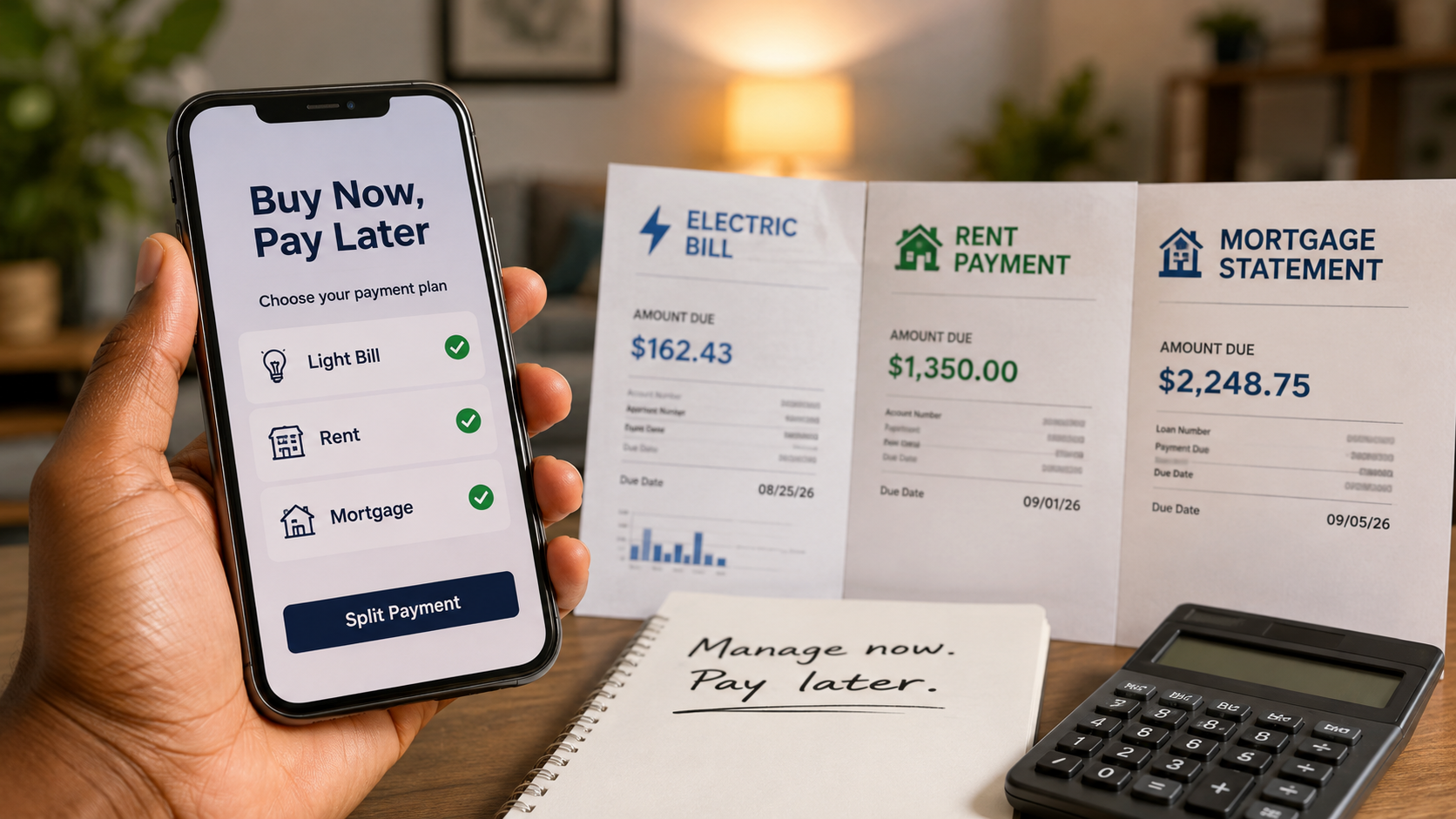
Buy now, pay later loans, the installment plans that first showed up at online checkouts to help people split up sneakers and concert tickets, are now being offered to cover electricity, water, rent, mortgages, health insurance, phone service, dentist visits, and taxes, according to a New York Times report this week.
If you have never used one, here is the basic setup. Instead of paying the full price at checkout, an app fronts the money, and you pay it back in a handful of smaller payments, usually four, usually over about six weeks. Most of them do not run a hard credit check, which means people who cannot get approved for a credit card can get approved for these in seconds. That accessibility is the entire pitch, and it is also the entire problem.
What changed is what the money is being used for. Apps like Flex and Zip now let people finance electricity, water, broadband, mobile phone service, health insurance, and mortgage payments. Affirm has started offering short-term loans to renters to stretch out monthly rent. Dentists, veterinarians, and medical clinics are offering instant financing right there in the chair. And Intuit, the company behind TurboTax, has begun promoting a product called File Now, Pay Later to filers who owe the federal government money. It covers federal tax balances between $200 and $6,000, pays the IRS directly, and gets repaid over three, six, or nine months. Unlike the classic buy now, pay later setup, that one charges interest.
Klarna and Afterpay are the names most people know, and they are two of the biggest lenders in the space alongside Affirm, PayPal, Synchrony, Splitit, Sezzle, and Zip. The advocacy group Protect Borrowers points out that most of them are backed by private equity firms and venture capital investors, meaning there is serious money betting that Americans are going to keep needing help covering the basics.
The numbers say that bet is paying off. Americans put about $160 billion through buy now, pay later loans last year, nearly double what they ran through them in 2023, according to Federal Reserve economists. Credit card balances hit $1.26 trillion in the second quarter of this year, up $21 billion from the quarter before, and roughly 60 percent of cardholders are carrying a balance month to month. Karen Webster, the chief executive of the payments research firm Pymnts, described these loans as “working capital for the modern middle class.
That framing is generous. What is actually happening is that the cost of ordinary life has outrun what people are earning. Electricity prices have climbed 18 percent since Trump returned to office, and gas is averaging around $4.06 a gallon. When your light bill jumps, and your check does not, an app offering to split it into four payments does not feel like a loan. It feels like a lifeline.
The trouble starts on the second month. Buy now, pay later loans are advertised as interest-free, and many of the short-term ones are, as long as every payment lands on time. Miss one and the fees begin. Protect Borrowers found late fees running $7 to $8 per missed payment, stacking up to a cap of 25 percent of whatever you borrowed. Mike Pierce, the group’s executive director, told CNBC that once those fees pile on top of each other, the effective cost can work out to 100 percent APR or more. APR stands for annual percentage rate, and it is the standard way of measuring what borrowing actually costs you over a year. For comparison, a bad credit card sits around 30 percent. Payday loans, the ones states have spent decades trying to regulate out of existence, are the thing a 100 percent rate usually describes.
The product is also quietly changing shape. More than 37 percent of buy now, pay later loans issued this year carry interest from the start, nearly double the share in 2021, and interest plus financing fees on some of them can reach 36 percent. So the version being marketed as the friendly, fee-free alternative to credit cards increasingly is not.
There are smaller traps stacked underneath. These apps typically pull payments straight out of your bank account on a set date, so if the timing is off by a day, you eat an overdraft fee from your bank on top of the late fee from the app. Because most buy now, pay later lenders do not report to the credit bureaus, you can carry several of these at once without any of them showing up in one place, which makes it easy to lose track of what you actually owe. A quarter of borrowers surveyed by LendingTree said they had three or more of these loans outstanding at the same time. But if you default, the debt can still get sold to a collection agency, and that absolutely lands on your credit report.
The clearest picture comes from the borrowers. The Times profiled Ashley Reed, who turned to Afterpay and Klarna after a family emergency wiped her out. She now spends around $700 a month paying down what she borrowed while taking out new loans to stay above water. She described it as a ride she cannot get off, and said she cannot afford another emergency. Half of the buy now, pay later users LendingTree surveyed said they could not make ends meet without the loans. Forty-four percent of Americans expect to apply for one in the next six months.
The industry says this is the market working. Phil Goldfeder, who runs the American Fintech Council, says consumers are choosing pay-over-time options with clear terms. Lauren Saunders, a senior attorney at the National Consumer Law Center, put the counterargument plainly: the loans do answer a real cash shortage, but adding fees to a monthly budget and leaving somebody short again the following week is not a fix.
Both things are true at once, which is what makes this hard. The apps are not creating the shortfall. They found it, and they built a business on top of it.
