

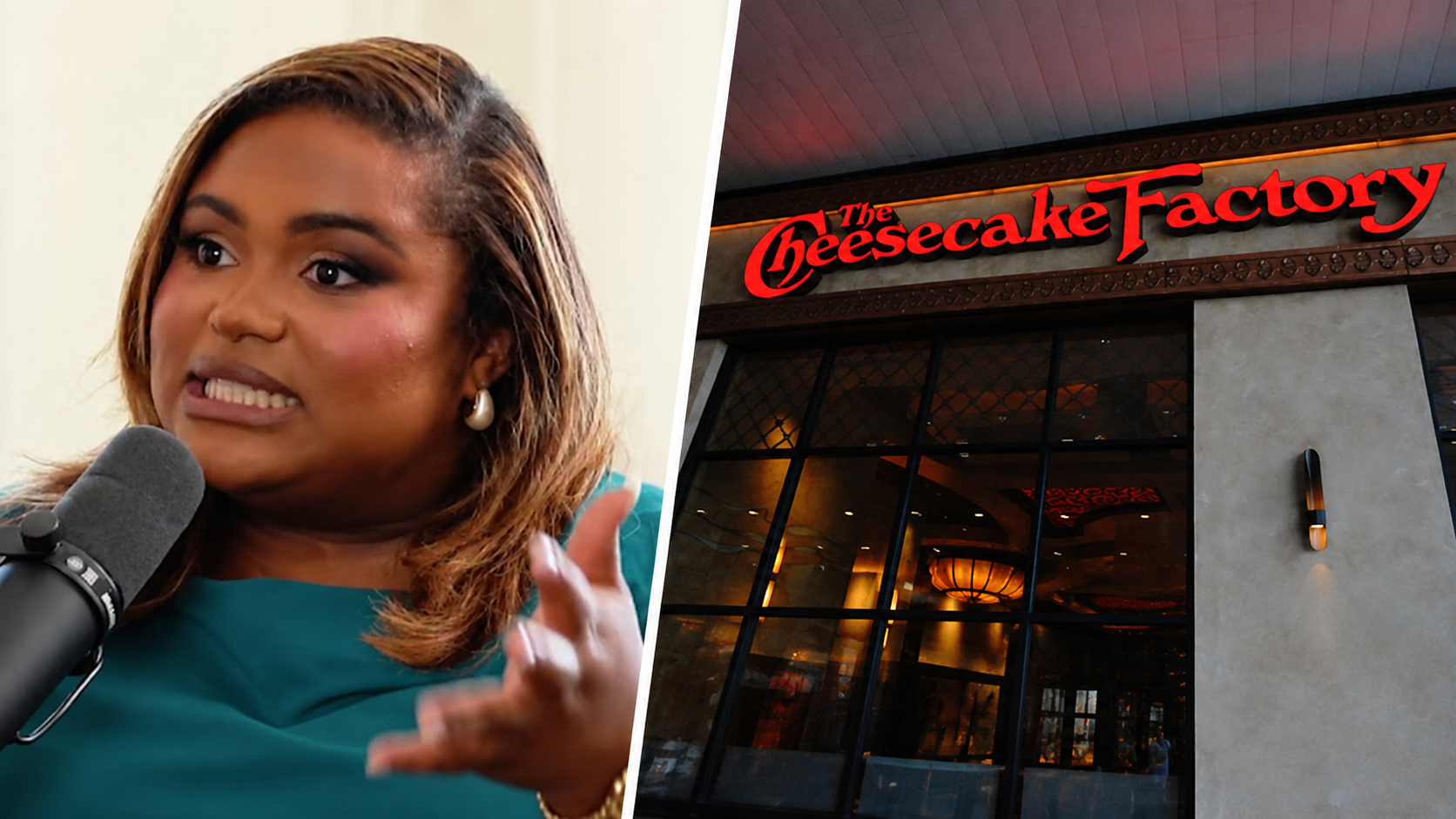
Cheesecake Factory’s SkinnyLicious menu is facing fresh criticism after singer, influencer, and size inclusion advocate Samyra Miller called out the restauranr for connecting lower calorie food with the word “skinny.”
In a series of viral TikTok videos, Samyra argues that the branding does more than describe a collection of menu choices. She believes it reinforces a culture that presents thinness as healthy, desirable, and morally superior.
“And while we’re chatting, Cheesecake Factory’s skinnylicious menu is fat phobic. The the fact that it is named Skinnylicious because it has fewer calories and quote unquote healthier options, it is fat phobic. That is not that is not an opinion, that is a fact. And I would say argue with your mama, but she probably fat-phobic too.”
Samyra has built a large following by documenting the experiences of plus size shoppers and challenging companies that promote inclusive imagery without offering meaningful access to larger sizes. Many people may recognize her name from a viral spat with Cardi B over what she deemed to be fat phobic comments made by the rapper. Their back-and-forth lasted for several days, with Samyra accusing Cardi’s fans of bullying.
The history of the SkinnyLicious menu shows that the connection between calorie reduction and thinness was intentional from the beginning. According to The Cheesecake Factory’s March 2011 announcement, the company first introduced five lower calorie cocktails under its “Skinny Style” branding. Each drink contained 150 calories or less, and the company marketed them toward customers seeking lower calorie ways to drink and dine.
Five months later, the idea expanded into a complete food menu. According to the August 1, 2011 press release, the original rollout included nearly 50 lower calorie selections on a separate menu. Small plates, appetizers, and flatbreads contained fewer than 490 calories, while salads and main courses contained 590 calories or less. The rollout continued for five weeks across 151 locations, excluding Honolulu.
The company’s founder, David Overton, described the menu as an option for calorie conscious customers who still wanted the restaurant’s familiar flavors, according to the same company announcement. The launch also introduced 13 new dishes, including a Mexican Tortilla Salad, SkinnyLicious Hamburger, and Tuscan Chicken. Existing lower calorie selections were moved onto the newly branded standalone menu.
More than a decade later, the SkinnyLicious menu remains part of the restaurant’s identity. According to The Cheesecake Factory’s current menu, its SkinnyLicious specialties are still marketed as containing 590 calories or less. The company also maintains SkinnyLicious categories for salads, appetizers, burgers, sandwiches, tacos, and other dishes.
In her second video, Samyra explained why she believes that branding can be harmful, especially when thinness is treated as proof of health.
“In order to understand why Cheesecake Factory’s having a menu with lower calorie options named Skinnylicious is incredibly harmful, you first have to understand and acknowledge that thinness does not equate health. Thinness does not equate health,” she explained.
That is a lie told to you by diet culture. Another thing you have to understand is that weight stigma, weight. Stigma is one of the biggest health risks in our society. Weight stigma. And you would know that if you care to read or listen to any of the books that I have recommended. Over the many years I’ve been on this app, over the many times that I have told y’all, given y’all. Definitions of things. But you don’t care about people’s health. You don’t care about health. It’s never about health. It’s just about not being fat because of how you all have moralized people’s bodies. Hello, light bulb, turn it on. Put your thinking caps on. Critical thinking skills.”
Medical guidance supports Samyra’s broader point that a person’s size alone cannot provide a complete picture of individual health. According to the Centers for Disease Control and Prevention, body mass index is a screening measurement that should be considered alongside factors such as blood pressure, cholesterol, laboratory findings, and a physical examination. The CDC does not describe body size or BMI as a complete individual diagnosis.
According to the American Medical Association, BMI has significant limitations when applied to individual patients and should be used with other measurements of health risk. The organization has also acknowledged that body composition, age, sex, race, ethnicity, genetics, and metabolic factors can affect how weight related measurements should be interpreted.
Samyra’s concerns about stigma also have support in published research. According to a joint international consensus statement published in Nature Medicine, weight stigma can cause physical and psychological harm, discourage people from seeking medical care, and contribute to discrimination in health care, education, employment, and other areas of society. The experts behind the statement concluded that weight stigma can undermine both health and human rights.
That research supports the seriousness of stigma, although it does not specifically rank weight stigma as one of society’s largest health risks. Samyra’s precise wording represents her conclusion about the scale of the problem. Her broader argument, however, is grounded in evidence showing that shame and discrimination are not harmless tools for motivating healthier behavior.
The SkinnyLicious menu debate ultimately comes down to the difference between providing nutritional options and assigning a body ideal to those options. Cheesecake Factory could describe the same meals through their calorie totals, portions, ingredients, or nutritional information. Samyra is asking why thinness must remain the promise attached to the plate.
Her criticism pushes the conversation beyond whether individual customers enjoy the food. It asks what restaurant language teaches people to associate with health, discipline, beauty, and worth. More than 14 years after SkinnyLicious arrived, that is the question now sitting on Cheesecake Factory’s table: can a restaurant offer lower calorie choices without turning thinness into the sales pitch?
