

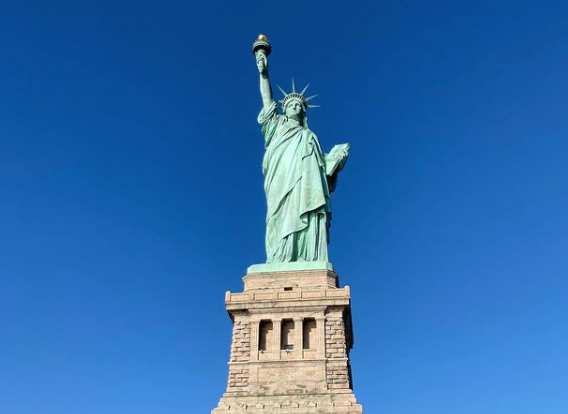
Lady Liberty became the center of a legal firestorm this week, and not because anyone has actually pointed a wrecking ball at her. The Statue of Liberty came up as a hypothetical inside a federal courtroom, and the government’s answer is what sent the moment around the internet.
On Friday, a Justice Department lawyer named Yaakov Roth stood before the D.C. Circuit Court of Appeals to defend Trump’s roughly $400 million White House ballroom, the one being built on the site of the now demolished East Wing. The government’s position throughout the case has been blunt. Once something is torn down, no one has the legal standing to undo it, so no judge can stop the project. The National Trust for Historic Preservation, which is suing to halt construction, argued the opposite.
To test how far that logic stretched, Judge Patricia Millett offered a scenario that nobody in the room expected. She asked what would happen if the government decided to move very fast and bulldoze the Statue of Liberty before anyone could file suit. Think of the descendants of the immigrants who saw that statue as the first thing they laid eyes on in this country. If the government moved too quickly, she asked, could nothing be done? Roth’s reply was four words. “I think that’s right, yes.” People in the courtroom reportedly gasped.
Let’s be clear about the facts, because the story is real but the panic should be calibrated. There is no plan to demolish the Statue of Liberty. The statue, like the White House grounds, is managed by the National Park Service, and tearing it down would require congressional approval and a long review under the National Historic Preservation Act. What happened was a lawyer conceding a hypothetical in order to protect a much larger legal theory about whether courts can ever step in once demolition begins. It was a strategy answer, not a policy announcement.
Still, symbolism matters, and this one cut deep. The Statue of Liberty is not just a tourist stop. For generations of immigrants, and for the children and grandchildren of people who arrived with nothing, she has stood as the literal first image of arrival, of welcome, of the idea that the door was open. So when a government lawyer shrugs and says there would be no recourse if she were flattened overnight, the offense is bigger than one ballroom or one lawsuit. It reads as a statement about how disposable the country’s founding promises have become.
The backlash online was immediate. Gavin Newsom’s office called it sick, and the clip ricocheted across social media all weekend, with critics arguing that a legal theory this expansive should alarm anyone who cares about what the government can and cannot knock down. Legal scholars pushed back too, noting that a tourist or an art historian who bought a ticket specifically to see the statue would likely have standing to sue, which would blow a hole in the government’s claim.
The ballroom case now sits with three appellate judges. But the line that will stick is the one about Liberty herself, and the quiet admission of just how little the administration believes stands between its plans and the things this country once called untouchable.
