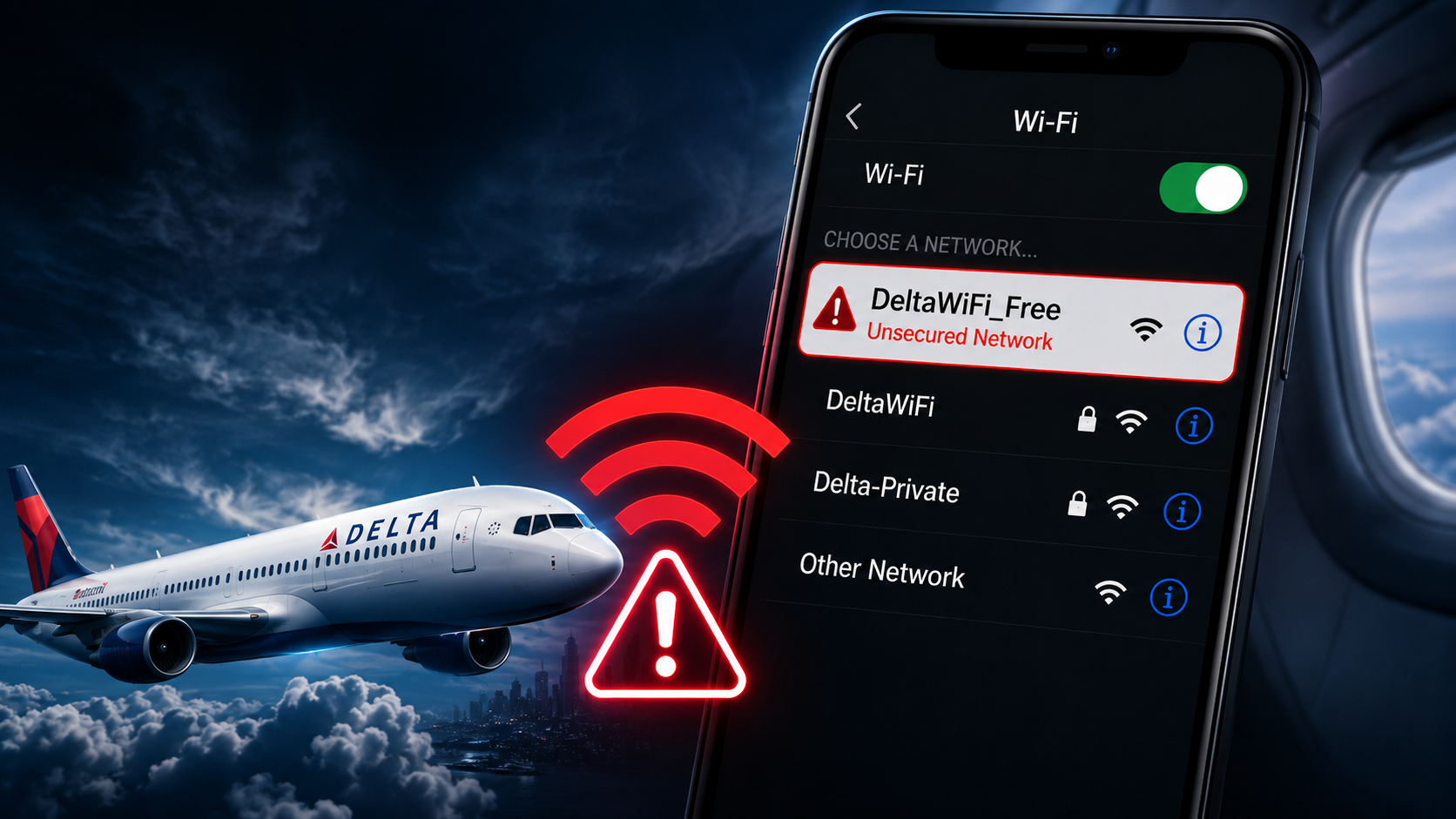
A Delta Airlines WiFi scare aboard a flight headed to Atlanta has triggered a cybersecurity investigation after an unauthorized wireless network briefly appeared while passengers were thousands of feet in the air.
According to CBS News Atlanta, the suspicious network surfaced Monday, August 10, on Delta Flight 591 traveling from Las Vegas to Hartsfield Jackson Atlanta International Airport. Delta told the outlet that none of the aircraft’s operating systems were hacked or compromised, but the appearance of an unauthorized network was serious enough for the crew to shut down the Boeing 757’s WiFi functionality for roughly 30 minutes.
The airline stressed that the situation never became an aviation emergency.
“Safety of flight was never in question, and no aircraft operating systems were affected. We are fully investigating to gather a complete set of facts, which will take time,” the Delta spokesperson said. “We will partner with federal law enforcement and aviation regulators to ensure the incident is thoroughly investigated. We thank our crew for their professionalism and our customers for their understanding.”
What investigators have not publicly established is who created the network, why it appeared, whether anyone connected to it, or whether any information was taken. Still, the Delta WiFi incident resembles a known cybersecurity tactic commonly called an evil twin attack, making the potential purpose of such a network particularly concerning.
In an evil twin scenario, someone creates a wireless network designed to look like a legitimate service. The objective can be to convince users that they are connecting to the WiFi offered by an airline, airport, hotel, coffee shop, or another trusted provider. Once a victim chooses the fake network, an attacker may attempt to direct that person to a fraudulent login page or otherwise place themselves between the user and the internet.
That does not mean whoever created the network aboard Flight 591 was attempting to steal information. No such motive has been confirmed. However, if the Delta WiFi network was created with malicious intent, one possible goal would have been convincing passengers to enter email addresses, social media credentials, passwords, or other personal information into a page controlled by whoever operated the network.
That type of access can create problems far beyond one flight. A stolen email password, for example, could potentially give an attacker a path into other accounts if a victim reused the same password. Access to email can also expose private conversations, password reset messages, financial notifications, photographs, travel information, and other personal material.
There are important limits to what someone operating a rogue public network can automatically see. According to the Federal Trade Commission, most modern websites encrypt information traveling between a user and the website, making ordinary public WiFi considerably safer than it was years ago. That protection does not eliminate phishing, however. The FTC warns that scammers can create fake websites that are themselves encrypted, meaning information can travel securely straight into the hands of the person operating the fraudulent page.
A similar case overseas shows why the Delta WiFi investigation is getting attention even though no theft has been established.
According to The Guardian’s reporting on Australian Federal Police allegations, authorities charged a Western Australian man in 2024 after investigators alleged he created fake WiFi networks at airports and aboard domestic flights. Police said an airline first alerted authorities after employees noticed a suspicious wireless network during a flight, a detail strikingly similar to the circumstances now being investigated aboard Delta Flight 591.
Australian authorities alleged that the fake networks imitated legitimate WiFi services at Perth, Melbourne and Adelaide airports as well as on flights. According to the report, users who connected could be sent to fraudulent pages requesting email or social media login information. Police alleged credentials collected through those pages could then provide access to communications, photographs, videos and potentially financial information.
That case demonstrates why a fake network does not need to interfere with an airplane to cause serious harm. The passengers themselves can be the target.
The Delta WiFi incident is therefore less about the possibility of someone taking control of an aircraft and more about whether someone attempted to exploit the trust passengers place in familiar wireless networks. A traveler who sees what appears to be an airline connection may have little reason to question it, especially during a long flight when cellular service is unavailable.
CBS News Atlanta reported that Delta also noted DEF CON 34 had been taking place in Las Vegas around the time of the flight. DEF CON is a major gathering for cybersecurity professionals, researchers and hackers, but the airline has not publicly connected any conference attendee to the incident. The timing alone does not establish responsibility.
For passengers, the investigation is a reminder that the name displayed in a WiFi menu is not proof that a network belongs to the company it appears to represent. The FTC recommends protecting accounts with strong passwords and two factor authentication, while travelers can also confirm the correct network name through an airline’s official instructions before connecting.
For now, the most important unanswered question surrounding Delta Flight 591 is whether the unauthorized network was an experiment, a hoax, or an actual attempt to collect passenger information. Until federal investigators and Delta determine who created it and what the network was configured to do, claims that passengers were hacked or had information stolen would go beyond the available evidence.
What is already clear is that an aircraft does not have to be hacked for a cybersecurity incident in the cabin to become dangerous. If a convincing fake network can persuade even one traveler to hand over valuable credentials, the damage can follow that passenger long after the plane reaches the gate.