


A Florida middle school teacher who was suspended without pay over a Facebook post about Charlie Kirk is one step closer to getting her job and lost wages back after an administrative law judge found that her comments caused little actual disruption to her school district.
According to the News Service of Florida through WUSF, Division of Administrative Hearings Judge Andrew Manko recommended that the Lee County School Board end Mariah Roller’s suspension and award her back pay. Roller, an educator at Three Oaks Middle School in Fort Myers, became one of several Florida teachers disciplined over Charlie Kirk comments posted after the conservative activist was shot and killed while appearing at Utah Valley University on September 10, 2025. Manko concluded that the disruption connected to Roller’s Facebook activity was “minimal.”
The judge also distinguished between Roller making the post and someone else spreading it outside her intended audience. In his August 14 recommended order, Manko wrote, “Ms. Roller’s private Facebook post on her personal Facebook page was not unethical, and it was not her action, but that of a third party, that resulted in its dissemination.”
Roller made the post on the same day Kirk was killed. According to the administrative decision cited by the News Service of Florida, she wrote, “What’s that about the cost of the Second Amendment being ‘some gun deaths every year,’? Bye Charlie,” followed by a waving emoji and three fire emojis. Her page was private, but someone captured the post and circulated it more widely before Roller deleted it less than an hour later.
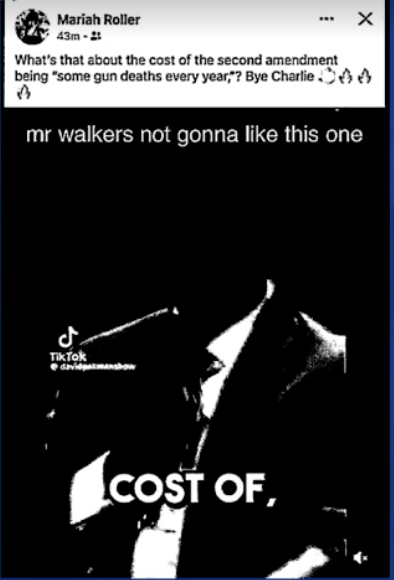
Lee County officials argued the Charlie Kirk comments created “substantial disruption” inside the district, but Manko found a much thinner record. According to the ruling, only two parents complained directly to the school board. Three Oaks Middle School’s principal received roughly 15 to 20 emails, but Manko noted that “he only took the time to send a generic response to a few of them.” That evidence was not enough, in the judge’s view, to support the level of discipline Roller received.
The recommendation does not automatically return Roller to the classroom. Under Florida’s administrative process, the Division of Administrative Hearings issues recommended orders in disputes involving government agencies and local boards, while the agency involved generally retains authority to enter the final order. That means the Lee County School Board still has an important decision to make about whether it will accept Manko’s findings and restore Roller’s pay.
Roller’s case developed during a much broader state response to educators who posted Charlie Kirk comments following his death. In a memo sent the day after the shooting, then Florida Education Commissioner Anastasios Kamoutsas wrote, “It has been brought to my attention that some Florida educators have posted despicable comments on social media regarding the horrific assassination of Charlie Kirk. These few are not a reflection of the great, high-quality teachers who make up the vast majority of Florida’s educators. Nevertheless, I will be conducting an investigation of every educator who engages in this vile, sanctionable behavior.” The state ultimately opened dozens of investigations involving educators, according to reporting from Florida Phoenix and other Florida outlets.
Those disciplinary efforts are now colliding with existing First Amendment precedent. In Caggiano v. Duval County School Board, Florida’s Fifth District Court of Appeal ruled in February 2025 that a public school teacher’s politically charged Facebook posts were protected speech where they were made on his own time, with personal equipment, without school resources or communications with students, and where the district failed to demonstrate meaningful disruption. The appeals court applied the long-standing constitutional framework that balances a public employee’s right to speak as a citizen on matters of public concern against the government employer’s interest in operating effectively.
That ruling has already surfaced in disputes over Charlie Kirk comments. Administrative Law Judge Jodi Ann Livingstone cited similar First Amendment concerns when she recommended in June that Martin County teacher Matthew Theobald be reinstated with back pay and benefits after his suspension and proposed termination. Livingstone found that the district had not established sufficient disruption or just cause and had bypassed its normal progressive discipline process. Martin County challenged that recommendation, arguing that Theobald’s comments damaged confidence in his ability to teach and affected district operations.
Outside Florida, public employers have already paid significant money to resolve lawsuits brought by workers fired over Charlie Kirk comments. The Associated Press reported that Florida Fish and Wildlife Conservation Commission biologist Brittney Brown reached a $485,000 settlement after suing over her firing for reposting a meme about Kirk on her private Instagram account. Brown’s settlement covered back pay, damages and attorney costs.
Ball State University also agreed to pay former health promotion director Suzanne Swierc $225,000 after she sued the Indiana public university over her firing. According to the Associated Press, Swierc argued that her private Facebook commentary concerned a public issue and was protected by the First Amendment. Ball State maintained that the backlash to her post threatened the university’s reputation, enrollment and donor relationships, but university President Geoffrey Mearns said resolving the case was less expensive than continuing the litigation.
The payouts began even earlier. Austin Peay State University in Tennessee reinstated tenured theater professor Darren Michael and agreed to a $500,000 settlement after firing him over a social media post related to Kirk. According to the Associated Press, the university acknowledged that it had not followed the proper process required to terminate a tenured professor.
At Clemson University, assistant professor Joshua Bregy sued after he was fired for sharing someone else’s Facebook post criticizing Kirk’s rhetoric. According to the ACLU of South Carolina, Clemson later rescinded Bregy’s termination, agreed to continue paying his salary and benefits through the original end of his employment term, and committed to providing positive teaching recommendations. Bregy agreed to dismiss his lawsuit and resign effective May 15, 2026.
Iowa has produced several additional challenges. Creston High School teacher Melisa Crook sued after her district moved to terminate her over a Facebook comment about Kirk. A federal judge initially blocked further punishment, and KCCI later reported that the case ended with a $145,000 settlement plus Crook’s salary and benefits for the remainder of the school year. Crook ultimately left the district.
Maria Ruhtenberg, a longtime attorney with Iowa’s Office of the State Public Defender, was actually fired after making private Facebook comments about Kirk. Iowa Public Radio reported that a civil service process later restored her job. Ruhtenberg then filed a federal First Amendment retaliation lawsuit and reached a $125,000 damages settlement in May 2026.
Georgia teacher Michelle Mickens also took her dispute to federal court after being removed from the classroom and facing termination over activity on her private Facebook account. The Atlanta Journal-Constitution reported that Oglethorpe County School District ultimately agreed to pay Mickens $270,420 for alleged emotional distress and another $17,080 in legal fees, bringing the settlement to nearly $300,000. Mickens agreed to resign and received a positive employment reference under the deal.
One of the largest settlements came from the University of Tennessee. Former assistant professor Tamar Shirinian was fired in February 2026 while litigating her punishment over Charlie Kirk comments. A federal judge had previously declined to immediately stop the university’s disciplinary process, showing that these cases have not produced uniform rulings. By late June, however, the university agreed to a $1.9 million settlement resolving Shirinian’s lawsuit. She was not reinstated.
Several other cases remain unresolved. South Carolina teacher assistant Lauren Vaughn sued Spartanburg County School District Five after being fired over a Facebook post quoting Kirk’s remarks on gun deaths. A federal judge denied her request for immediate reinstatement, but the underlying lawsuit continued. Tennessee state employee Monica Meeks has an active federal case seeking reinstatement and damages after being fired over a Facebook comment. Arkansas biology teacher Chance Duncan filed suit in July seeking reinstatement after Russellville School District terminated him.
Florida grant accountant Erika Santos is also suing Eastern Florida State College after the public college fired her over private Facebook posts. The ACLU of Florida says her case remains in litigation, with discovery underway. In Missouri, former state education department attorney Lindsey Phoenix filed a federal lawsuit in July alleging that she was terminated because of a social media repost made after Kirk’s killing. Iowa teacher Matthew Kargol, who was fired after posting “1 Nazi down,” has likewise challenged his termination in federal court, although an administrative judge separately ruled against him in an unemployment benefits proceeding after finding his posts caused substantial workplace disruption.
The legal divide matters because the First Amendment generally restricts government retaliation, making public employees and workers at public institutions differently situated from many employees of private companies. Reporting from NPR, citing a Reuters investigation, found that more than 600 people were fired, suspended, or investigated over reactions to Kirk’s death. The publicly known cases that have produced major First Amendment settlements have largely involved government workers or employees of public institutions.
Roller’s recommended reinstatement does not settle where every court will draw the line, but it adds another ruling to a growing body of litigation asking the same question: when a public employee speaks about politics on personal time and a private account, how much actual workplace disruption must the government prove before an offensive or unpopular opinion can cost that person a career?

Don’t want her teaching my kids!!