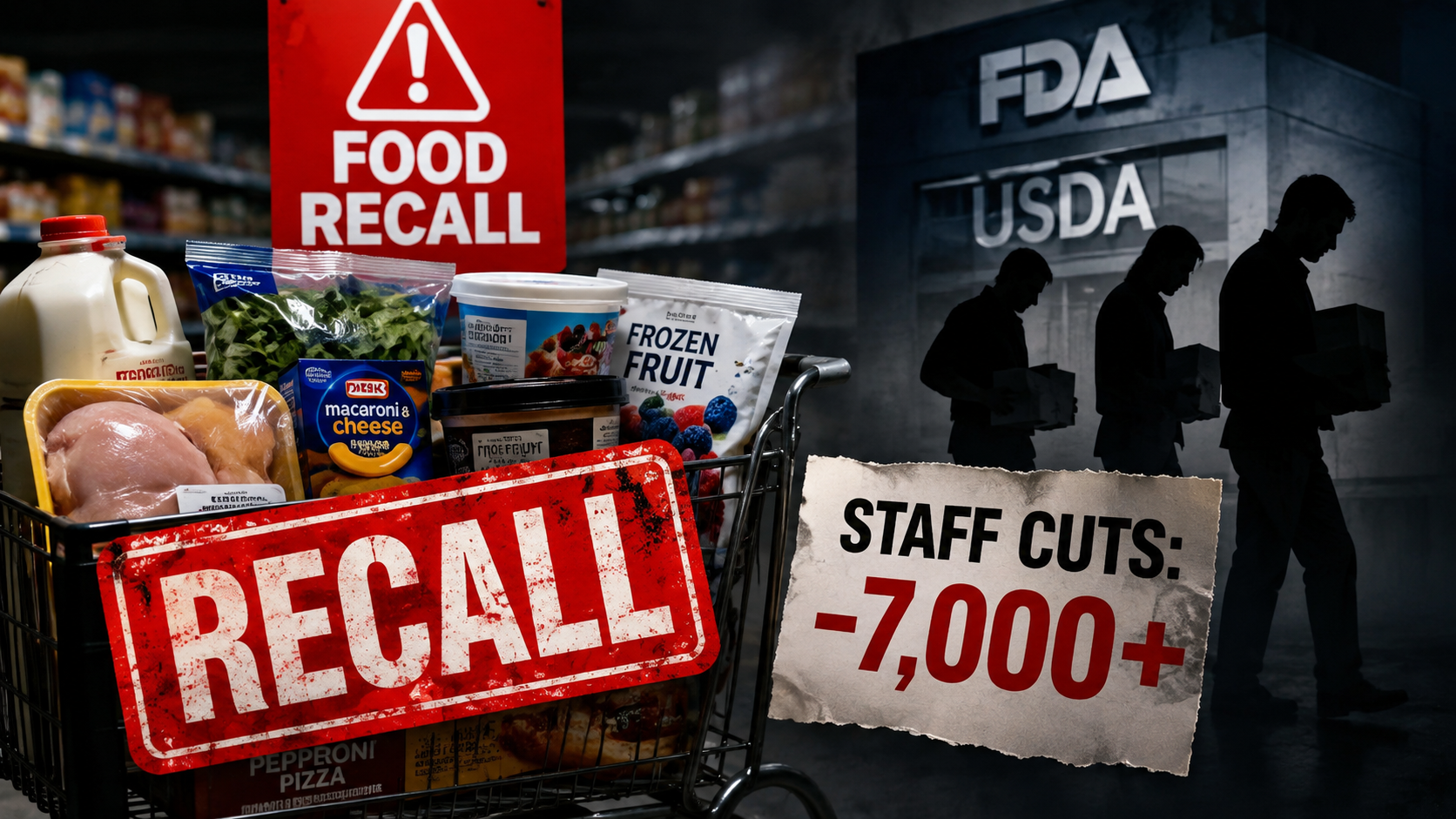
More than fifty food recalls have been logged in the United States so far in 2026, and the federal agencies responsible for catching contaminated food before it reaches your kitchen have lost more than 7,000 employees between them since January 2025. Those two facts are not the same story, but they are happening in the same room.
Start with what has actually been pulled. In July, Publix recalled every lot of its GreenWise organic frozen whole blueberries and whole mixed berries after federal investigators linked them to an outbreak of E. coli O145:H28. The berries came from a supplier in Chile and had gone out to Publix stores across eight states. Around the same time, the FDA issued an advisory about shredded iceberg lettuce from Mexico served at Taco Bell locations in Indiana, Kentucky, Michigan, Ohio, and West Virginia, tied to a Cyclospora outbreak. Cyclospora is a parasite that spreads through contaminated food and water and causes prolonged diarrhea. It is not bacteria and it does not respond to the usual food safety assumptions people carry around, which is part of why it is hard to trace. Sysco, the largest food distributor in the country, has stopped buying lettuce from Mexico entirely.
The rest of the year’s food recalls read like a full grocery run. Shell eggs for Salmonella. Pistachio nut butter. Green powder supplements. Jalapeño dips, salsa and guacamole. Soup kits and salad dressings and granola. Multiple cheese varieties, cottage cheese and ricotta, all for Listeria, a bacteria that is especially dangerous for pregnant women, newborns, adults over 65, and anyone with a weakened immune system. Infant formula appeared twice, once for botulism risk and once for Bacillus cereus toxin. Dog food and chicken dog treats for Salmonella. Smoked and dried herring for botulism. Peeled garlic. Raw milk cheddar.
Here is who is supposed to be watching all of that. The FDA covers roughly 80 percent of the American food supply, meaning almost everything except meat and poultry. Meat and poultry fall to the Food Safety and Inspection Service inside the Department of Agriculture. The CDC does something different from both: it does not inspect anything; it tracks who is getting sick and connects the dots between a person in Ohio and a person in Georgia who ate the same thing. Without that third piece, a recall never happens, because nobody knows there is a pattern.
All three have been cut. According to Office of Personnel Management data, the FDA lost 3,859 employees in fiscal year 2025 and another 473 in fiscal year 2026. The CDC lost 2,499 and then 390. The USDA lost 19,984 and then 2,269, with the Food Safety and Inspection Service down 913 across both years. Governmentwide, the federal workforce has shrunk by more than 242,000 people since January 20, 2025.
The single biggest cut to food safety was announced, not inherited. On March 24, 2025, HHS said it would remove 3,500 people from the FDA, a 20 percent reduction of the agency, including more than 170 staff from the Office of Inspections and Investigations. That announcement came from Health and Human Services Secretary Robert F. Kennedy Jr., who defended it publicly and framed it as refocusing the department on chronic disease. A month earlier, Jim Jones, the deputy commissioner who ran the FDA’s entire Human Foods Program, had already resigned as thousands of HHS workers were terminated.
The CDC side came apart in August 2025. Director Susan Monarez was fired after refusing to dismiss three veteran officials. Those three left anyway, along with a fourth. One of them was Dr. Daniel Jernigan, who had spent three decades at the agency and ran the National Center for Emerging and Zoonotic Infectious Diseases, the center that tracks foodborne illness outbreaks. His colleagues Debra Houry, Demetre Daskalakis and Jen Layden walked out the same week. Layden ran the office responsible for public health data and surveillance, which is the machinery that makes outbreak detection possible in the first place.
Then there is the change almost nobody noticed. On July 1, 2025, the CDC quietly scaled back FoodNet, the surveillance network that monitors foodborne infections across ten states and serves as the country’s early warning system. It went from tracking eight pathogens down to two, Salmonella and Shiga toxin-producing E. coli, with the agency citing inadequate funding. The cut did not become public until August. Listeria, Campylobacter, Cyclospora and several others fell off the list. Look back at the recall roster above and count how many of this year’s food recalls involve pathogens the CDC stopped systematically tracking.
The effect on outbreak investigations is already measurable. In 2024, the FDA investigated 26 outbreaks and identified the source in 20 of them, about 77 percent. In 2025, it closed 11 investigations, having pinned down the source in only 4, about 36 percent. That is the difference between knowing which farm to shut down and issuing a general warning about berries. Inspections are thinning too, and mostly not at the federal level. States conduct roughly 90 percent of produce inspections and 75 percent of manufactured food inspections under federal grants, and those state programs were told to expect funding cuts approaching 60 percent. The FDA’s own numbers show it employed 443 food safety inspectors in 2024 to cover 36,600 food facilities, against an internal estimate that it needs about 1,500. The proposed fiscal 2026 FDA budget would shrink Human Foods Program staffing another 7.6 percent and cut Field Laboratory Operations, which is the lab capacity that actually tests samples, by 54.4 percent.
One thing worth being precise about: this is no longer a DOGE story. The Office of Personnel Management director said in November 2025 that DOGE no longer exists as a centralized entity and that OPM had absorbed its functions, eight months before its charter was set to expire. The cuts kept coming after that. The FDA and CDC losses in fiscal 2026 happened without it.
And rebuilding is not happening at speed. As of June 2026, the CDC had made 167 hires since the start of the administration, 29 of them in the current fiscal year, against a loss of nearly 2,900.Kennedy campaigned on food safety. He has pushed to close the loophole that lets companies declare their own additives safe without telling the FDA, and he launched an initiative on heavy metals in baby food. Those are real food safety priorities. They also require staff to write, enforce, and test, which is the part of the equation that has been shrinking.
Short Link: https://balleralert.com/z020