

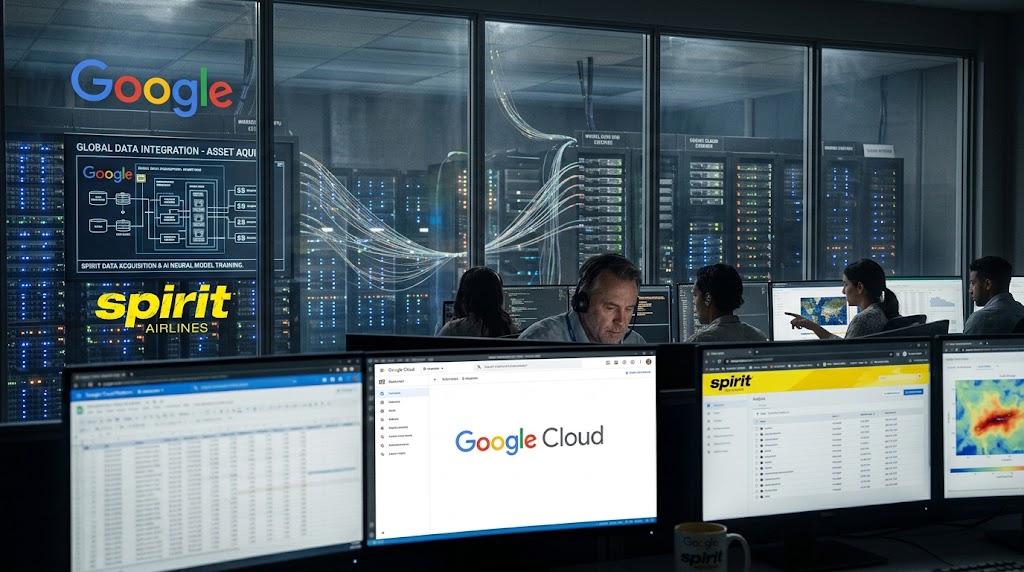
Spirit Airlines stopped flying months ago, but decades of emails, workplace messages, employee records and company software have become some of the most contested assets left behind by the collapsed carrier. The Spirit Airlines data sale has drawn Google, competing artificial intelligence companies, a major flight attendants union and now a software company into a bankruptcy fight over who can buy the records, what can be included and how information created by employees should be protected. According to Reuters, Google won the original bankruptcy auction with a $10 million bid and said it intends to use the material for product development and training AI models. The sale has not received final court approval.
That distinction matters because reports describing Google as having already purchased the archive go further than the current court status. Per the Association of Flight Attendants CWA, the records have not been transferred to Google, and a hearing on whether to approve the transaction is scheduled for September 9, 2026. The union filed an objection seeking stronger restrictions on the employee information included in the proposed transfer.
The scale of the archive helps explain the interest. According to Bloomberg Law, the package includes marketing, human resources, strategy and project management material, roughly 30 million lines of software code and more than 175,000 employee records dating back decades. Other court reporting says the Spirit Airlines data collection includes approximately 100 million emails and 500 million Microsoft Teams messages, along with spreadsheets, calendars and operational information.
Google has maintained that it does not want personally identifiable information. A company spokesperson told WIRED that Google “will not receive any personal information from this dataset.” According to Reuters, Spirit has said the records would be deidentified before any completed transfer and that customer information and personally identifiable information would be excluded.
The flight attendants union argues that removing names and obvious identifiers does not necessarily solve the confidentiality problem. In its objection, the AFA pointed to the broad categories of employment information listed for inclusion:
“Nearly every category under the heading ‘Team Member,’ time card information, employee data and employee records, employee business travel records, corporate and crew training records, payroll records, employee tax forms, and employee documents, is designated ‘included,’” the filing argues. “The privacy architecture of this transaction is consumer-facing; its payload is disproportionately employee-facing. Hence, the employee data is far more confidential than the customer data, yet receives far less protection than the customer data.”
According to the union’s public notice, its concern is also technical. The proposed deidentification process is expected to preserve what the agreement calls “referential integrity” across datasets, meaning relationships between records remain intact. AFA argues those connections could potentially make it possible to reconstruct information about identifiable workers or small groups even after names are stripped away.
The debate has become even more complicated because Google may not remain the ultimate buyer. According to Business Insider, AI startup Micro1 made a late $12.5 million offer after Google defeated a $7.5 million bid from AI company Mercor in the original auction. Micro1 missed the initial bidding deadline, so whether the bankruptcy court will allow its higher proposal to alter the process remains unresolved.
That competition shows why Spirit Airlines data has value well beyond traditional airline assets. Fast Company reported that companies developing AI systems are increasingly interested in internal corporate records because those records show how real organizations make decisions, communicate, and complete work. Mercor told the publication that decades of operational information can help models understand how work actually gets done inside companies, instead of relying entirely on public internet material.
The sale also faces a separate dispute that has little to do with employee privacy. According to Bloomberg Law, operations software company Springshot filed an objection asserting that some proprietary intellectual property contained in the proposed package belongs to Springshot under a 2022 agreement with Spirit. That claim gives the bankruptcy court another ownership question to consider before approving any transfer.
Spirit’s collapse came after repeated attempts to restructure the airline. According to SEC filings, Spirit first entered Chapter 11 in November 2024 and emerged in March 2025 after restructuring its balance sheet. The company filed for Chapter 11 again on August 29, 2025, according to another Spirit SEC filing. Spirit ultimately announced an immediate wind-down on May 2, 2026, saying rising oil prices and other financial pressures had left it without additional funding.
The larger concern is what happens when a company’s digital history becomes AI training material after the workers who created much of it have lost their jobs. Google has publicly described the Spirit Airlines data as useful for improving products and AI models, not as a plan to replace Spirit employees or reproduce the airline’s workforce. Still, the fear is landing during a broader corporate push to determine how much human work AI agents can absorb. Reuters reported this week that Meta explored an AI-focused workforce overhaul that included dramatically smaller teams before employee resistance and disappointing results disrupted parts of that effort.
That makes the Spirit case about more than one bankrupt airline. The September 9 hearing could help establish how courts balance creditor value, intellectual property rights, and employee confidentiality when decades of corporate communications suddenly become valuable training material for artificial intelligence, turning the Spirit Airlines data fight into an early test of who controls the digital work employees leave behind.
