

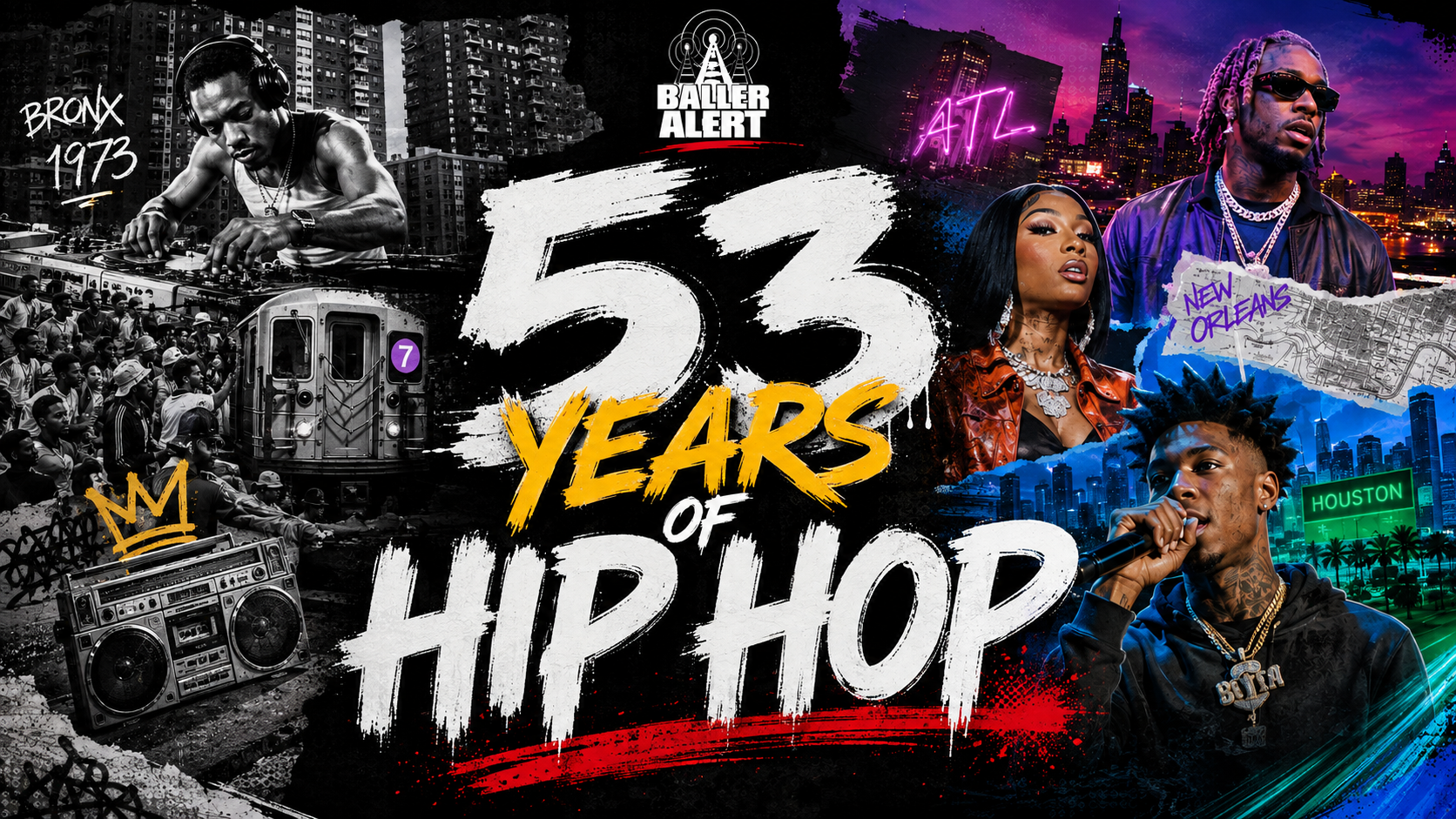
Everybody threw hip-hop a party for its 50th birthday in 2023. The documentaries ran, the anniversary shows sold out, the think pieces stacked up about where the genre had been since DJ Kool Herc plugged into a party at 1520 Sedgwick Avenue in the Bronx back in August of 1973. It was a beautiful moment, but it also had the feel of a culture pausing to catch its breath and look in the rearview mirror. Three years later, as hip-hop turns 53, the more interesting story isn’t what the genre used to be. It’s what it just became.
Because hip-hop did not spend the last three years coasting on nostalgia. It had one of the most consequential stretches in its recent history, and most of that history was written by people who weren’t even the ones getting toasted at the 50th anniversary specials. Start with the beef that redefined what a rap battle could even do. In March of 2024, Kendrick Lamar dropped a verse on Future and Metro Boomin’s “Like That” that rejected the idea of a “big three” in hip-hop and set off a chain reaction with Drake that hip-hop had not seen at that scale in a generation. By May, the two had traded a combined stack of diss tracks in the span of days, and Kendrick’s “Not Like Us” became something no diss record had really managed before.
It wasn’t just a rap battle cut. It became a cookout anthem, a chant at concerts, a certified cultural moment that broke Spotify’s single day streaming record for a hip-hop song. Kendrick performed it five times at a free concert in Compton that summer, turned it into the centerpiece of a Juneteenth Pop Out show built around unity and West Coast pride, and then took the entire thing to the Super Bowl halftime stage in February of 2025 in front of more than 100 million people, a stage most artists spend a career hoping to reach even once. The song went on to sweep Record of the Year and Song of the Year at the Grammys. Drake reportedly filed a defamation suit against his own label, Universal Music Group, alleging the label artificially inflated the record’s streaming numbers, a suit that was dismissed with an appeal still pending. Whatever side anyone landed on, the beef proved something bigger than either artist: hip-hop can still stop the internet cold when the writing is sharp enough.
That same window gave the culture one of its most important award season moments in years. At the 2025 Grammys, Doechii won Best Rap Album for her mixtape “Alligator Bites Never Heal,” becoming only the third woman in the history of the category to take that trophy home, following Lauryn Hill and Cardi B. The Tampa native beat out a stacked field that included J. Cole, Eminem, and Future and Metro Boomin, and she did it with a mixtape, not a traditional studio album, which is its own kind of statement about how hip-hop releases and consumes music now. Her acceptance speech, telling every Black girl watching that anything is possible and that she shouldn’t let anyone project stereotypes onto her, became one of the most replayed moments of the entire ceremony.
The regional map of hip-hop also got redrawn. For years there was chatter that the genre was flattening out, losing its local flavor to algorithm driven playlists that made everything sound the same. Instead, regional scenes came roaring back with distinct identities.
Kendrick’s run reignited West Coast pride in a way that had fans dancing in the streets of Los Angeles and Compton just from the sound of a beat drop. In New York, the Bronx born Sexy Drill movement, led by Cash Cobain, started bleeding out of the five boroughs and into the mainstream conversation. Detroit’s Veeze built a devoted following out of a hyper local sound that eventually broke past Michigan entirely. None of these scenes needed a major label push to travel. They spread the way hip-hop always has, from block to block, DJ to DJ, before the internet caught up and made it national.
Streaming and social media also finished rewriting how hip-hop gets made and released. Surprise drops became a real strategy rather than a gimmick, independent artists built real careers off pay what you want pricing models and direct fan engagement instead of waiting on a label deal, and platforms like TikTok became the new farm system for finding the next big voice in the genre, the same way mixtapes and DJ drops used to do it in earlier decades. Artificial intelligence started creeping into production too, with a meaningful share of hip-hop producers reportedly experimenting with AI assisted tools, which has sparked its own debate inside the culture about authenticity and what actually counts as an artist’s voice.
None of this happened because hip-hop needed permission from a birthday. It happened because the culture has never actually been about celebrating what it was. It has always been about pushing toward what it can become next, from a park jam in the Bronx to a Super Bowl stage, from a mixtape beating out legacy acts at the Grammys to a regional sound crossing state lines because the music was too good to stay local. Fifty years got the big party. Fifty three is proving the party was never really the point.
