
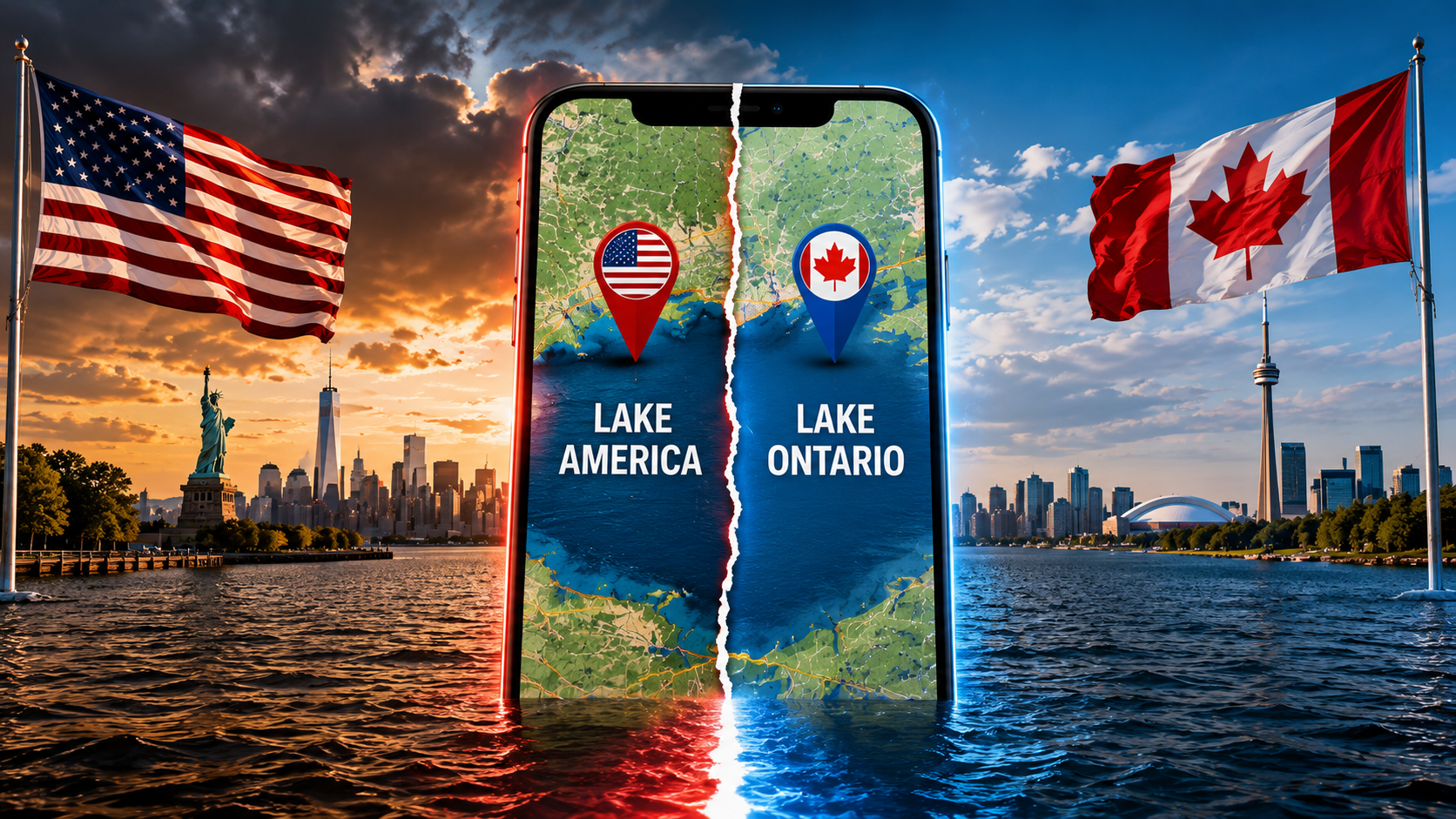
Google Maps users in the United States are waking up to a familiar Great Lake with a very unfamiliar name. Following Donald Trump’s order renaming Lake Ontario, Google has begun displaying “Lake America” for American users, turning the Lake America debate from a White House proclamation into something millions of people can actually see on their phones.
Google confirmed the change Saturday after the U.S. Geographic Names Information System, known as GNIS, formally updated the federal designation. But this is not a universal rename. The company is treating the lake differently depending on where a user is located.
“Since we update Google Maps to reflect name changes in official government sources, which is GNIS for the U.S., people using Maps in the U.S. will see ‘Lake America,’ those in Canada will continue to see ‘Lake Ontario,’ and those outside of the U.S. and Canada will see both names,” Google said in a blog post Saturday.
That means two people standing on opposite sides of the U.S.-Canada border can open the same mapping service and get different names for the same body of water.
Trump signed the executive order on August 27, directing Interior Secretary Doug Burgum and the U.S. Board on Geographic Names to rename Lake Ontario in federal records. The order also instructs federal agencies to use “Lake America” in government maps, documents and communications. According to the White House, the administration tied the move to what it described as America’s economic, environmental and security contributions to the Great Lakes.
The move landed in the middle of a much bigger fight between Washington and Ottawa.
U.S.-Canada trade negotiations recently broke down as the two countries exchanged new tariff measures covering billions of dollars in goods. Trump had publicly floated the Lake America name days before signing the order, connecting the idea directly to deteriorating business relations with Ontario and Canada. The U.S. announced 50 percent tariffs on roughly $20 billion worth of Canadian goods after negotiations collapsed, while Canada prepared retaliatory measures of its own.
Canada, unsurprisingly, did not get the memo that four centuries of naming history were suddenly up for revision.
Prime Minister Mark Carney rejected the change shortly after Trump announced it. Canadian government records trace “Ontario” to an Indigenous-language origin, with the name appearing in historical records as early as 1641, long before either modern Canada or the United States existed in their current forms.
New York Gov. Kathy Hochul was just as direct. New York shares Lake Ontario with Canada, but Trump’s order does not require state governments to adopt the federal terminology.
“New York won’t be calling it that,” Hochul said following the announcement.
Republican Vermont Gov. Phil Scott also pushed back, calling Trump’s decision “petty and disappointing.”
Ontario Premier Doug Ford went a step further and turned the disagreement into a literal roadside statement. On Saturday, Ford unveiled a large lakeside sign reading “Lake Ontario: Now and Always” in English and French.
“President Trump can call it whatever he wants, but I can tell you, the rest of the world will always call it Lake Ontario,” Ford said.
The dispute closely follows Trump’s earlier effort to rename the Gulf of Mexico as the “Gulf of America.” On his first day back in office in January 2025, Trump signed an executive order directing the federal government to adopt the new gulf name. Google eventually followed the updated U.S. government designation for American Maps users while continuing to display different naming conventions elsewhere.
The Lake Ontario situation is now following nearly the same playbook.
What makes this round more complicated is that Lake Ontario is directly shared by two countries. Trump can determine terminology used by the U.S. federal government, but the order does not give Washington authority over Canada’s geographic database, Canadian government documents, or international naming practices.
And Google may not be the last major tech company to make a change.
On Monday, August 31, Burgum said Trump had personally contacted Apple about updating the lake’s name in Apple Maps.
“The president reached out to Apple directly, so I’m sure that we may be seeing that change coming up soon to Lake America,” Burgum told Fox Business. Apple had not publicly confirmed a change as of Monday morning.
So, for now, Lake Ontario has entered a strange new reality. The water did not move, the international border did not change, and Canada certainly did not rename anything. But depending on which country your phone thinks you are standing in, even the map may disagree with the person across the lake.