

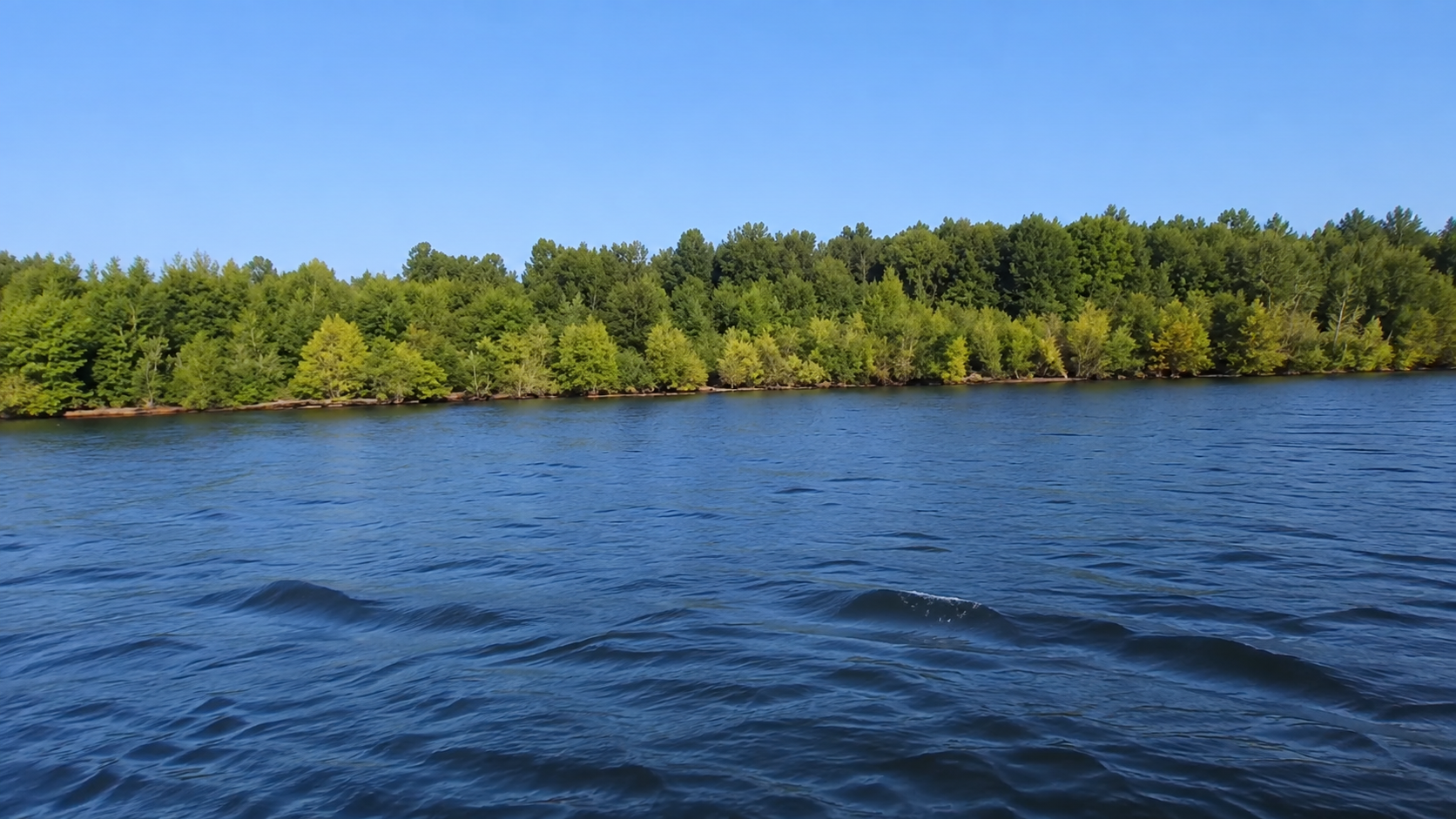
A piece of northern British Columbia’s landscape apparently decided it was done staying in one place. A massive Williston Reservoir island covered in trees and vegetation was spotted floating through the province’s largest reservoir this summer, creating a scene strange enough that even officials initially questioned whether the images were real. Then came the bigger twist: after satellite imagery confirmed the floating mass existed, it disappeared from view.
Video
The unusual formation surfaced in late July on Williston Reservoir in northern British Columbia. It measured roughly 70 meters wide and 140 meters long, giving it an estimated area of 9,800 square meters. That is roughly comparable to two NFL football fields.This was not just a few logs tangled together. Photos showed what appeared to be an intact chunk of vegetation complete with standing trees drifting across the water.
Local resident Rocky Avery received photos and video of the formation from a boater and shared them online, where the footage quickly gained attention.
“It was a pretty amazing sight to see, never seen anything like that in my 40 years in this country,” Avery told CBC News.
He also posted a warning about the unexpected visitor.
“There’s a new floating island on Williston Lake, it was by the peace arm the other day not sure where it is today lol,” he wrote on Facebook.
The internet predictably had questions. The sight even prompted comparisons to Lost, the television series built around a mysterious island that seemed to have its own rules.
Still, this was no television plot.
Satellite imagery captured on July 21 confirmed the formation was actually there. The massive object was photographed west of Finlay Bay, approximately 100 kilometers west of the W.A.C. Bennett Dam.
B.C. Hydro spokesperson Bob Gammer said the utility initially had reason to be skeptical. In an era when convincing AI-generated images can circulate online within minutes, footage of an entire forest seemingly floating across a reservoir was not exactly something officials could automatically take at face value.
“It’s certainly something we’ve not heard of before,” Gammer said. “And with not very many people reporting it, it was difficult to locate.”
Satellite evidence changed that.
Then the story got stranger.
By August 5, updated imagery no longer showed the island where officials had previously located it.
“We’ve been taking more updated snapshots, and we can’t see the object anymore. So it’s disappeared now,” Gammer said.
That does not necessarily mean thousands of square meters of trees and vegetation suddenly sank to the bottom.
“It doesn’t mean it’s gone to the bottom of the reservoir. It may have returned to a more sheltered area along the shoreline,” Gammer explained.
B.C. Hydro plans to continue watching for additional sightings through satellite imagery. Monitoring every section of Williston Reservoir directly by boat would be a major undertaking considering the enormous size of the body of water.
Williston is not an ordinary lake. Created after the W.A.C. Bennett Dam impounded the Peace River in 1968, it is British Columbia’s largest reservoir and the seventh-largest reservoir in the world by volume.
That scale also helps explain how something measuring nearly 10,000 square meters could seemingly disappear.
Officials have a working theory for where the floating island came from, and unusually high water levels may be the key.
Heavy winter snowpack followed by steady summer rain pushed Williston to levels not seen in years. The reservoir became so full that B.C. Hydro opened the W.A.C. Bennett Dam spillways during June and July to release water.
According to the utility’s theory, driftwood may have accumulated in one location along the shoreline for years. Over time, the decomposing material created enough of a base for plants and eventually trees to take root.
Then rising water changed everything.
The increased reservoir level could have lifted the enormous mass from the shoreline. Once detached, wind may have pushed the tree-covered formation into open water.
“We haven’t had a full reservoir in 14 years,” Gammer said. “We can’t pinpoint the origin of this floating island [but that’s] one explanation that seems reasonable.”
There are signs the unusually high water has been reshaping other parts of the reservoir as well. Avery said areas that boaters previously avoided because they were too shallow are now accessible.
“There’s areas we would never even drive a boat on before, and now we’re going up over top of it,” Avery said.
Floating islands themselves are not unheard of. Similar phenomena can occur when mats of vegetation, peat, roots, and organic material break free and remain buoyant. At Wisconsin’s Lake Chippewa, for example, floating peat bogs created after the reservoir was formed have become a long-running local phenomenon, including a large floating bog that periodically has to be moved when it drifts toward infrastructure.
Williston’s disappearing forest brings a more immediate problem, though: navigation.
The same high water capable of moving a giant vegetation mat can pull trees, logs, and other debris into the reservoir. Some hazards can sit partially submerged, making them difficult for boaters to see, especially once conditions become choppy.
“When it’s calm, it’s fine. You can usually see them, but you get a little bit of choppy waves, and it’s really hard to see them until you’re right on top,” Avery said.
And hitting one can turn a strange sightseeing story into an expensive emergency.
“Some are full-size trees, and it’ll do a lot of damage to your boat. So you got to be super careful.”
For now, the satellite-confirmed island has not been publicly relocated. B.C. Hydro continues to rely partly on public sightings while monitoring the massive reservoir, meaning the floating forest could still be sitting somewhere along its sprawling shoreline.
So, no, an island probably did not disappear into thin air.
But somewhere around one of Canada’s largest reservoirs, nearly two football fields worth of trees and vegetation may still be hiding in plain sight.
