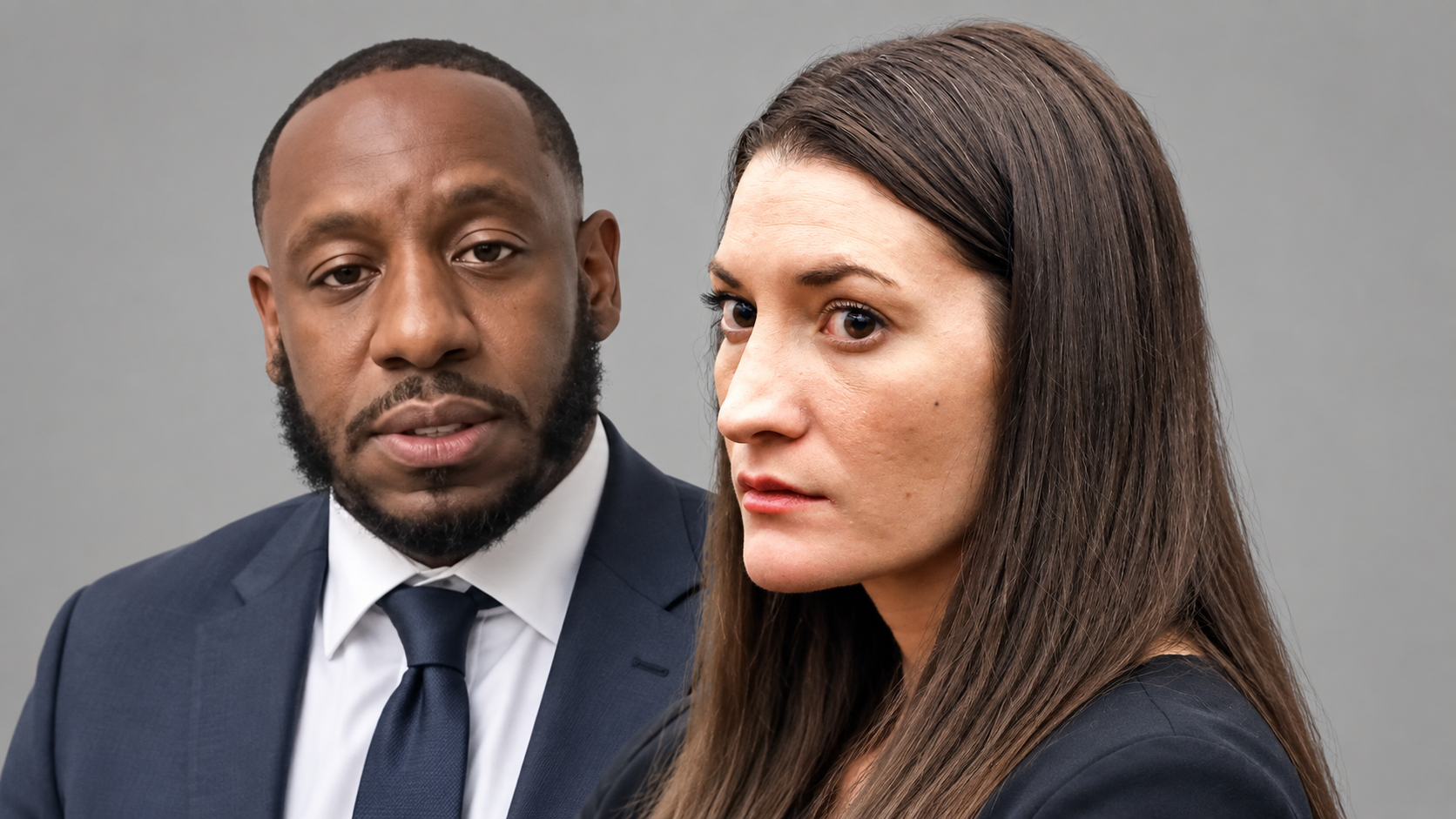
The juror at the center of the Lindsay Clancy mistrial is speaking publicly for the first time on video, but Michael P. Desronvil says the conversation should not be about him.
Video
According to Fox News, Desronvil appeared in a video aired on “Hannity” following weeks of attention surrounding the deadlocked jury in Clancy’s murder case. Rather than focus on the criticism directed at him, Desronvil asked people to remember Clancy’s three children, Cora, Dawson and Callan.
“I know the whole focus has been on me, but we want to reel everything back and put the focus on the three angels,” Desronvil said. “The ones that can’t speak for themselves, the ones that can’t defend themselves, and the ones that can’t fight the battles — and those are Cora, Dawson and Callan.”
The Lindsay Clancy mistrial was declared September 4 after seven days of jury deliberations in Plymouth Superior Court. According to CBS News, several jurors said the panel ultimately stood 11 to 1 in favor of finding Clancy not criminally responsible, with Desronvil maintaining that prosecutors had proven she should be convicted.
Clancy, a former labor and delivery nurse, was charged with murder in connection with the January 2023 deaths of 5-year-old Cora, 3-year-old Dawson and 8-month-old Callan at the family’s Duxbury, Massachusetts, home. Prosecutors alleged Clancy deliberately strangled the children with exercise bands after arranging for her then-husband, Patrick Clancy, to leave the house to pick up medicine and dinner.
The defense did not dispute during the trial that Clancy killed the children. Instead, attorney Kevin Reddington argued she was suffering from postpartum psychosis and lacked criminal responsibility at the time.
Under Massachusetts’ criminal responsibility standard, prosecutors must prove beyond a reasonable doubt that a defendant was criminally responsible once the issue is properly raised. A defendant may lack criminal responsibility when a mental disease or defect leaves that person without substantial capacity to appreciate the criminality or wrongfulness of the conduct or conform the conduct to the law.
That question became the central battle of the Lindsay Clancy trial.
Defense psychiatrist Dr. Phillip Resnick testified that he believed Clancy was “frankly psychotic” when the children died and described her condition as postpartum psychosis. Prosecutors presented competing expert testimony, including psychiatrist Dr. Avram Mack, who testified that his assessment led him to conclude Clancy could understand that her actions were wrong.
The prosecution also pointed to Clancy’s actions surrounding the killings as evidence of planning. According to The Associated Press, Clancy asked Patrick to leave the home for errands before the children were killed. Prosecutors argued those circumstances supported their position that she acted deliberately.
After the killings, Clancy attempted to take her own life and suffered injuries that left her paralyzed from the waist down, according to the Associated Press. She remains in a psychiatric hospital while the criminal case continues.
Desronvil has pushed back against claims from fellow jurors about what happened during deliberations. In a previous statement reported by CBS News, he said his position was based on the evidence presented at trial.
“I didn’t have any doubts,” Desronvil said. “As I tried to explain different possible theories during deliberation, I kept getting cut off as if I had doubts based on the evidence present.”
“Based on all the physical evidence, key witnesses, and what the prosecution presents, I thought it was enough proof that [Clancy] knew exactly what she was doing and planned,” he added.
Other jurors have publicly disputed his account. Juror Paula Devlin told CBS News that the jury was more divided when deliberations began before eventually moving toward an 11-to-1 split. Another juror, Nick Dargie, told ABC News that Desronvil did not identify evidence that persuaded the other jurors to adopt his position.
The legal fight has continued beyond the mistrial. According to The Associated Press, Reddington argued at a September 29 hearing that the evidence was insufficient to prove Clancy killed the children, a shift from the defense strategy presented during the trial. Prosecutor Shanan Buckingham rejected that argument and maintained that the evidence was sufficient for a conviction. Judge William Sullivan did not immediately rule, and no new trial date was set.
Clancy’s defense has also sought dismissal of the case and raised questions about Desronvil’s conduct during deliberations. Prosecutors still have options that include pursuing another trial, proceeding on lesser charges, or dropping the case, according to the Associated Press.
Amid those legal battles and the public scrutiny surrounding his role in the Lindsay Clancy mistrial, Desronvil used his first video statement to lean on his faith and thank those supporting him.
“I want to thank God for my Catholic faith,” he said. “I want to thank God for blessing me with the ability to love my daughter. And foremost, I would like to thank everyone, every individual, that has supported me throughout this difficult situation.”
For Desronvil, however, the lasting focus should remain on Cora, Dawson, and Callan, the three children whose deaths remain at the center of a criminal case that, more than three years later, still has no final verdict.