


Mary J. Blige built a career on making people feel something, which is exactly why her latest appearance has some fans feeling conflicted. The Queen of Hip-Hop Soul recently appeared in an advertisement for Suno, putting the Mary J. Blige AI conversation directly in the middle of one of music’s biggest debates. For an artist whose catalog is celebrated for raw emotion, heartbreak and unmistakably human vocals, seeing her attached to a generative AI music company was enough to set off backlash online.
Video
There is one important distinction. Viral posts have claimed Blige signed a multimillion-dollar agreement with Suno, but neither Blige nor Suno has confirmed that figure. What can be verified is her appearance in the company’s advertisement.In the clip, Blige listens as people in the studio demonstrate AI-assisted music technology. She acknowledges that she does not fully understand what they are discussing at first, but after listening, she calls it “pretty dope” and expresses interest in learning and experimenting with it further.
That curiosity was enough to ignite a larger argument.
For critics, the issue is bigger than one advertisement. Generative AI companies have become a flashpoint over how models are trained, whether creators are properly compensated, and what happens when software can generate finished songs at enormous scale. Suno, in particular, has faced copyright litigation over allegations involving the music used to train its technology. The legal fights surrounding generative music remain part of a much broader battle over licensing and intellectual property.
Meanwhile, some of hip-hop’s most established names are moving in the opposite direction of the backlash.
Dr. Dre recently made his position especially clear. Speaking to The New York Times alongside longtime business partner Jimmy Iovine, Dre compared resistance to AI with earlier skepticism surrounding drum machines and synthesizers.
“It’s a new tool for creativity,” Dre said.
He also said he does not view AI as a threat and revealed that he has experimented with it during production, using the technology to see what it could do with something he had already created. Dre went even further, arguing that people who see AI as threatening are those who “have trouble creating.”
That is a major statement coming from someone whose fingerprints are all over multiple generations of hip-hop production.
Iovine said there are “a lot of closet AI producers out there,” while pointing to Timbaland as another prominent producer using the technology. Timbaland has been far more public about his experimentation with AI, making the divide increasingly difficult for the music business to ignore.
Then there is Meek Mill.
Meek’s enthusiasm stretches beyond making records, but he has repeatedly praised AI as a technology. On August 31, he tweeted, “Nothing teaches me better than AI,” adding that it had helped him understand things he had asked people about for years.
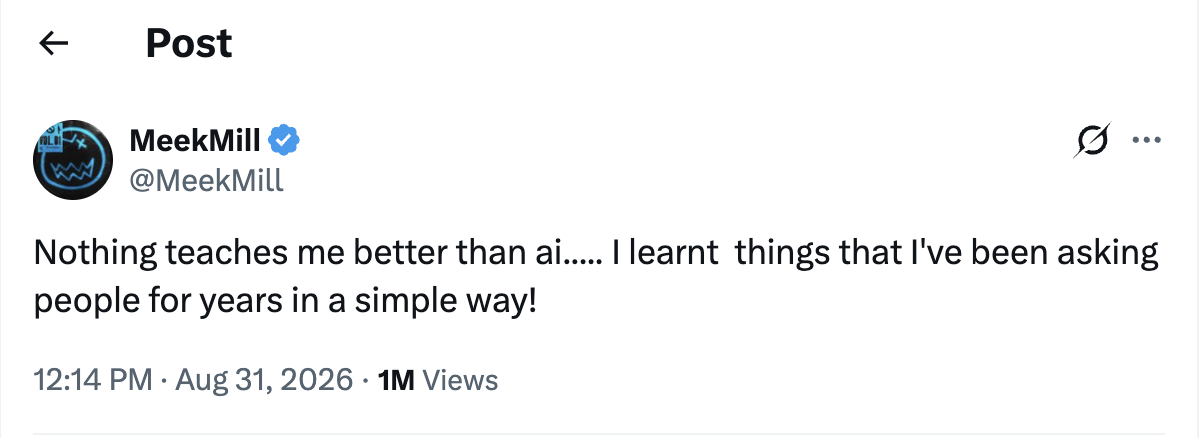
He has also discussed using AI to simplify complicated contract language before consulting legal representation and previously announced that he was working on an AI tool he believed could “change the world.” During a 2026 conversation with Lyor Cohen, Meek discussed AI and technology as part of his larger business ambitions.
His interest in AI music is not entirely new either. Back in 2023, when the AI-generated Drake and The Weeknd imitation “Heart on My Sleeve” went viral, Meek called the song “flame” and said he had listened to it repeatedly.
So why does the technology keep getting applause from some artists and smoke from fans?
The answer may be in what each side believes is actually being automated.
When Dre describes AI as another tool, he is talking about putting new technology in the hands of an established creator. From that perspective, AI can sit somewhere in the lineage of samplers, digital recording software, Auto-Tune, synthesizers and drum machines: technologies that changed how music gets made without eliminating the need for ideas.
Fans and working musicians often see a different possibility. Their concern is not simply that an artist might use software during production. It is that generative systems can potentially imitate voices, styles, and musical characteristics while producing huge amounts of material faster than human creators could ever match.
The numbers explain why that fear is not disappearing.
In July 2026, streaming service Deezer reported receiving approximately 90,000 fully AI-generated tracks every day. At its June peak, AI-generated tracks represented more than 50 percent of all new music delivered to the platform.
That does not mean half of the music people are actually listening to is AI. Far from it. Deezer says fully AI-generated music accounts for only about 1 to 3 percent of streams on its service.
There is another wrinkle. Deezer reported that up to 85 percent of streams generated by fully AI-made tracks in 2025 were fraudulent, leading the company to demonetize those streams. The platform also removes detected AI music from algorithmic recommendations and has introduced labeling intended to tell listeners when music is fully AI-generated.
The audience appears to want that transparency.
A Deezer-commissioned Ipsos survey of 9,000 people across eight countries found that 80 percent agreed fully AI-generated music should be clearly labeled. At the same time, 97 percent of respondents failed to distinguish fully AI-generated songs from human-made music in the blind test used for the survey.
That combination may explain the anxiety better than almost anything else. People overwhelmingly want to know when AI made the music, yet most could not reliably tell when it did.
And that brings the Mary J. Blige backlash into sharper focus.
The real fight is no longer about whether AI is coming to music. It is already here. The question is who controls it, who gets paid when it learns from existing work, how audiences are informed, and whether artists use AI to expand human creativity or eventually replace parts of the creative process altogether.
Mary J. Blige calling the technology “pretty dope” does not mean she is handing her career over to a machine. Dr. Dre experimenting with AI does not mean producers are disappearing tomorrow. Meek Mill praising AI does not mean every rapper is ready to let software write the bars.
Still, the direction is hard to miss. Some of the same artists who helped define what hip-hop and R&B sound like are now openly exploring technology that could reshape how the next generation makes music.
The legends are curious. The machines are getting better. The fans are skeptical.
And music’s AI argument is only getting started.
