

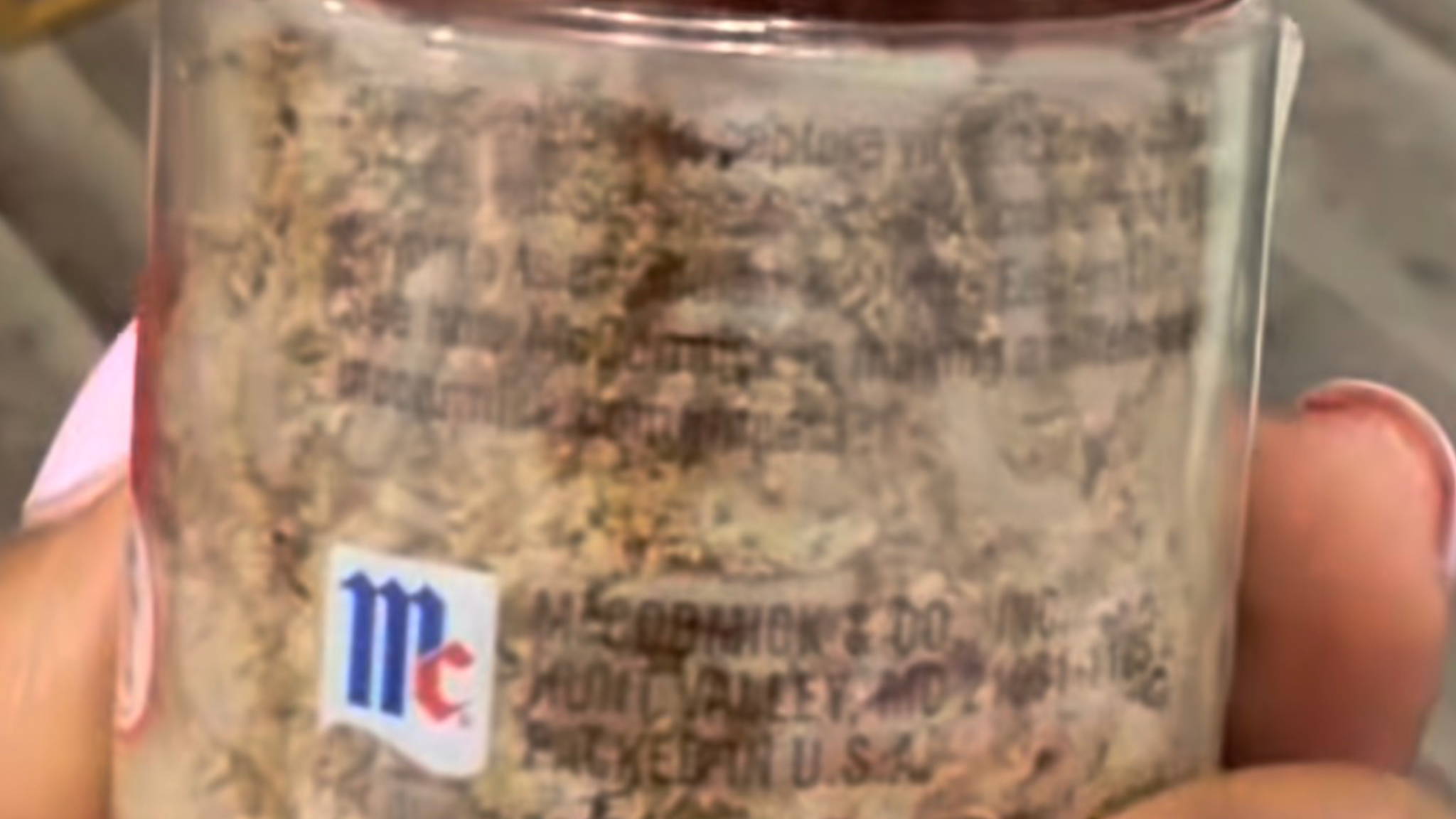
McCormick is responding publicly after a customer posted video of what she says are maggots moving around inside one of the brand’s sealed spice jars.
The video shows a jar with the red flip top lid, held up to the light, with the contents visibly moving. The woman says the container had never been opened and that the date printed on it runs to 2028. The McCormick label and the Hunt Valley, Maryland address are visible on the back.
Video:
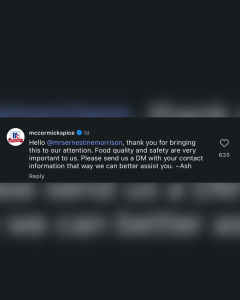
The company answered in the comments. Its account thanked her for bringing the issue to its attention, said food quality and safety are very important to the company, and asked her to send a direct message with her contact information so it could better assist her. That reply has drawn hundreds of likes and a lot of side eye, largely because a request to take the conversation private is not what people want to hear after watching something move inside a sealed jar.
Nothing here has been confirmed. McCormick has not said whether it has examined the product, whether it has identified a lot number, or whether anything was found. There is no recall. The claim is a customer’s account and a video, and the company’s public statement is the only thing it has said.
Worth understanding, though, is that a sealed jar and a 2028 date do not settle the question the way people assume. Pantry pests are a known problem in dried spices, and the insects most often found in things like paprika and chili powder are beetle and moth larvae rather than fly maggots. Eggs can be present in the raw material at the time of packaging, small enough to go unnoticed, and hatch months later in a warm cabinet. That is why a container can be genuinely sealed and still end up with something alive inside it. Whether that is what happened here is exactly what an investigation would determine, and none of that has taken place publicly.
What is not in question is why one video is traveling this fast.
Baller Alert reported earlier this week that more than fifty food recalls have been logged in the United States so far in 2026, and that the federal agencies responsible for catching contaminated food have lost more than 7,000 employees between them since January 2025. The FDA shed roughly 20 percent of its workforce, the CDC about 25 percent. In 2024 the agency employed 443 food safety inspectors to cover 36,600 food facilities, against its own estimate that it needs around 1,500. States handle roughly 90 percent of produce inspections and 75 percent of manufactured food inspections under federal grants, and those state programs were told to expect funding cuts approaching 60 percent.
The trend in outcomes is the part that lands. In 2024, the FDA investigated 26 outbreaks and identified the source in 20 of them. In 2025, it closed 11 investigations and pinned down the source in 4. Cuts also hit the labs that actually test samples, and the staff who alerted the public when something went wrong.
To be clear about what this does and does not mean: none of that has anything to do with this specific jar, and nobody should claim otherwise. Federal inspectors do not open individual spice containers on store shelves, and a contamination that occurs during packaging or in a warehouse is a manufacturer problem before it is a regulator problem. It is also true that federal recall totals for 2026 are tracking close to a normal year, which complicates the simplest version of the story.
But it explains the reaction. A few years ago, a video like this would have been an argument about one bad jar. Now it lands with an audience that has watched inspectors get cut, labs get cut, and the people whose job was to tell the public get cut, and that audience does not extend the benefit of the doubt anymore. That erosion of trust is its own cost, and it shows up in the comments under a spice jar.
If you find something in a food product, you can report it directly to the FDA through its consumer complaint system rather than relying on a company’s DMs. Keep the container, keep the lot number, and photograph the label.
