

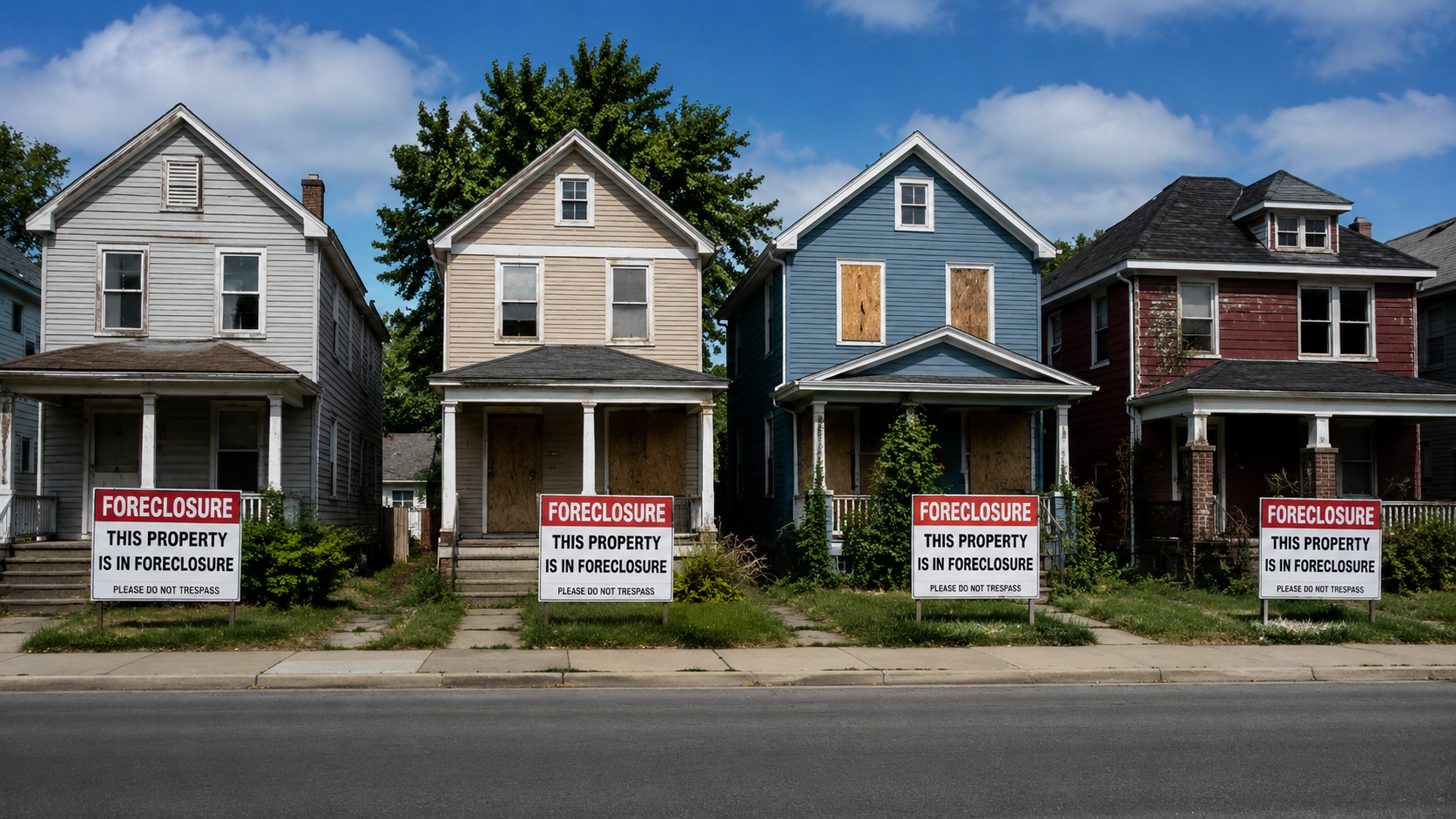
The foreclosure notices are piling up again across the country, but the numbers do not show America reliving 2008. According to ATTOM’s Mid-Year 2026 U.S. Foreclosure Market Report, 227,548 properties received a foreclosure filing during the first six months of 2026. That was 21 percent more than the same period in 2025 and 28 percent more than two years earlier. Foreclosure starts increased 18 percent, while completed foreclosures jumped 33 percent from last year. Florida recorded the nation’s highest foreclosure rate, followed by South Carolina, Indiana, Delaware and Illinois.
The rising foreclosures are not coming from one single pressure point. ABC News identified higher housing costs, property taxes, insurance expenses and the fading of pandemic-era protections among the factors squeezing homeowners. Jacob Inwald, director of litigation for economic justice at Legal Services NYC, described what that pressure looks like at the household level: “If there are economic stresses on a household, people have to make decisions,” Inwald said. “What bill am I going to pay now? What bill am I going to put off?”
Those costs have moved higher. ATTOM’s 2025 property tax analysis found that property taxes levied on single-family homes increased 3.7 percent in 2025, with the average bill reaching $4,427. The Insurance Information Institute has also documented higher insurance costs tied to inflation, rebuilding expenses, and catastrophe losses. Meanwhile, Freddie Mac reported the average 30-year fixed mortgage rate at 6.67 percent on August 13, 2026. Higher market rates do not raise payments for borrowers already locked into fixed-rate mortgages, but they have made newer mortgages more expensive and can make refinancing harder for households trying to reduce their payments.
The pandemic comparison also needs context. Federal foreclosure restrictions pushed activity to extraordinary lows beginning in 2020, and later protections continued for some borrowers. The Department of Veterans Affairs encouraged a targeted foreclosure moratorium for eligible VA loans through December 31, 2024. The federal Homeowner Assistance Fund, which can cover mortgage payments, taxes, and insurance for qualifying households, is scheduled to end in September 2026 or when individual programs exhaust their funds. That means part of the foreclosure rise reflects cases moving through a system that had been deliberately slowed by emergency protections.
Mortgage data shows real stress underneath that normalization. ICE Mortgage Technology reported more than 850,000 borrowers were at least 90 days delinquent or already in foreclosure in January, up 104,000 from a year earlier. ICE also connected increased serious delinquencies and active foreclosures to FHA loans following changes in loss mitigation guidelines. By June, however, new FHA defaults were down 15 percent from a year earlier, suggesting the newest wave of missed payments was not continuing to accelerate at the same pace.
That distinction helps explain why housing analysts are not treating rising foreclosures as proof of another nationwide housing crisis. ICE’s June data put the national mortgage delinquency rate at 3.55 percent, below the 4.16 percent recorded in June 2019. Foreclosure sales were still 46 percent below pre-pandemic levels. ATTOM also reported that 2025 foreclosure filings remained 87 percent below the nearly 2.9 million properties that received filings at the 2010 peak.
Home equity provides another buffer, although that cushion is weakening in some places. ATTOM’s first quarter equity report found 43.3 percent of mortgaged homes were equity rich, while 3.2 percent were seriously underwater. Both measures deteriorated from earlier periods, with Florida, Arizona, Colorado, North Carolina and Texas posting some of the sharpest annual declines in the share of equity-rich properties. That matters because homeowners with substantial equity often have the option to sell before a foreclosure is completed.
For Arizona homeowner Emily Arner, job loss was enough to overwhelm that financial equation. Arner told ABC News that she and her husband bought their Chandler home in early 2022.
“We just immediately fell in love with it,” Arner said. “It had a great backyard. It had a big giant tree with a lot of shade in the backyard, which obviously here, shade is very hard to come by.”
“We had no plans to ever leave,” she said. “That was going to be our home.”
After her husband lost his job, the mortgage became unsustainable.
“My husband’s job was great, and we could afford it, but once he lost his job, it was this huge mortgage payment, and we had no way to cover it, no way to pay for it, so we tried everything that we could possibly think of,” said Arner. Her family lost the home to foreclosure in September 2025 and moved into a rental nearby. “If you don’t have savings or a way to cover yourself, it absolutely can happen to you,” Arner said. “It can happen to anybody.”
The burden is also not falling evenly. ABC News’ analysis of ATTOM data found that the average number of annual foreclosures in majority nonwhite ZIP codes was more than three times the national average. “We are talking about a crisis that disproportionately impacts communities of color and the elderly because those are the communities that were targeted for bad loans in the first place,” Inwald said.
He also cautioned against assuming every current foreclosure began with today’s economy. “In some respects, that same foreclosure crisis is still going on,” Inwald said. “Many of the clients that we see have been in foreclosure or at risk of foreclosure for years. Many of the cases that are getting brought in court were brought before and did not succeed.”
For Arner, going public with her experience became a way to push back against the shame surrounding foreclosure. “It just was a tough situation to feel like such a failure, and to feel like we had just done everything wrong, and it helped me to be able to share that, and to say it’s OK to feel this way,” Arner said.
The evidence does not support calling rising foreclosures a repeat of the last housing crash, but it does show a growing group of homeowners reaching the point where higher carrying costs, income shocks, weaker equity, and fewer extraordinary relief programs can turn a manageable mortgage into a foreclosure case.
