

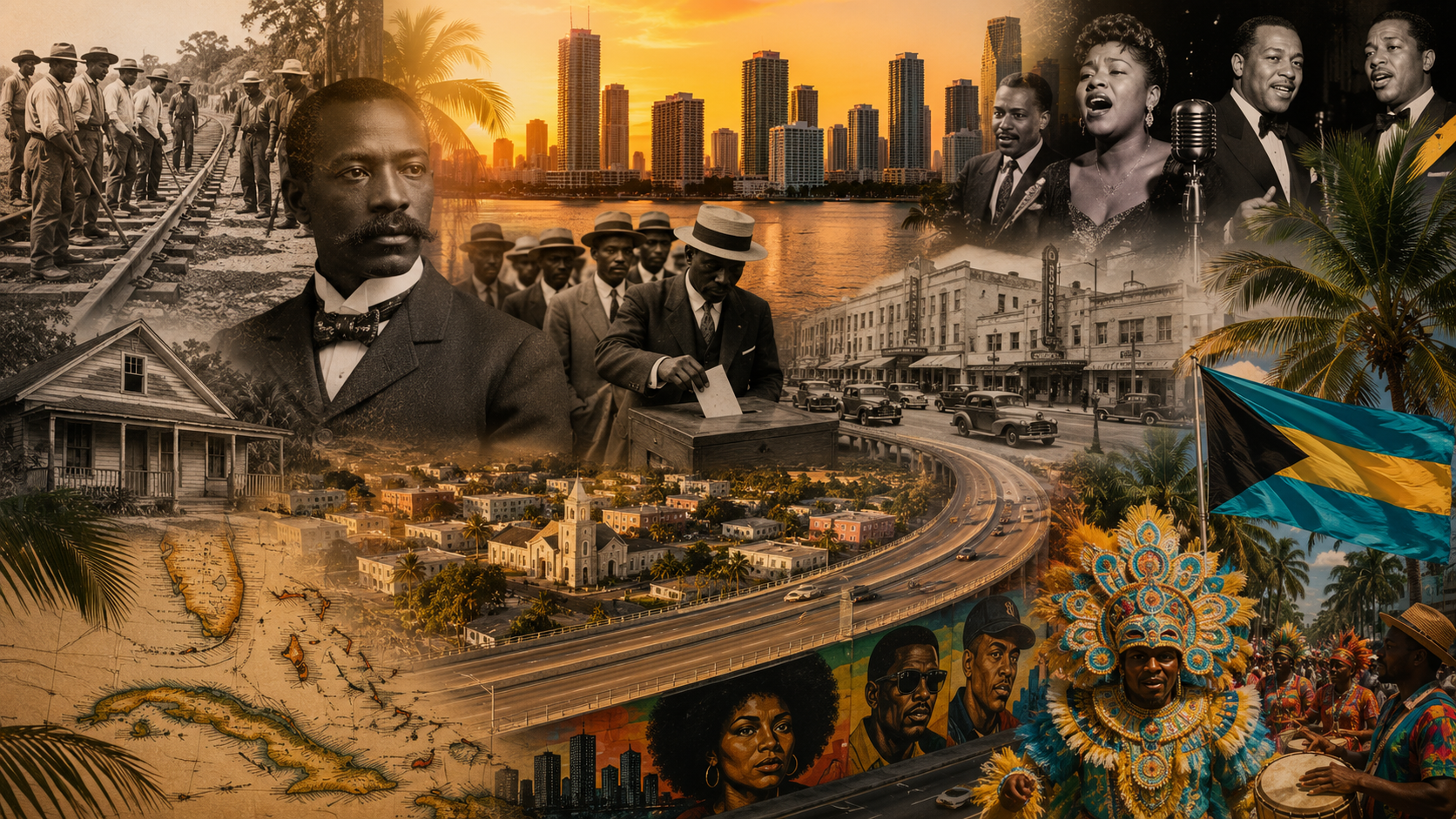
When the vote to incorporate Miami as a city took place, roughly 367 registered voters showed up to make it official. Of those voters, 162 were Black men, many of them Bahamian immigrants who had come to South Florida for construction and railroad work. That means Black voters made up close to forty four percent of the people in that room, and without them, Miami would not have hit the minimum number of registered voters required by Florida law to incorporate as a city at all. The first name recorded on Miami’s founding charter belonged to a Black man named Silas Austin. Miami literally could not have become Miami without Black participation, and specifically without the Bahamian labor force that cleared the land, built the railroad, and constructed the hotels that put the city on the map.
That contribution deserves to be said plainly on a day like today, because what came next tells a very different story about how that labor was repaid. The same Black and Caribbean workers who built Miami’s earliest hotels and infrastructure were segregated into a neighborhood originally called Colored Town, later known as Overtown. Jim Crow laws meant Black residents could work on Miami Beach, serve the tourists, and even perform for them, but they were not allowed to stay there after dark. Legendary entertainers including Cab Calloway, Ella Fitzgerald, Billie Holiday, Sam Cooke, and Nat King Cole would headline shows on Miami Beach and then travel back across the water to Overtown, where they were actually permitted to sleep, eat, and unwind. Out of that forced separation, Overtown built something remarkable anyway. By the 1930s through the 1950s, the neighborhood had earned the nickname Harlem of the South, centered around Northwest Second Avenue, a strip so packed with Black owned businesses, clubs, and theaters that it became known as Little Broadway. Sam Cooke recorded a legendary live album inside Overtown’s Harlem Square Club. The neighborhood had its own hotels, doctors, laundries, and drugstores, all Black owned, all thriving despite the conditions forced on the community around them.
Then in the 1960s, the construction of I95 tore directly through the heart of Overtown, displacing tens of thousands of residents and gutting the business district that had taken generations to build. What was once home to close to forty thousand people shrank to roughly ten thousand within a decade. The community that helped birth Miami was physically cut apart by the same city it helped create, and today much of what remains of that original footprint has been reshaped by decades of development pressure and gentrification, a pattern that continues to reshape historically Black neighborhoods across the country.
Miami’s Caribbean identity did not start or stop with Overtown, though. Because of the city’s location, just a short distance from the Bahamas, Cuba, Haiti, and Jamaica, Miami became one of the most Caribbean cities in America almost from its founding, and that influence only deepened over the following century. Nowhere is that more visible than in Coconut Grove, where Bahamian settlers built one of Miami’s earliest communities, now honored as Little Bahamas. Every year, the Coconut Grove Goombay Festival celebrates that heritage with Junkanoo, the centuries old Bahamian tradition of rhythmic drumming, elaborate costumes, and street parades that fill Grand Avenue with color and sound. What began in the late 1970s as a way to bridge divides within the Grove has grown into one of South Florida’s longest running cultural celebrations, a direct thread connecting modern Miami back to the same Bahamian community that helped incorporate the city in 1896.
Out of all of that history, struggle, segregation, displacement, and Caribbean culture holding its ground anyway, Miami built a sound and a swagger that the rest of the world eventually caught up to. Betty Wright came out of Overtown and Liberty City to become one of the defining voices of Miami soul, influencing generations of artists who came after her. Uncle Luke and 2 Live Crew put Miami bass on the national map and forced the culture to reckon with Miami as a hip-hop city in its own right, not just a vacation backdrop. Trick Daddy and Trina carried that torch forward out of Liberty City, building an entire era of Dade County sound that shaped Southern hip hop far beyond Florida’s borders. None of that happens without the neighborhoods, the churches, the cookouts, and the resilience that took root in Overtown, Liberty City, Little Haiti, and Little Bahamas long before those names meant anything to the rest of the country.
So today, on Miami’s 130th birthday, it is worth remembering that the city’s origin story is not just about railroads and orange blossoms. It is about the Black and Caribbean hands that built it, the Black votes that made it official, the segregation that tried to erase that contribution, and the culture that refused to disappear anyway. Miami’s magic was never just the beaches. It was always the people the city tried hardest to push to the margins, and who built something undeniable there instead.

More of this! Miami’s Black history will not be erased! The real history of Fisher Island originally owned by Dana Dorsey. It’s so much we have to keep alive!