

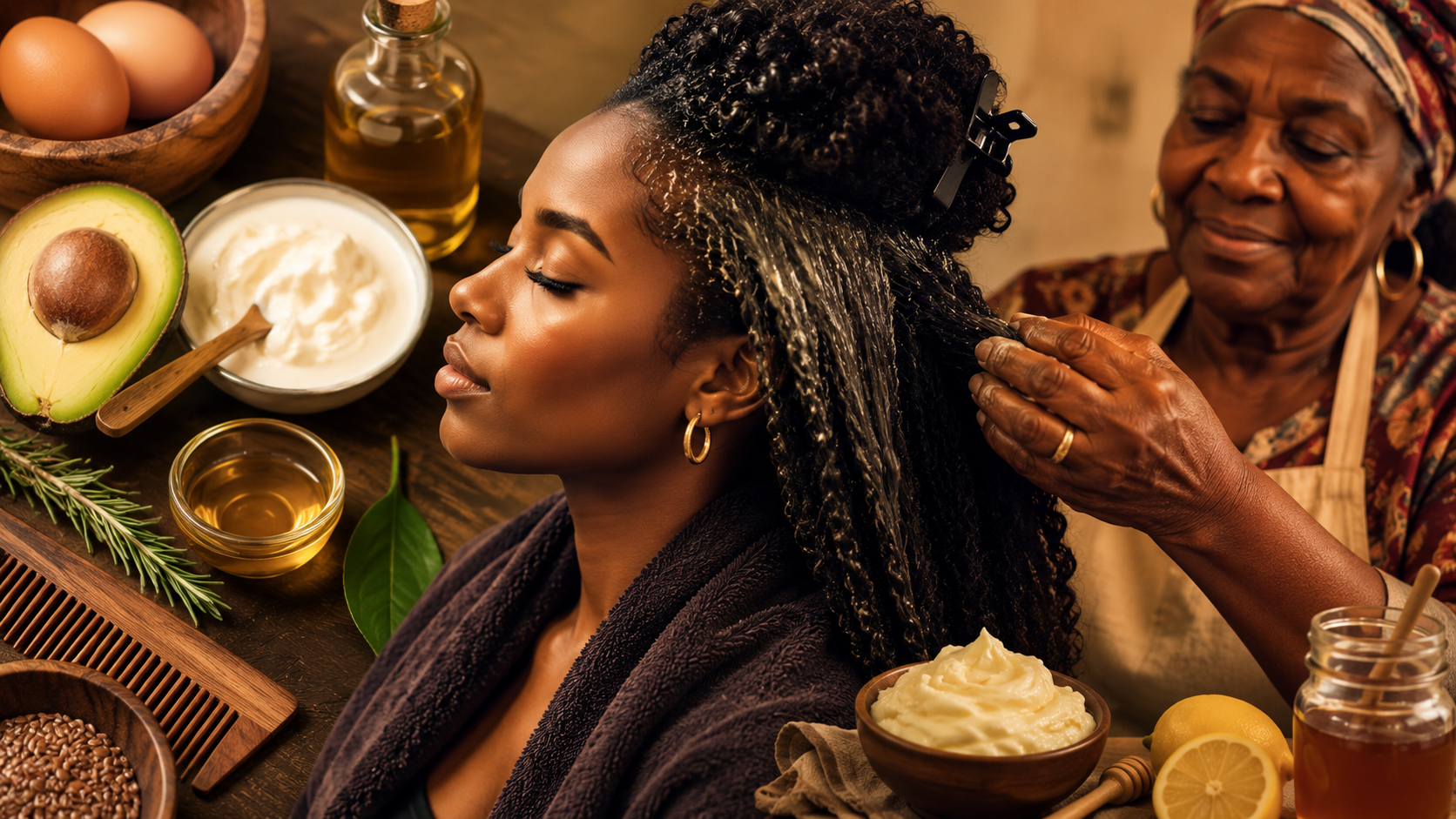
Before wash day became a hashtag and curl creams got their own dedicated aisle, Black hair care already had its own sacred system, passed down through kitchens, porches, and Saturday afternoons spent between somebody’s knees. Long before “hair health” became a buzzword, our mothers and grandmothers were already practicing rituals that modern hair science is only now catching up to. Turns out a lot of what felt like tradition back then was actually technique all along.
@bluemagichaircareSealing in moisture for every style has been our specialty for generations. 🔒♬ original sound – Blue Magic
Scalp greasing might be the most iconic ritual of them all. Anyone who grew up getting their hair done remembers the jar, whether it was Blue Magic, Royal Crown, Dixie Peach, or whatever tin happened to be sitting on the bathroom shelf, and the specific ceremony of a dollop being warmed between somebody’s palms before it hit your scalp section by section. It felt like a treat at the time, but it was also functional. Natural hair is prone to dryness, and that grease, however heavy handed it sometimes got, was doing real work to seal in moisture and keep the scalp from drying out. Today’s version just comes in a cuter bottle labeled as a hair oil or scalp serum, but the goal has not changed one bit.
Then there was the hot comb, heating up on the stove while Sunday dinner cooked on the back burners, an entire multitasking operation happening in one kitchen. The unofficial soundtrack of the ritual was always the same, someone reminding you to hold your ear so you wouldn’t get burned, followed by that unmistakable sizzle when hot metal met greased hair. It turned kinks into silk for a Sunday morning at church, and while today’s flat irons come with digital temperature settings and ceramic plates instead of an open flame, the basic goal of using heat to transform texture has stuck around for generations, minus a few singed ears along the way.
Wash day itself deserves its own spot in the hall of fame, because it was never really just about washing hair. It was an entire event, stretching across hours and sometimes an entire afternoon, complete with detangling, conditioning, styling, and usually a movie playing in the background to make the process feel shorter than it actually was. What made it a ritual instead of a chore was the intimacy built into it, the time spent sitting on a pillow between somebody’s legs while they worked through your hair with patience that felt like love in physical form. Modern wash day routines still follow that same rhythm today, shampoo, deep condition, detangle, style, except now it comes with a name people put on their calendars and treat as legitimate self care instead of just Saturday obligation.
Protective styling has deep roots too, long before it became a trending topic online. Braids, cornrows, and twists were never just about convenience, they were a way to protect hair from daily manipulation and heat damage while still keeping it styled and neat. Those same styles are still considered some of the healthiest options for hair growth and retention today, proof that what looked like a practical choice decades ago was actually solid hair care logic the whole time.
Even the less glamorous rituals hold up under a second look. Scratching the scalp with a rat tail comb to lift dandruff and buildup might not be recommended by today’s dermatologists in quite the same rough form, but the instinct behind it, addressing scalp health as the actual foundation of healthy hair, is exactly what modern scalp care trends are built around now. We just call it exfoliating instead of scratching, and it comes with a much gentler tool.
What ties all of these rituals together is something that never really needed modernizing in the first place, the relationship behind the routine. Hair care in Black households was rarely just about hair. It was time spent between a mother and a daughter, a grandmother and a grandchild, conversation happening in between parts and product, life lessons slipped in right alongside styling tips. That part of the tradition has not aged a single day, and no trending product or salon technique will ever be able to replicate it.
So the next time someone reaches for a trendy hair oil or books a scalp treatment at a salon, it is worth remembering that a lot of this was already figured out decades ago in somebody’s kitchen, with a jar of grease, a hot comb, and a whole lot of patience. Some things really do hold up.
