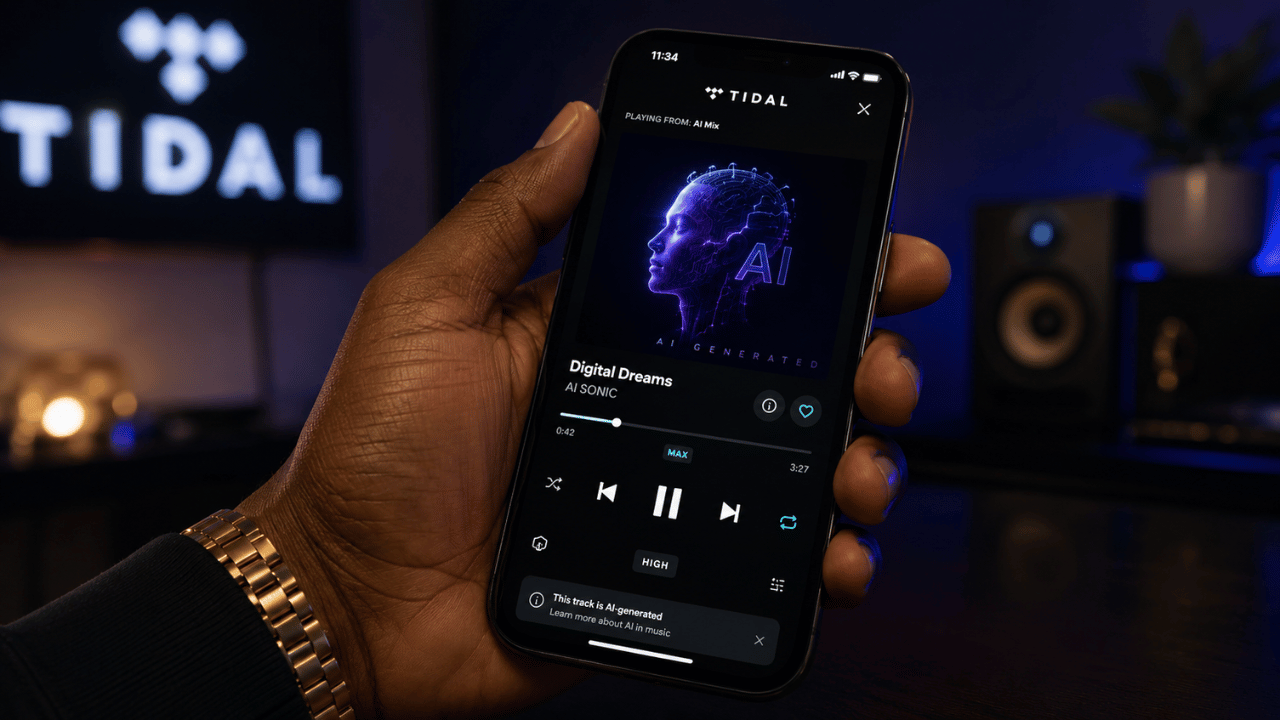
TIDAL is officially banning fully AI-generated music from its streaming platform beginning December 9, 2026, escalating its efforts to protect recording artists, preserve human creativity, and prevent millions of artificially produced songs from overwhelming its music catalog.
The streaming service announced the decision Tuesday, November 24, after spending several months identifying, labeling, and stripping entirely AI-generated recordings of their ability to earn royalties. Now, those songs are losing their place on the platform altogether.
“Starting December 9, any wholly AI-generated track that’s submitted to Tidal will be rejected and removed from our platform,” the company announced.
The decision extends beyond new releases. TIDAL will also begin removing existing recordings identified as entirely generated by artificial intelligence, meaning songs already available to subscribers could disappear from their libraries.
The numbers behind the company’s decision reveal just how rapidly artificial intelligence has infiltrated the music streaming business.
According to figures released by TIDAL, approximately 27 million tracks in its catalog have been identified as AI-generated. Roughly 43% of the music delivered to the platform over the past 90 days was determined to have been created entirely using artificial intelligence.
On November 6 alone, that percentage climbed above 60%.


Made to order and shipped to your door.
Despite the enormous volume of AI-generated music entering the platform, listener demand appears considerably smaller. TIDAL reported that 96% of its tracks carrying an AI identification badge received zero streams during the previous 90 days.
Approximately 94% of those flagged recordings were attributed to Suno, an artificial intelligence music generator capable of producing complete songs from written instructions.
For independent musicians, the explosion of synthetic recordings presents another challenge in an industry where securing visibility and building an audience can already require years of work and significant financial investment.
Generative AI technology allows users to produce songs without traditional recording sessions, musicians, vocalists, or expensive studio equipment. That accessibility also makes it possible to distribute large quantities of music in relatively short periods.
Artist impersonation has become another concern. TIDAL has already removed more than 65,000 tracks associated with suspected artist-name impersonation, a practice that can mislead fans searching for legitimate releases from their favorite performers.
The company previously introduced restrictions on AI-generated music in June, with its labeling system rolling out in July. Recordings identified as entirely artificial were made ineligible for streaming royalties, although subscribers could still listen to them.
Removing financial incentives, however, did not prevent millions of additional artificial recordings from reaching streaming services.
TIDAL’s latest policy will rely on information supplied by music distributors and detection technology designed to identify recordings produced entirely by generative AI. The company has partnered with audio technology provider Ircam Amplify to help identify synthetic recordings.
Musicians who incorporate artificial intelligence into their creative processes are not automatically facing removal. The announced ban focuses on recordings generated entirely by AI rather than music created by people who use artificial intelligence as a production tool.
That leaves room for artists who experiment with emerging technology while maintaining human involvement in their songwriting, performances, and production.
The crackdown comes as competing streaming services develop their own approaches to AI-generated music.
Earlier this month, French streaming platform Deezer announced plans to introduce a feature allowing subscribers to exclude fully artificial recordings from their search results. The company also reported receiving nearly 90,000 entirely AI-generated tracks daily.
A survey commissioned by Deezer and conducted by Ipsos found that 80% of respondents supported clearly identifying music created entirely by artificial intelligence.
The debate also extends to how streaming revenue is distributed. Fraudulent streams can reduce the money available to legitimate rights holders, while unauthorized synthetic recordings can complicate how artists manage their identities and intellectual property.
TIDAL, which Jay-Z helped position as an artist-focused alternative to competing streaming services following its 2015 relaunch, is now taking a more restrictive approach to the presence of artificial recordings.
For subscribers, the upcoming changes could mean discovering fewer machine-generated songs while browsing the platform. For independent musicians, the policy could reduce competition from mass-produced synthetic releases.
Questions remain about how accurately detection systems can distinguish human performances from artificial recordings, particularly as music generation technology becomes increasingly sophisticated.