

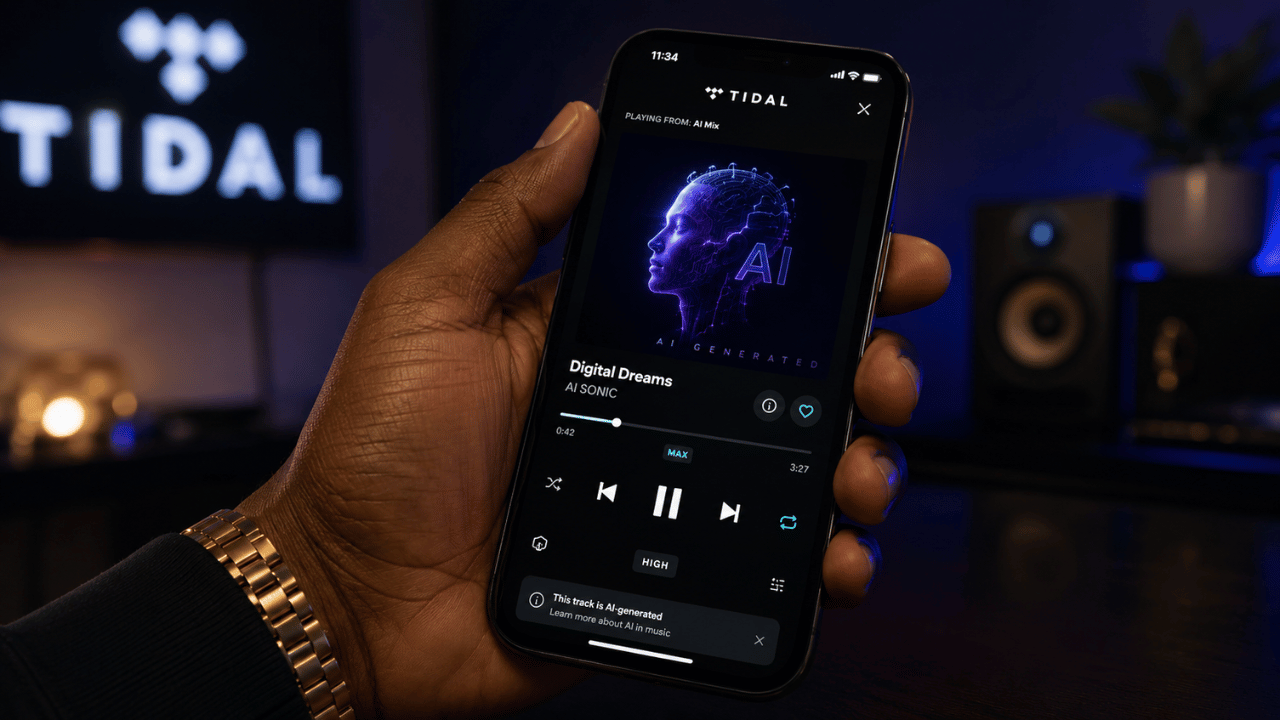
Tidal is putting AI music on notice, and for creators, this could be one of the clearest signs yet that streaming platforms are starting to decide what counts as real creative labor, and what gets paid.
According to Variety, the music streaming service announced Monday that songs wholly or substantially created with artificial intelligence will have to be labeled as AI-generated. Even bigger? Fully AI-generated songs will not be eligible for royalties. The policy is set to roll out July 15 and will also apply to Tidal Upload, the platform’s independent artist franchise.
Tidal is not banning AI music altogether, but it is making one thing clear: if a track is fully computer-made, the bag may not be coming with it. The platform said it will also remove AI-generated music tied to “fraudulent activity,” including songs that impersonate established artists or try to “deceive listeners.”
“Artists should have the freedom to create with AI tools, and listeners should have the autonomy to choose the type of content they consume,” Tidal’s new AI policy reads. “Due to the problems associated with the influx of AI-generated content, we will hold AI-generated content to a higher standard of content integrity.”
For human creators, especially independent artists already fighting for visibility and fair payouts, this could be a major shift. Streaming fraud has become a growing concern as AI tools make it easier for people to pump out hundreds or thousands of tracks, upload them through distributors, and attempt to game the royalty system. The issue is not just whether AI can make music. The issue is whether fake songs, fake artists, fake voices, and fake streams are taking money and attention away from real people trying to build careers.
Tidal said AI tools have been part of music production for years, but they have recently become “more commonplace and advanced.” The company plans to begin with labels for wholly AI-generated songs before expanding to music substantially generated with AI “as AI-detection methods become more reliable.”
Robert Andersen, a principal designer at Tidal developer Block, also wrote on X that Tidal receives “an overwhelming amount of AI-generated music from 3rd party distributors.”
“It has been clear for some time that we need to evolve our platform and standards to deal with this new type of submission to our catalog,” Andersen wrote, “so today we are announcing an AI-generated music policy designed to provide a great experience for our listeners, while protecting the authenticity and livelihoods of artists and rightholders.”
That “livelihoods” part is where creators should really be locked in. Tidal’s move lands as other platforms are also wrestling with AI music. Spotify has announced AI protections, including a music spam filter aimed at stopping bad actors from diluting the royalty pool. Spotify has also said it remains a “platform for licensed music where royalties are paid based on listener engagement, and all music is treated equally, regardless of the tools used to make it.”
Meanwhile, Deezer has reported that AI music is flooding platforms at a wild pace. The company previously said it was receiving more than 50,000 fully AI-generated tracks per day and found that up to 70% of streams generated by fully AI-generated tracks were fraudulent. Deezer later said that, as of April 2026, it was receiving more than 75,000 AI-generated songs daily, representing more than 44% of daily uploads.
The fraud concerns are not just industry chatter, either. In March, the U.S. Department of Justice announced that North Carolina man Michael Smith pleaded guilty in an AI-assisted streaming fraud case after prosecutors said he used AI to create hundreds of thousands of songs and bots to stream them billions of times. Prosecutors said the scheme fraudulently generated more than $8 million in royalties.
The copyright fight is also heating up. In 2024, the RIAA announced lawsuits against AI music companies Suno and Udio, accusing them of using copyrighted sound recordings without permission to train generative AI models. That matters for creators because the battle is not only about streaming payouts. It is also about whether artists, songwriters, producers, and rights holders will have control over how their work is used to train technology that could later compete with them.
Tidal acknowledged that the debate over officially licensed AI-generated music is far from over, saying “this debate will continue as the technology advances and rightsholders and AI music platforms develop licensing models.”
Still, the platform made its current stance clear: “Tidal’s priority is ensuring royalties go to original works directly produced, written, and performed by people,” the company said. “We will therefore not knowingly attribute royalties to music we identify as wholly AI-generated.”
For creators, this could be the beginning of a new streaming era where disclosure, proof of human authorship, rights clearance, and distributor accountability matter more than ever. Artists using AI as a tool may need to keep cleaner records, be transparent with distributors, and understand each platform’s rules before uploading. But for creators worried about AI slop flooding the market, Tidal’s policy sends a loud message: the robots can upload, but that does not mean they automatically get to touch the royalty pool.
