

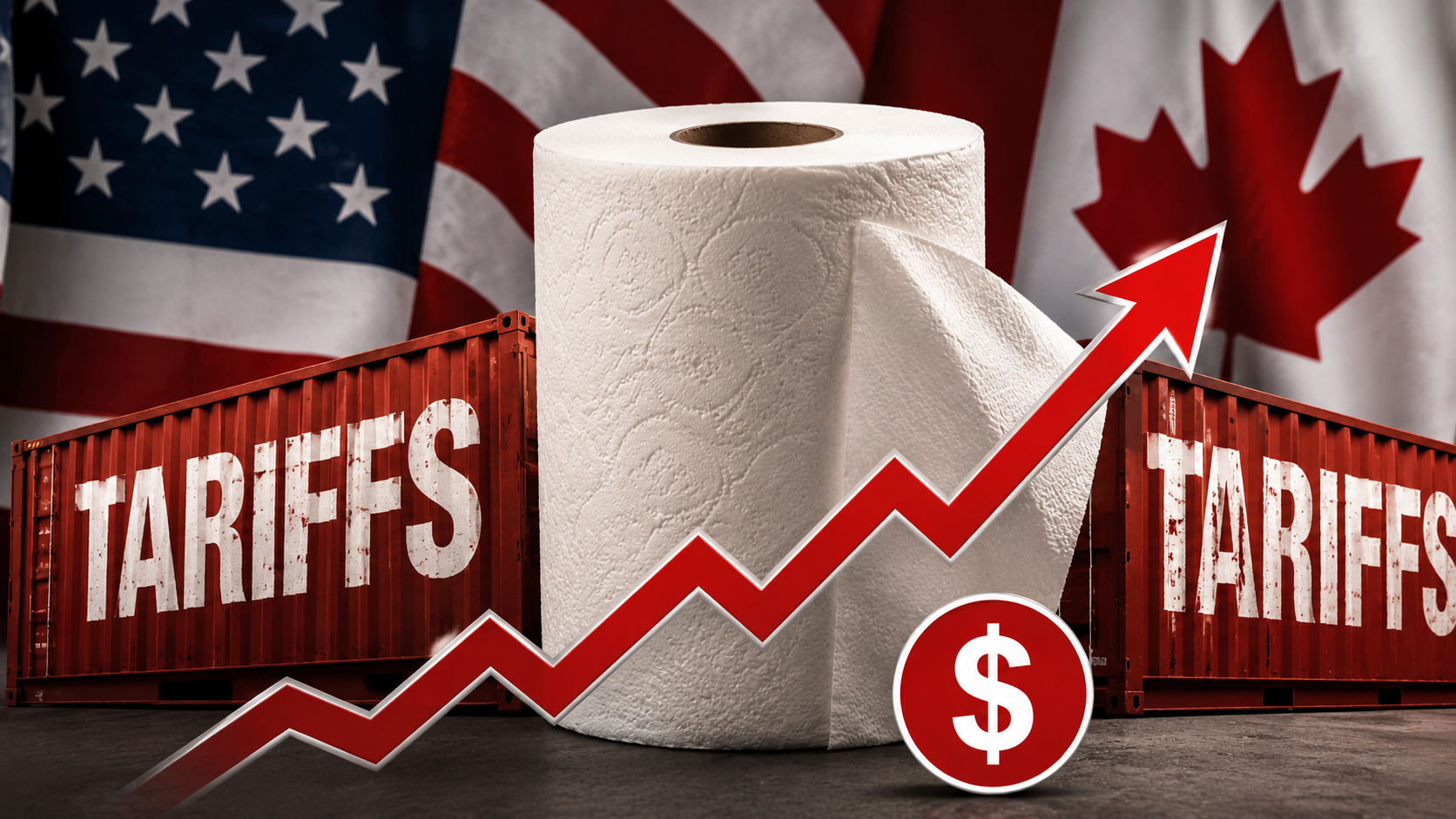
The U.S.-Canada trade fight is getting so deep that even a trip down the toilet paper aisle could come with a bigger bill. New toilet paper tariffs are putting one of North America’s most basic household products in the middle of an escalating trade dispute after negotiations between the United States and Canada collapsed. Now, tariffs are stacking up across the border, and the paper industry is one place where consumers could eventually feel the fallout.
Canada announced that beginning September 8, it will impose new tariffs of 15%, 25% and 50% on a wide range of American products. The move comes after the U.S. imposed a 50% tariff on $27.6 billion worth of Canadian goods beginning August 22. Canadian officials say their response will match Washington “dollar for dollar” and rate for rate.
Paper products landed directly in the crossfire.
Canada’s official tariff list places a 25% duty on U.S. toilet paper as well as handkerchiefs, cleansing tissues, facial tissues and towels. Other paper products, including some tablecloths, napkins and additional paper categories, face tariffs as high as 50%.
The Guardian described one of the affected paper categories as “toilet paper or face tissue stock.”
That may sound like a niche trade issue until you look at how connected the two countries are when it comes to keeping bathroom shelves stocked.
The United States imported roughly $328.2 million worth of toilet paper from Canada in 2024, according to World Bank trade data. Canada was easily the biggest foreign source of toilet paper for the U.S. that year. Overall, America imported approximately $509.7 million worth of toilet paper worldwide.
The relationship also runs in both directions. Canada imported nearly $189.4 million worth of U.S. toilet paper in 2024, showing just how intertwined the North American paper market has become.
That means tariffs are not simply hitting finished rolls sitting on a truck headed across the border. Paper manufacturers operate through a supply network in which raw materials, production, and finished goods can cross national lines, raising the possibility that companies will absorb some added costs or eventually pass them along to retailers and customers.
Major consumer brands have already set a precedent for responding to tariff pressure with higher prices.
Procter & Gamble, the company behind Charmin, said in 2025 that tariffs were contributing to increased costs. The consumer-products giant announced price increases on roughly one-quarter of its U.S. products as it projected about $1 billion in additional pre-tax tariff-related costs during its 2026 fiscal year.
So, while nobody needs to start panic-buying rolls, the trade fight is increasingly reaching products people purchase without giving international policy much thought.
And toilet paper is only part of the story.
Canada’s latest countermeasures cover sectors including dairy, seafood, appliances, steel, aluminum-related products, agricultural equipment, pulp, paper and electronics. The Canadian government says the new tariffs will cover $27.6 billion in U.S. imports.
Seafood has become another political pressure point. Canada’s tariff package includes 25% duties on multiple fish and seafood products, an especially sensitive issue for American states where fishing plays a major economic role.
Maine Republican Sen. Susan Collins criticized Trump’s latest tariff escalation, calling it “a mistake.”
The fight also stretches into dairy and alcohol, industries that have repeatedly become bargaining chips in U.S.-Canada trade disputes.
Canadian provinces previously removed American alcohol from some government-controlled shelves in response to earlier U.S. tariffs. Nova Scotia Premier Tim Houston made clear that simply restoring those products would not guarantee customers were ready to welcome them back.
“Whether Nova Scotians or Canadians will actually buy it when it’s back on the shelves, that’s a whole other discussion.”
That consumer reaction adds another layer to the fight. Tariffs can be changed through negotiations, but buying habits, brand loyalty and public sentiment do not necessarily switch back overnight.
Meanwhile, both governments are framing the dispute very differently.
Canada says its latest tariffs are a direct response to Washington’s new measures and describes its counterattack as proportional. The Canadian government also announced billions of dollars in additional assistance intended to support workers and businesses affected by the trade fight.
The Trump administration, however, has pushed back against warnings that Americans will ultimately pay the price.
U.S. Trade Representative Jamieson Greer said “there’s no possible way” the trade dispute with Canada would hurt American consumers.
“The fundamentals are good,” he said. “I don’t think this is going to affect anything.”
Companies facing higher import costs will ultimately determine how much of that confidence makes it all the way to the checkout line.
For consumers, that is where the trade war becomes much less theoretical.
Tariffs on cars, dairy, seafood and industrial materials may dominate negotiations between governments, but toilet paper brings the fight directly into an aisle almost every household visits. With Canada supplying hundreds of millions of dollars worth of toilet paper to the United States and both countries targeting each other’s paper industries, one of the most ordinary purchases in America now sits inside an unusually complicated international showdown.
The real question is not whether tariffs exist. They do.
It is how much of the added cost eventually lands on shoppers.

NONE OF THIS HAS ANYTHING TO DO WITH MAPLE BAR DONUTS RETURNING TO KRISPY KREME NOR CREAM CHEESE STUFFED FRENCH TOAST RETURNING TO INTERNATIONAL HOUSE OF PANCAKES!!!
MAPLE BAR DONUTS ARE NOT TO BE REFERRED TO AS “ICED FLUFF DONUTS” AT WAL-MART!!!
HOW ABOUT SOME CLEMENCY FOR YOUR GRAMMY AWARD WINNING MUSIC RECORDING ARTIST, TORY LANEZ, THERE PRIME MINISTER!!!???
YOU COULD’VE CHOSE AN ASIAN WOMAN BY THE WAY!!!
HOW ABOUT SOME CLEMENCY FOR YOUR GRAMMY AWARD WINNING MUSIC RECORDING ARTIST, TORY LANEZ, THERE PRIME MINISTER!!!???