

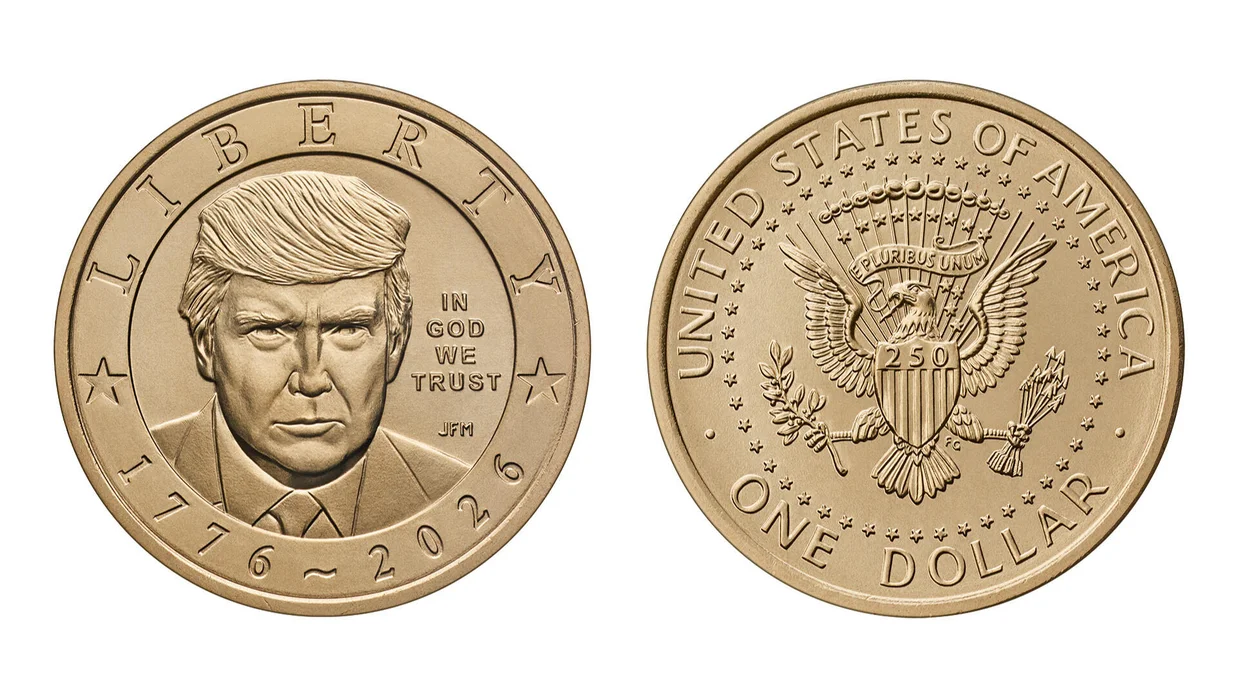
Donald Trump’s likeness is officially on U.S. money, with collectors now paying more than face value for a newly released $1 coin tied to America’s 250th anniversary. According to the U.S. Mint, the Trump $1 coin is being sold in rolls of 25 for $61 and bags of 100 for $154.50. That works out to roughly $2.44 per coin in a roll and about $1.55 per coin when purchased by the bag. As of September 3, the Mint’s online store listed the product as backordered while allowing customers to continue placing orders.
Despite its shiny gold appearance, there is no actual gold in the Trump $1 coin. The Mint’s official specifications show the coin is made primarily of copper, along with 6 percent zinc, 3.5 percent manganese, and 2 percent nickel. It weighs 8.1 grams and was struck at the Philadelphia Mint.
Trump’s portrait appears on the front alongside “LIBERTY,” “IN GOD WE TRUST” and “1776 ~ 2026.” The reverse carries the Presidential Seal, including the eagle, olive branch and arrows, along with a “250” marking recognizing the United States semiquincentennial. The Mint says Chief Engraver Joseph Menna designed the portrait using an official White House photograph by Daniel Torok as inspiration.
The Mint is also turning part of the release into a chase for collectors. According to its product listing, 250,000 coins carrying a special “July 4th” privy mark were randomly placed into the rolls and bags being sold to the public. Those versions were struck on July 4 at the Philadelphia Mint.
Although the pieces have not been released into general circulation, the Mint says they can still be spent as legal tender. The agency is simultaneously marketing them as collectibles, saying, “Created to celebrate this historic national milestone, these special circulating dollar coins combine everyday American coinage with a once-in-a-generation anniversary design destined to become a standout addition to modern collections.”
The legal path behind the Trump $1 coin is more complicated than the average commemorative release. According to the federal law published by GovInfo, the Circulating Collectible Coin Redesign Act of 2020 gave the Treasury secretary authority to redesign certain coins issued during 2026 to celebrate the nation’s 250th anniversary. The law specifically authorizes special $1 coins with designs emblematic of the semiquincentennial.
That same statute says a portrait of a living person cannot appear on the reverse of coins issued under the program. Trump’s portrait appears on the obverse. The law does not specifically name Trump or direct Treasury to place his likeness on a coin, making the design a decision made under the broader authority Congress granted for the 2026 redesign program.
There is also historical precedent for a living occupant of the White House appearing on American coinage. According to the U.S. Mint’s historical record, a 1926 half dollar commemorating the 150th anniversary of American independence featured George Washington and Calvin Coolidge. The Mint says Coolidge’s appearance marked the first time a U.S. president was depicted on a coin during his lifetime.
The Trump coin arrives amid a broader effort by some Republican lawmakers and administration officials to place his image on additional forms of money. In February 2025, Rep. Joe Wilson of South Carolina introduced the Donald J. Trump $250 Bill Act. According to Wilson’s congressional office, the proposal would create a new $250 Federal Reserve note carrying Trump’s portrait and carve out an exception to the law restricting living people from appearing on paper currency.
GovInfo records for H.R. 1761 show the $250 proposal was introduced on February 27, 2025, and referred to the House Financial Services Committee. In May 2026, Axios reported that the Bureau of Engraving and Printing was conducting planning related to the proposed note. Wilson’s spokesman also told Axios that Trump and Treasury Secretary Scott Bessent had discussed their support for the idea with Wilson on multiple occasions.
A second proposal targets one of America’s most recognizable bills. Rep. Brandon Gill of Texas introduced the Golden Age Act of 2025, which would eventually replace Benjamin Franklin’s portrait on the $100 bill with Trump’s. According to GovInfo’s congressional record, H.R. 1790 was introduced in March 2025 and referred to the House Financial Services Committee.
Paper money presents a clearer statutory barrier. Under federal law cited by the Legal Information Institute, only the portrait of a deceased individual may appear on U.S. currency and securities. Congress would therefore need to change existing law before a Trump $100 or $250 note could move from proposal to actual currency.
For now, the Trump $1 coin has moved beyond the concept stage. It is minted, legal tender, and available for purchase, putting Trump’s image into a piece of official American coinage while the larger campaign to place his portrait on paper money remains unfinished.
