

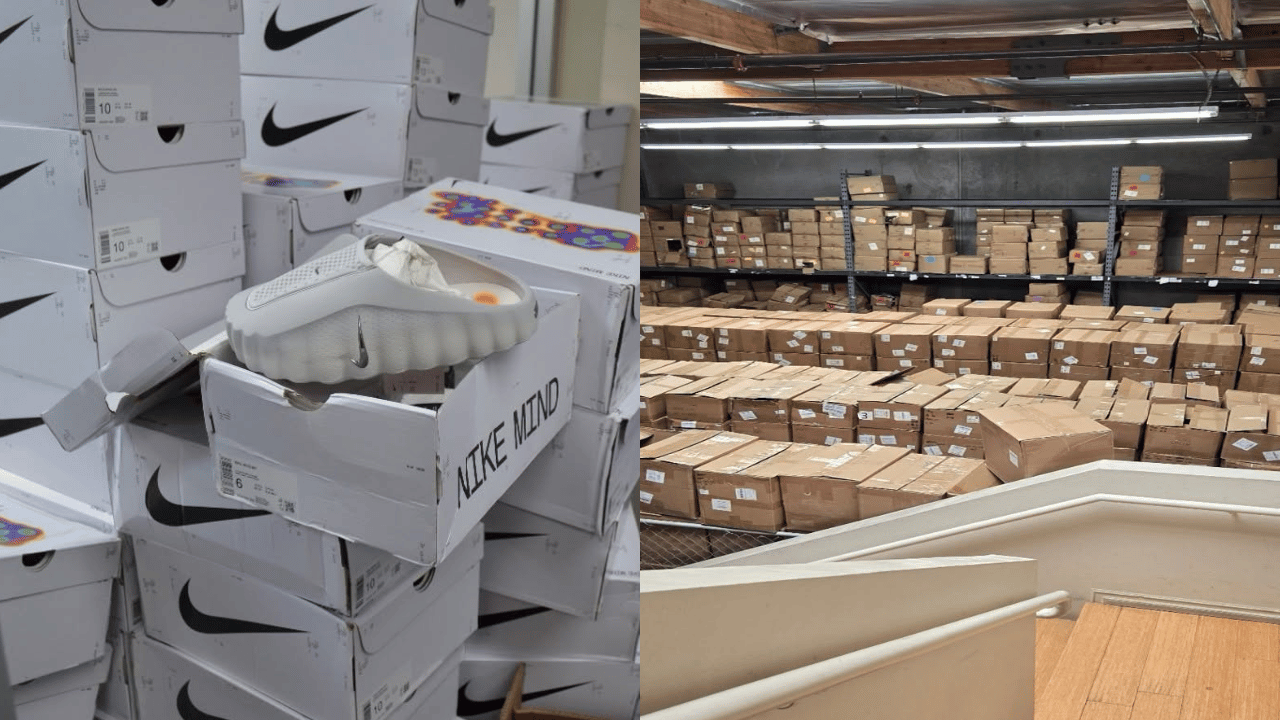
A Southern California warehouse raid turned up nearly 26,000 fake Nike, Adidas and other streetwear items, putting another massive counterfeit haul in the spotlight as sneaker related seizures continue surfacing across the country.
According to a Los Angeles County Sheriff’s Department announcement, its Counterfeit and Piracy Enforcement Team received information in early August about a shipment intercepted and inspected at a port of entry. Investigators said the cargo contained large quantities of counterfeit Nike, Adidas, and other branded streetwear and was addressed to a commercial warehouse in the 11600 block of Goldring Road in Arcadia, California.
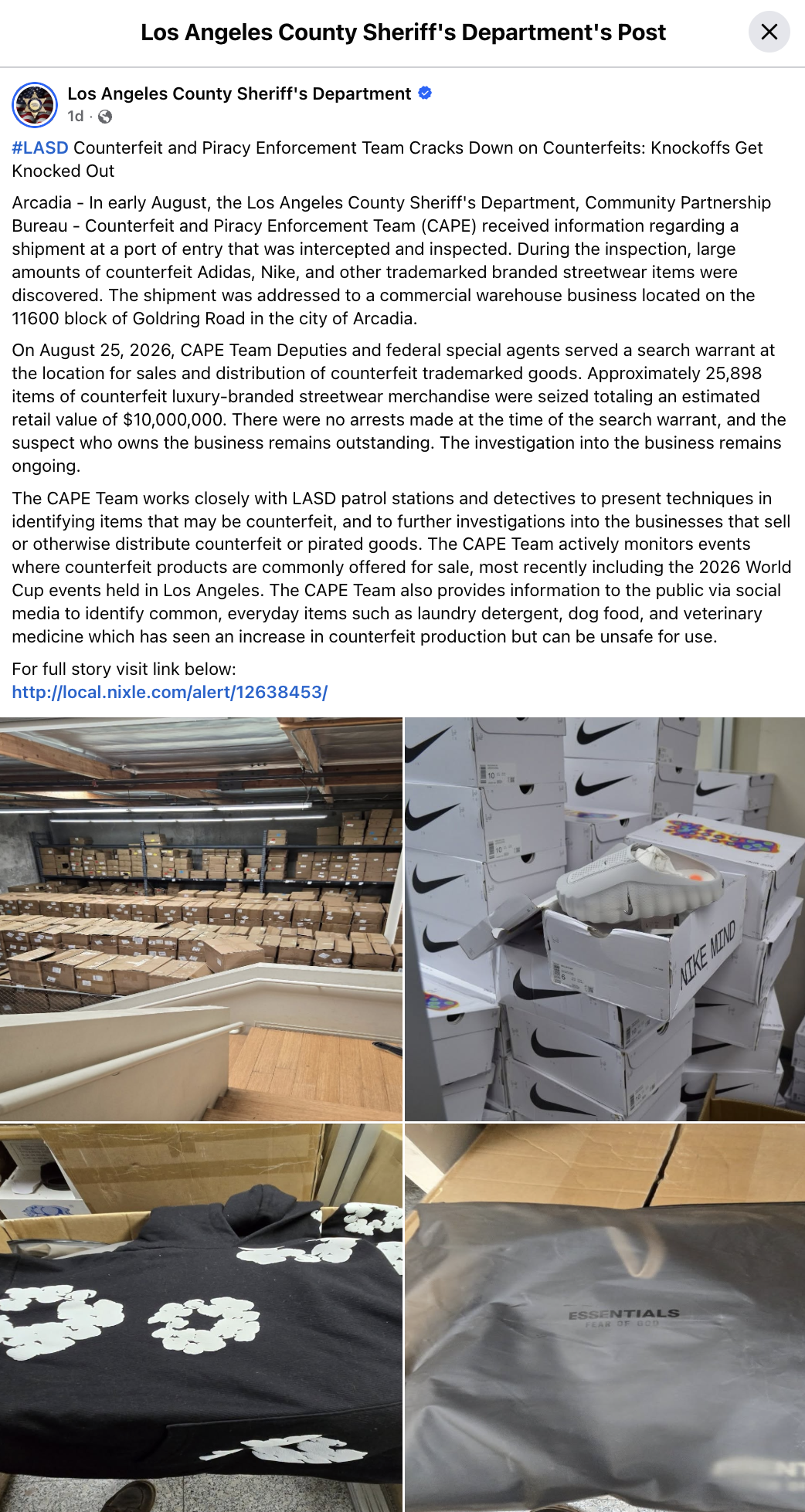
Deputies and federal special agents served a search warrant at the property on August 25. According to the Sheriff’s Department, investigators seized approximately 25,898 counterfeit items carrying an estimated retail value of $10 million. While photographs released after the raid showed stacks of footwear and apparel, authorities have not publicly identified the shipment’s point of origin, sender, or the federal agency involved in the initial interception.
No one was arrested when the warrant was served. The Sheriff’s Department said, “There were no arrests made at the time of the search warrant, and the suspect who owns the business remains outstanding,” adding, “The investigation into the business remains ongoing.”
The Arcadia raid is not an isolated counterfeit sneakers case for Los Angeles County. According to information released by the Sheriff’s Department, its CAPE Team has served roughly 25 warrants across the county over the past year and recovered approximately 200,000 counterfeit items valued between $15 million and $25 million. The unit focuses on the sale, manufacturing, and distribution of counterfeit goods while working with local, state, and federal law enforcement partners.
Major sporting events have also become a focus for counterfeit enforcement. The Sheriff’s Department said, “The CAPE Team actively monitors events where counterfeit products are commonly offered for sale, most recently including the 2026 World Cup events held in Los Angeles.”
That World Cup focus has stretched far beyond California. In June, U.S. Customs and Border Protection conducted an enforcement effort in Cincinnati called Operation Protect the Pitch. CBP said officers seized 68 shipments from June 1 through June 5 containing counterfeit World Cup jerseys, clothing, hats, jewelry and footwear. The haul included 200 pairs of footwear among 2,589 total items, which CBP said would have carried a combined manufacturer’s suggested retail price of $266,566 if they had been genuine. Most of those shipments originated in Mexico and Colombia and were headed to destinations across the United States.
The Cincinnati operation was only part of a much larger World Cup crackdown. CBP said that during the first week of match play alone, the agency made more than 1,400 World Cup-related seizures with a combined genuine MSRP exceeding $23 million. The agency said enforcement efforts were specifically aimed at markets surrounding host cities, including Los Angeles, Atlanta, Boston, Dallas, Houston, Kansas City, Miami, New York and New Jersey, Philadelphia, San Francisco, Seattle and others.
In Texas, counterfeit sneakers were part of an even larger haul. According to ABC13 Houston’s report on CBP enforcement, officers working through the Houston and Galveston port operation seized more than $6 million in counterfeit World Cup merchandise in June. The inventory included approximately 12,000 Adidas soccer jerseys, 4,500 Adidas FIFA soccer balls, and nearly 4,400 pairs of athletic shoes, along with fake electronics, toys, and perfume. Authorities said most of the shipments originated in China and were destined for locations inside and outside the United States.
The sneaker and streetwear market remained on enforcement radars through August. On August 18, U.S. Customs and Border Protection reported that officers at the Port of Louisville intercepted a shipment from the Republic of Korea that was headed to Georgia. Inside were 152 counterfeit watches and 32 pairs of shoes carrying suspected Gucci trademarks. CBP trade experts determined the products were counterfeit. The agency said the combined shipment would have been worth more than $9.3 million at manufacturer suggested retail prices if the merchandise had been authentic.
Earlier that month, CBP officers at George Bush Intercontinental Airport in Houston also seized nearly $4 million in counterfeit merchandise. According to CBP’s August enforcement announcement, the goods included fake Nike apparel, Major League Baseball merchandise, Louis Vuitton bags, Cartier sunglasses and Jaguar Land Rover computer systems. CBP placed the genuine MSRP of that collection at approximately $3.7 million and said most shipments originated in China.
Southern California has faced the issue on an even larger scale before the latest Arcadia seizure. In January 2025, the U.S. Justice Department announced federal charges in an alleged smuggling operation accused of moving counterfeit and other illegal goods from China through the Ports of Los Angeles and Long Beach. Federal investigators said more than $130 million in contraband had been seized during that investigation, including $20 million worth of counterfeit shoes, apparel, handbags, watches and perfume from a single warehouse searched in June 2024. Prosecutors alleged members of the network used warehouses and swapped customs seals in an effort to evade inspections. The allegations against defendants who had not been convicted remained accusations unless proven in court.
The scale of those cases reflects a counterfeit market that reaches well beyond one warehouse or one sneaker brand. Citing CBP figures, the House Ways and Means Committee reported that the agency seized nearly 79 million counterfeit products in fiscal year 2025, carrying an estimated $7.3 billion in MSRP if the items had been authentic. CBP has also identified footwear, apparel, handbags, watches, jewelry, and consumer electronics as product categories with a higher risk of counterfeiting.
Online shopping has made enforcement more complicated because counterfeit merchandise does not always arrive in massive shipping containers. CBP reported that in fiscal year 2024, 97 percent of its intellectual property rights seizures came through low-value de minimis shipments, accounting for roughly 31 million counterfeit items. That means counterfeit sneakers can move through both large commercial supply chains and individual packages headed directly toward consumers.
For sneaker buyers, the latest raids are another reminder that a familiar logo, convincing box, or attractive price does not guarantee authenticity. CBP advises consumers to purchase from trademark holders or authorized retailers, research online sellers, and be cautious when a deal appears unusually cheap. With counterfeit sneakers moving through warehouses, airports, ports, and online marketplaces, the Arcadia raid is one more example of how far the fake footwear business can reach before a single pair ever makes it onto someone’s feet.
