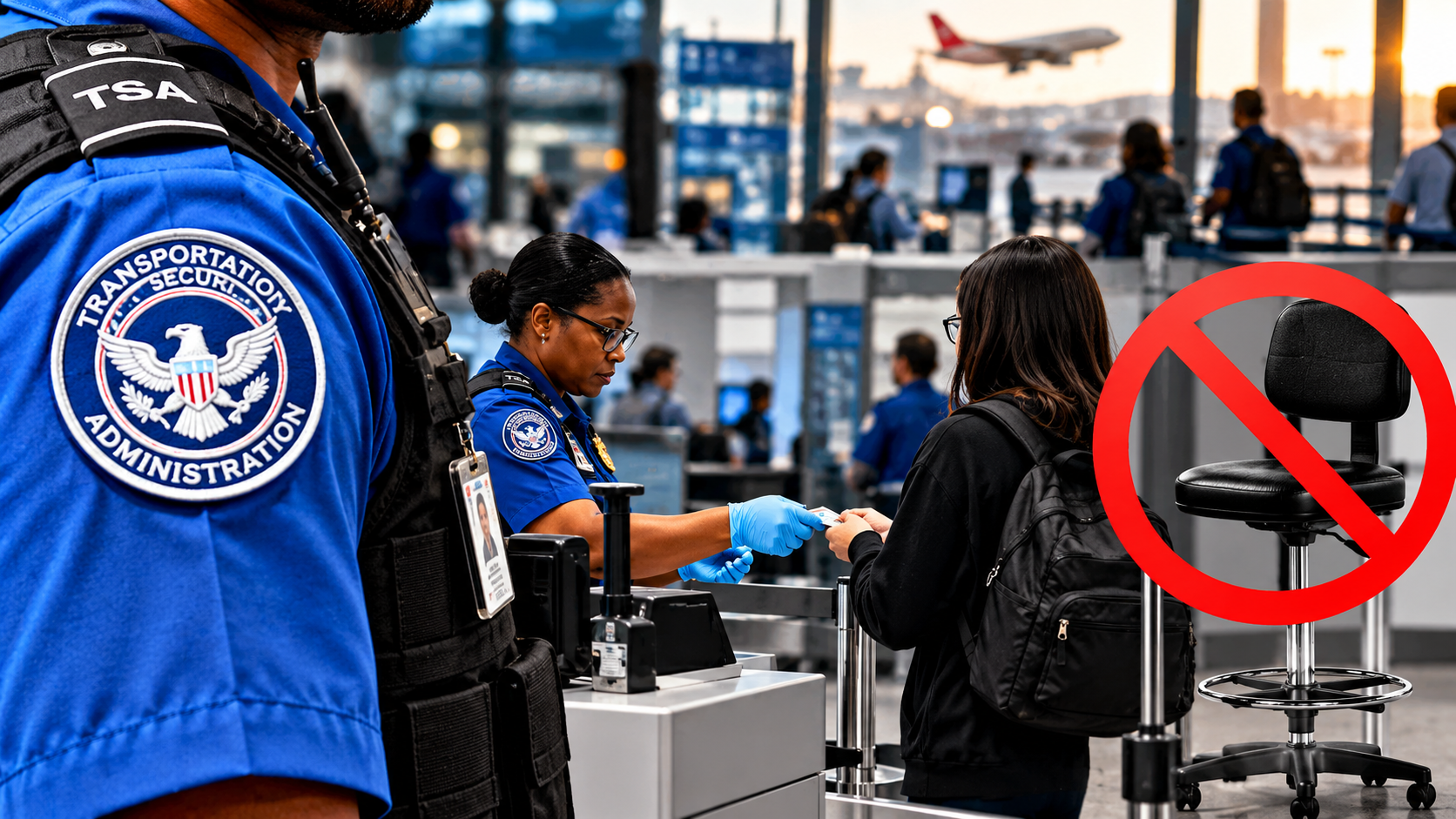
Airport security workers across the country are being told to stay on their feet as TSA removes chairs from the ID checkpoints where officers first meet travelers. The Transportation Security Administration has confirmed that officers checking passenger identification must now stand as part of a nationwide change the agency says is meant to keep workers alert.
The TSA chair ban is already drawing a sharp response from the workers tasked with carrying out airport security every day. ABC News reported that TSA is removing chairs from checkpoint positions used by officers who verify passenger IDs, putting a basic part of the work environment at the center of a growing dispute between the agency and its workforce.
TSA defended the decision in a statement.
“This welcome change reinforces both our security posture and our commitment to hospitality by having these officers on their feet and alert,” a TSA spokesperson said in a statement to ABC News. “All officers must meet fitness for duty requirements to be capable of performing their vital national security function while simultaneously creating a welcoming and professional environment for travelers.”
The American Federation of Government Employees TSA Council 100 sees the change very differently. According to Reuters, the union represents TSA workers and has criticized the policy as a workplace safety and employee rights issue. Reuters also confirmed that TSA officers will no longer be permitted to sit while conducting ID checks at airport checkpoints.
The union told ABC News that it was not consulted before the TSA chair ban was implemented and directly challenged the idea that seating at the document-checking position should be treated as optional.
“These chairs serve as basic ergonomic and safety support for officers that stand and walk on hard surfaces all day. TSA is treating this matter like it is a privilege; it is not; it is basic safety and common decency for the workforce.”
AFGE TSA Council 100 said chair removal had already begun at most commercial airports. CNN reported that workers began learning about the change days before the national attention around it intensified, while one union leader said there had been no formal notification to AFGE or its local chapters.
That timeline adds urgency to the TSA chair ban because the change is reaching officers directly at their workstations while organized labor is still pressing the agency over how the decision was made. ABC News reported that the union has instructed local leaders to communicate with officers and is encouraging members to contact lawmakers about the policy.
Union representatives said they “are moving aggressively to address this matter,” while urging TSA employees to make their concerns known to congressional leaders.
“This disregard for employee rights and safety is an example of a broad pattern of TSA’s true consideration of the employees who keep our nation safe,” the union said.
There is also previous workplace language that gives the dispute additional context. The 2024 collective bargaining agreement between TSA and AFGE specifically addressed employees who spend extended periods standing. The agreement states that TSA would provide anti-fatigue mats at bargaining unit workstations where employees stand in one place for extended periods. It also includes broader language concerning ergonomic equipment and workplace health and safety.
That provision does not by itself establish whether the new TSA chair ban violates the agreement, particularly given the broader labor disputes surrounding TSA collective bargaining in recent years. It does, however, show that prolonged standing and ergonomic support have previously been addressed formally between the agency and its unionized workforce.
The change also arrives during a major transition in TSA leadership. According to a TSA announcement, David Cummins was sworn in as the agency’s eighth administrator on August 7 after Senate confirmation. TSA said Cummins took responsibility for a workforce of approximately 60,000 employees and security operations covering more than 430 airports nationwide.
Less than three weeks later, TSA announced its Horizon 25 Strategy, which the agency described as a plan for its next phase as it approaches its 25th anniversary. According to TSA’s August announcement, the strategy centers on modernizing airport checkpoints, improving the traveler experience and strengthening security across multiple transportation systems.
CNN reported that the Horizon 25 effort includes expanded TSA PreCheck access, new technology, changes involving private screening operations and a broader push to improve passenger experience. CNN also noted that it remains unclear whether requiring document-checking officers to stand is formally connected to that strategy.
For travelers, the TSA chair ban may initially look like a small visual change at the front of the security line. For the officers stationed there, however, it directly changes how one of the most visible checkpoint duties is performed throughout the workday. The agency says standing supports alertness, professionalism, and security. The union says the chairs provide basic ergonomic protection for workers already spending significant time walking and standing on hard surfaces. Both positions are now colliding in airports nationwide.
With chairs already disappearing from document-checking stations, the argument has moved beyond a policy memo and onto airport floors, where TSA officers, travelers, and union leaders are now watching how far the nationwide change goes and whether pressure from the workforce leads the agency to reconsider it.