

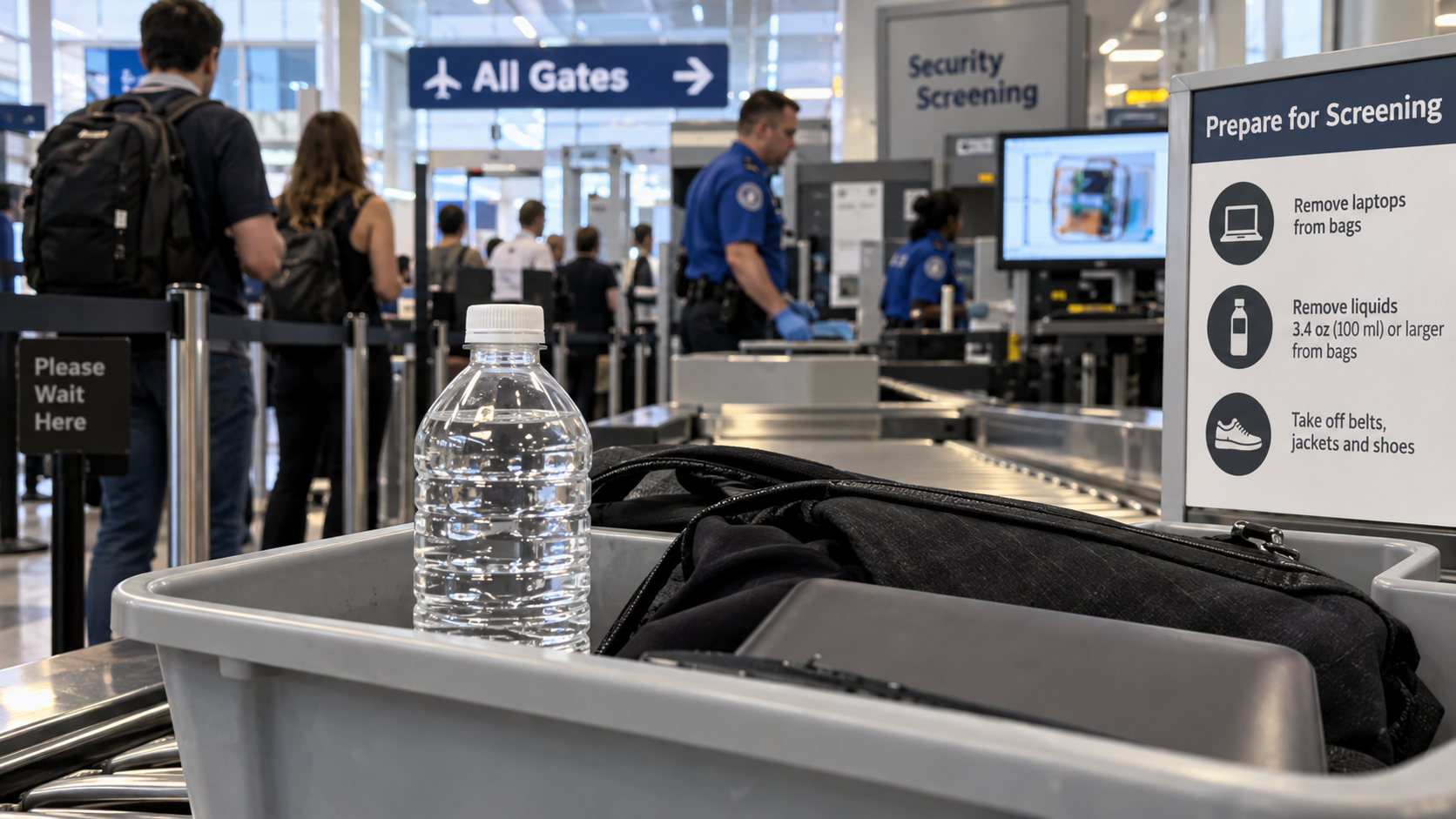
A rule that has forced travelers to dump perfectly good water at airport checkpoints for two decades could finally be changing for some passengers. The TSA liquid rule may be loosened for TSA PreCheck members, potentially allowing eligible travelers to carry full bottles of water through security at select airports. According to The New York Times, former Transportation Security Administration administrator John Pistole said the agency is considering the change, although he indicated it is unlikely to take effect before the holiday travel season. Which airports would participate first also remains unclear.
For now, nothing has changed at the checkpoint. According to TSA’s current liquids guidance, passengers are still generally limited to liquids, aerosols, gels, creams and pastes in containers of 3.4 ounces, or 100 milliliters, or less. Those containers must fit inside a single quart-sized bag. Larger containers normally belong in checked luggage unless they qualify for an exemption, including certain medications and infant or child nourishment.
The TSA liquid rule is sometimes lumped in with the sweeping airport security changes that followed the September 11 attacks, but the restriction on water bottles came later.
According to TSA’s historical account of the 2006 liquid bomb plot, British authorities disrupted a plan in August 2006 involving as many as 10 airliners scheduled to travel from London to North America. TSA says 24 people were arrested as investigators moved against the alleged plot. The agency’s historical exhibit says the devices under development included concentrated hydrogen peroxide mixtures that were intended to be concealed inside sports drink bottles. None of the devices made it onto an aircraft.
That drink bottle detail is the reason an ordinary bottle of water became a security issue.
The threat was not water itself. Security officials were confronting the possibility that a container appearing to hold a harmless beverage could instead conceal components of an explosive device. The U.K. government’s account of the plot similarly describes the 2006 case as an attempt to destroy several transatlantic flights using explosives hidden inside drink bottles.
In response, American authorities initially went much further than today’s 3.4-ounce limit. According to a Government Accountability Office review of TSA screening changes, TSA first prohibited liquids, gels, and aerosols from passing through checkpoints in carry-on baggage. The immediate restrictions were designed to address a threat that existing screening procedures could not simply dismiss because a bottle looked like soda, water, shampoo, or another normal liquid.
The total ban quickly proved difficult for everyday travel. The GAO found that TSA continued gathering intelligence, consulting explosives experts, and reviewing testing conducted by federal agencies. By September 26, 2006, travelers were permitted to carry small containers of liquids, gels, and aerosols that fit into one clear quart-sized bag. In November 2006, the limit was adjusted to 3.4 fluid ounces, equal to 100 milliliters, partly to align U.S. procedures with standards used by other countries.
That became the familiar TSA liquid rule that millions of travelers still deal with today.
Now, technology may be creating room for another shift. According to TSA’s own review of its screening technology, newer computed tomography scanners can produce high-quality three-dimensional images of carry-on bag contents that security officers can rotate for closer inspection. TSA said the technology improves visual analysis while reducing the need for officers to manually inspect bags or require passengers to remove some approved items.
A separate TSA checkpoint planning guide says computed tomography systems are part of the current generation of carry-on baggage screening and can help officers identify prohibited or dangerous objects inside luggage. The catch is that airport screening equipment is not identical nationwide, which helps explain why any relaxation of the TSA liquid rule could begin at selected airports rather than everywhere at once.
TSA has not officially announced that PreCheck members can start bringing full water bottles through security.
In a statement included in the original report, the agency said, “TSA will continue to explore opportunities to enhance security and improve the traveling experience for the public. As technology evolves, TSA’s multilayered security protocols will evolve, including benefits for our most trusted travelers.”
A TSA spokesperson also said any actual screening policy changes would be announced through official channels.
The possible water bottle change would fit into a broader push to offer additional flexibility to trusted travelers. According to TSA’s announcement of Gateside by TSA PreCheck, the new program allows eligible PreCheck members to apply for access beyond security at participating airports even when they are not flying. TSA says approved visitors can accompany loved ones, greet arriving passengers, shop, eat, or otherwise visit “the terminal beyond airport security.” They still undergo security screening.
Officials had already publicly signaled that the TSA liquid rule was under review. In July 2025, then Homeland Security Secretary Kristi Noem said she was “questioning” liquid carry-on restrictions while discussing ways to modernize airport screening.
“It’s not certainly anything we’ll be announcing in the next week or two, but we’re working to see what we can do to make the traveling experience much better and more hospitable for individuals, but also still keep safety standards,” Noem said at the time. Her comments were reported following an appearance at the Hill Nation Summit, with UPI also reporting her remarks about changing liquid limits.
Twenty years after the liquid bomb plot transformed what passengers could pack in a carry-on, the debate is no longer simply about whether a water bottle is too large. It is about whether modern screening technology can reliably identify what is inside that bottle without requiring every passenger to throw it away first. Until TSA formally announces a new policy, however, travelers should expect the current 3.4-ounce TSA liquid rule to remain in effect at airport security checkpoints.
