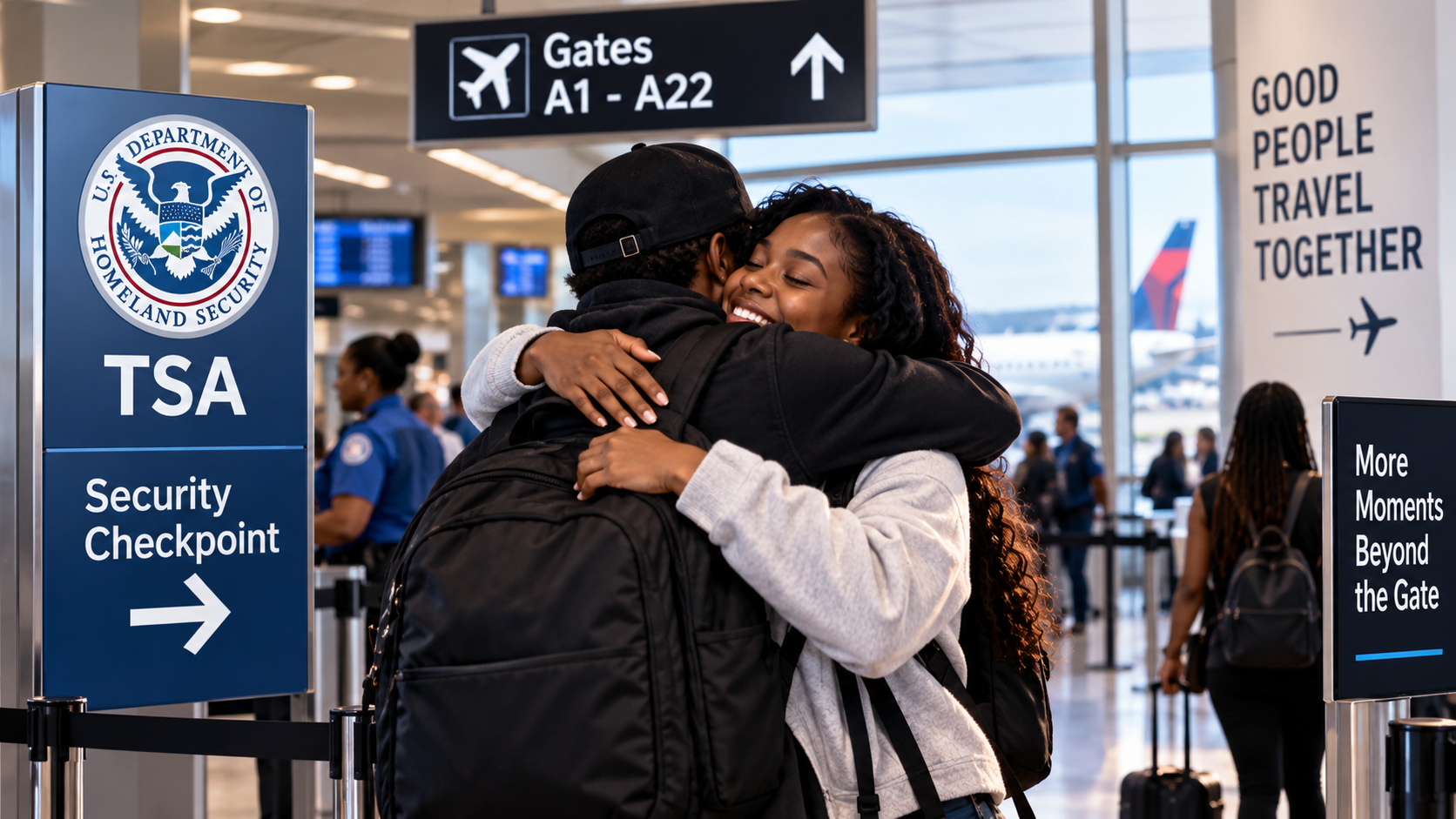
Airport goodbyes are about to look a little different for some families as a familiar part of air travel makes an unexpected comeback.
The Transportation Security Administration has launched TSA Gateside, a pilot program allowing approved people without airline tickets to pass through security and enter gate areas at 13 U.S. airports. The program is free, but applicants must already have TSA PreCheck benefits or qualify through another trusted traveler program with a Known Traveler Number.
For travelers old enough to remember flying before September 11, 2001, the idea may feel surprisingly familiar. The Associated Press reports that people without tickets were generally allowed to accompany travelers to their gates before security rules tightened after the attacks. TSA now describes Gateside as a way of “bringing back the moments that once defined air travel,” while keeping the security screening structure that exists today.
TSA Gateside does not mean anyone can simply walk into an airport and head toward a departure gate. Eligible visitors must apply online between one and three days before their planned visit and receive approval. Once cleared, visitors bring acceptable identification and go through a TSA PreCheck security lane. The authorization is valid for one calendar day, and approved visitors can leave and reenter during that day. Children may also participate when included on a parent or guardian’s application.
The initial airports include Mesa Gateway Airport in Arizona, John Glenn Columbus International Airport in Ohio, Dallas Fort Worth International Airport in Texas, Detroit Metropolitan Wayne County Airport in Michigan, Wichita Dwight D. Eisenhower National Airport in Kansas, Indianapolis International Airport in Indiana, Harry Reid International Airport in Nevada, Los Angeles International Airport and San Diego International Airport in California, Bill and Hillary Clinton National Airport in Arkansas, Will Rogers International Airport in Oklahoma, Eppley Airfield in Nebraska, and Salt Lake City International Airport in Utah. TSA has said more airports are expected to be added as the program expands.
The most obvious benefit is personal.
TSA Gateside could allow parents to stay with nervous young travelers until boarding, adult children to spend more time with older relatives, couples to stretch a goodbye beyond the security checkpoint, or friends to actually sit down together when one has a long layover. Mesa Gateway Airport officials specifically promoted those possibilities when announcing the program. J. Brian O’Neill, executive director and CEO of the Mesa Gateway Airport Authority, said: “This new program enhances the travel experience.”
There is also a security argument in TSA’s favor. Gateside visitors are not skipping the checkpoint. They still undergo TSA screening, and eligibility is centered on people who already hold trusted traveler status. TSA documentation says the PreCheck enrollment process includes a security threat assessment, while other TSA materials explain that criminal history checks are part of the vetting process used before a Known Traveler Number is issued. That does not make any system risk-free, but Gateside is significantly different from simply reopening secure terminals to the general public.
Still, convenience for visitors could become inconvenience for actual passengers.
Because approved TSA Gateside visitors use PreCheck lanes, adding non-flyers to those checkpoints could create additional demand at airports where travelers specifically enrolled in PreCheck to move through security faster. Axios noted that longer PreCheck lines are one potential concern at Salt Lake City International Airport. Mesa Gateway Airport also says Gateside availability may be restricted during peak travel periods, suggesting TSA is already considering capacity as part of the rollout.
The same question applies once visitors reach the gates. More people inside secure terminals could mean more customers for airport restaurants and stores, something TSA openly includes among the program’s intended uses. It could also mean more people competing for seating, charging outlets, restaurant tables, and space near crowded departure gates. Those effects will likely depend heavily on how many passes individual airports approve and when access is restricted.
There is another tradeoff involving who gets access. Gateside itself is free, but it is not universal. Visitors generally need an existing PreCheck benefit or another qualifying Known Traveler Number. By comparison, some airports already operate their own visitor pass systems that can be available to approved people without TSA PreCheck, according to aviation travel publication Stuck at the Airport. Detroit and San Diego, for example, already have separate airport visitor programs alongside the new federal option.
That makes TSA Gateside both a new perk and a test of how airports define access. Families may see it as a welcome return to something air travel lost decades ago. Airport businesses could see new customers. Travelers may appreciate having someone stay with them until boarding. At the same time, passengers who already deal with packed terminals may be less enthusiastic if airport visits begin translating into longer lines or more crowded gate areas.
TSA is treating the early rollout as an operational assessment while preparing to expand Gateside to additional airports. That makes the first 13 airports important testing grounds. The real measure of success will be whether TSA can bring back the emotion of meeting someone at the gate without also bringing more frustration to the people who are actually trying to catch a flight.