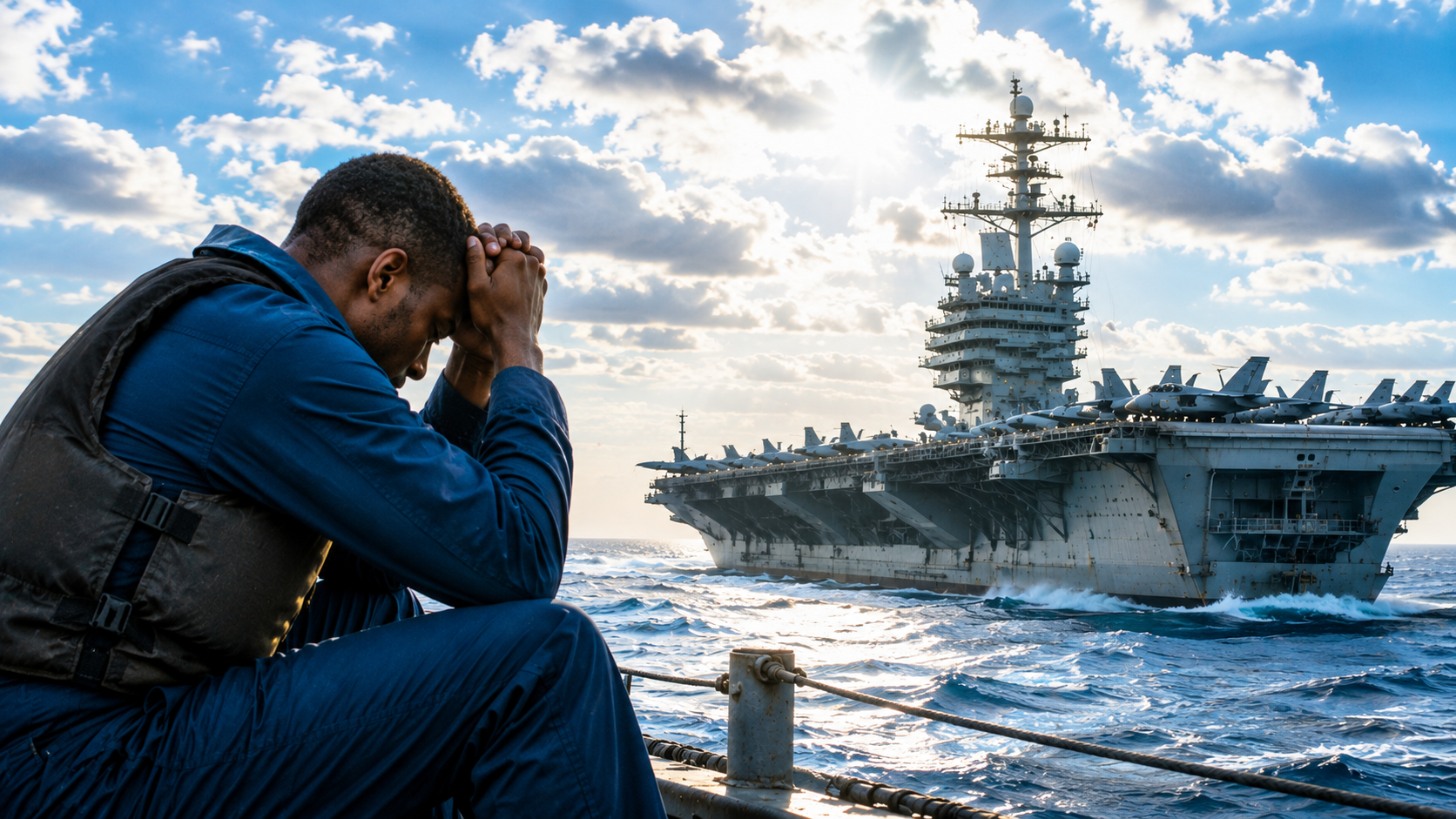
A young sailor’s reported suicide attempt aboard the USS Abraham Lincoln has turned into a disciplinary case, raising new questions about how the Navy responds when service members reach a mental health crisis. The 19-year-old USS Lincoln sailor jumped overboard on August 3 in what his wife described as an attempt to die by suicide. Charging documents reviewed by the outlet show that he is now accused of violating Articles 83 and 86 of the Uniform Code of Military Justice.
The documents accuse him of “malingering,” which MS NOW described as intentionally faking illness or injuring oneself to avoid military duties, and “absence without leave.” Federal law states that Article 83 covers intentionally inflicting self-injury or feigning a condition with the intent to avoid work, duty, or service.
“I think they’re insane for doing this to people who need mental help,” the sailor’s wife told MS NOW. “Instead of giving them help, this is just another huge stressor.”
The couple has a 3½-year-old son and welcomed a daughter in February while the sailor was deployed, according to MS NOW. His wife said he repeatedly asked for paternity leave but was denied. She said the USS Lincoln sailor was medically evacuated after going overboard and returned to San Diego on August 13.
His wife told MS NOW that he spent five days at Naval Medical Center San Diego, also known as Balboa, where staff monitored his vital signs, but he did not see a psychiatrist or therapist. She said he was directed to return to work after his release and did not receive his first therapy appointment until August 26.
The sailor now faces nonjudicial punishment. According to the Navy Judge Advocate General’s legal guidance, the process, commonly called captain’s mast in the Navy, allows commanders to address alleged minor misconduct without a court-martial conviction. Possible punishments for enlisted sailors include restrictions, extra duties, rank reduction, and forfeiture of pay.
The case is especially notable because guidance published in the Federal Register states, “Bona fide suicide attempts should not be charged as criminal offenses.” The guidance says decision makers should consider health conditions, personal stressors and military suicide prevention policy when determining whether an incident was a bona fide attempt. The same document notes that this discussion language is nonbinding.
Rep. Sara Jacobs, whose district includes the Lincoln’s San Diego home port, told MS NOW that she remains concerned about sailors and Marines serving aboard ships during lengthy deployments.
“No one should be punished for getting the mental health care they need,” Jacobs said. “I will continue to call on the Navy to provide our Sailors with the necessary support they deserve and will continue doing oversight to ensure that is the case.”
The disciplinary case comes as military suicide remains a broader concern. According to the military’s 2024 Annual Report on Suicide, 471 service members died by suicide in 2024, compared with 531 in 2023. The report also found that suicide rates among active service members have gradually increased over the longer period beginning in 2011.
Cody Harnish, a former Army judge advocate general who now represents military service members, questioned the tension between encouraging troops to seek help and maintaining a legal pathway to discipline.
“We tell service members to reach out for help, and then we keep a criminal statute on the books for the ones who didn’t get it in time. That’s a policy choice,” Harnish told MS NOW.
A Navy official defended the service’s approach in a statement to the outlet.
“The Navy is fully committed to the health and well-being of every Sailor. We strive to foster environments that support mental health by removing barriers to seeking help, increasing awareness of resources, and taking appropriate action when someone is in need. Mental health resources are available to our Sailors 24/7, and asking for help is a sign of strength.”
The USS Abraham Lincoln left San Diego in November 2025, and its deployment was extended as military operations connected to the war with Iran continued. The Navy confirmed this month that the ship was preparing to return home, with Acting Navy Secretary Hung Cao acknowledging that its deployment had been extended because of mission requirements.
MS NOW reported that the sailor’s wife said Navy officials did not contact her about the August 3 incident until four days later. She said an email from the command master chief eventually told her that her husband was “safe and sound onboard and will be returning to San Diego soon to receive support from Balboa.”
She also said her husband had approached his chain of command and the ship’s medical team multiple times about his mental health before going overboard. In a July 21 text shared with MS NOW, he wrote, “I think the boat is finally getting to me.”
As another deployment extension weighed on him, he sent another message: “I don’t think I can do another deployment after this and I don’t even know if I can finish this deployment,” underscoring why the USS Lincoln sailor’s disciplinary case is now fueling a larger debate over where military discipline ends and mental health intervention should begin.