

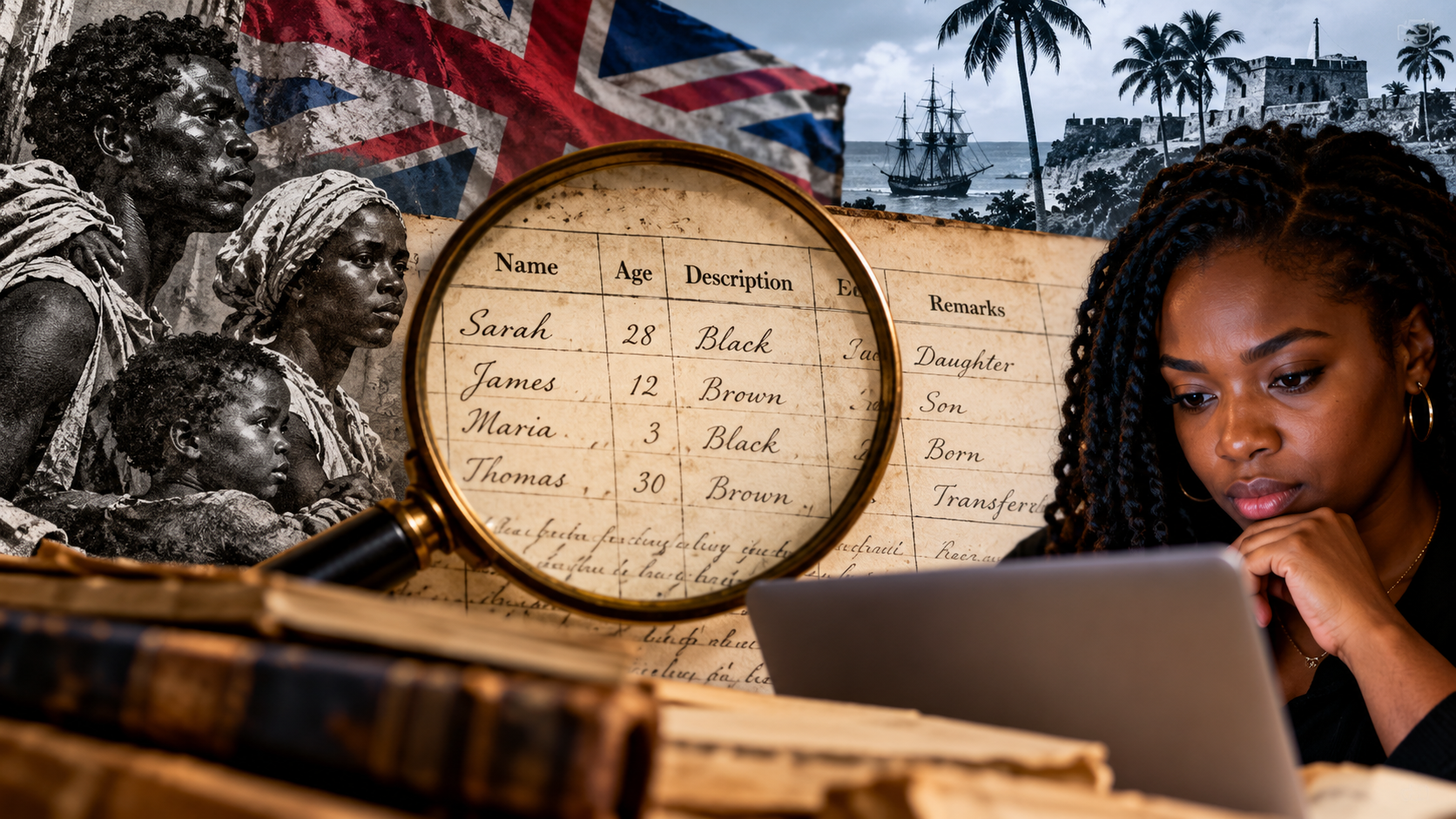
Ancestry made nearly 4 million enslavement records from 20 former British colonies searchable online on September 22, giving descendants access to the names, ages, physical descriptions, and family ties that were written down while their ancestors were held as property.
View this post on Instagram
The collection is called the Former British Colonies Enslavement Registers. It covers 1813 to 1840 and spans about 300,000 digitized pages. Anyone can search it with a free Ancestry account, and Ancestry says the enslavement records are available at no cost. The company scanned the originals, which are held at The National Archives in the United Kingdom, and made them searchable by name in partnership with the Centre for the Study of the Legacies of British Slavery at University College London.
The territories include Jamaica, Barbados, the Bahamas, Trinidad, Mauritius, and the Cape of Good Hope in present-day South Africa. University College London describes the registers as the most comprehensive records of enslaved populations in the British Empire.
The British government created them after abolishing the transatlantic slave trade in 1807. The goal was to prevent the illegal trading of enslaved people and to monitor the enslaved population. The registers were a government tool for counting people it treated as property.
That is what makes the level of detail so striking. Entries include names, ages, physical descriptions, and family relationships, along with births, deaths, and transfers of ownership, meaning when an enslaved person was sold or passed to another owner. Some entries also record whether a person was born in Africa or in the Caribbean. Nicka Sewell-Smith, a professional genealogist and senior story producer at Ancestry, told The Guardian that in some cases the detail is enough to pinpoint an exact birthday for an enslaved baby.
Sewell-Smith also said it is not lost on her that records made to count enslaved people as property are now being used by their descendants to rebuild their family histories. “Our product is restoring the humanity of a person,” she said.
The records have limits, and researchers are being upfront about them. Jamaican historian Suzanne Francis-Brown wrote in a guide that accompanies the collection that some Jamaican registers identify mothers when they stayed on the same property as their children. Later returns, which were follow-up filings, recorded changes such as births, sales, and deaths. Many people appear under only one name, though. Paternal relationships may be missing, and some entries leave out the estate name. Francis-Brown recommends checking the enslavement records against baptism, marriage, and burial records, along with newspaper reports. Researchers can start a search with a name, an approximate date, or a location.
University College London is also building something on top of the registers. Its Valuable Lives project is creating a free, open-access database of every person enslaved in Jamaica who appears in the registers between 1817 and 1832, which the university describes as the final 15 years before abolition. The database is meant to give a full social history of Jamaica in those last decades of slavery and connect enslaved people with descendants and communities.
The release came one week after another major project went public. On September 14, historians published the Register of British Slave Traders, the result of a three-year research effort led by Professor William Pettigrew of King’s College London. It provides biographical detail on as many as 10,500 investors in Britain’s near 250-year transatlantic slave trade, running from the first traffickers in the 1560s to abolition in 1807. One database names the people who financed and profited from the trade. The other lists the people who were enslaved, and both are now open to the public.
For descendants across the African and Caribbean diaspora, the enslavement records offer a new starting point where slavery and colonial recordkeeping left gaps. Some of the answers are sitting in handwriting that was never meant to be read as a family tree.
