

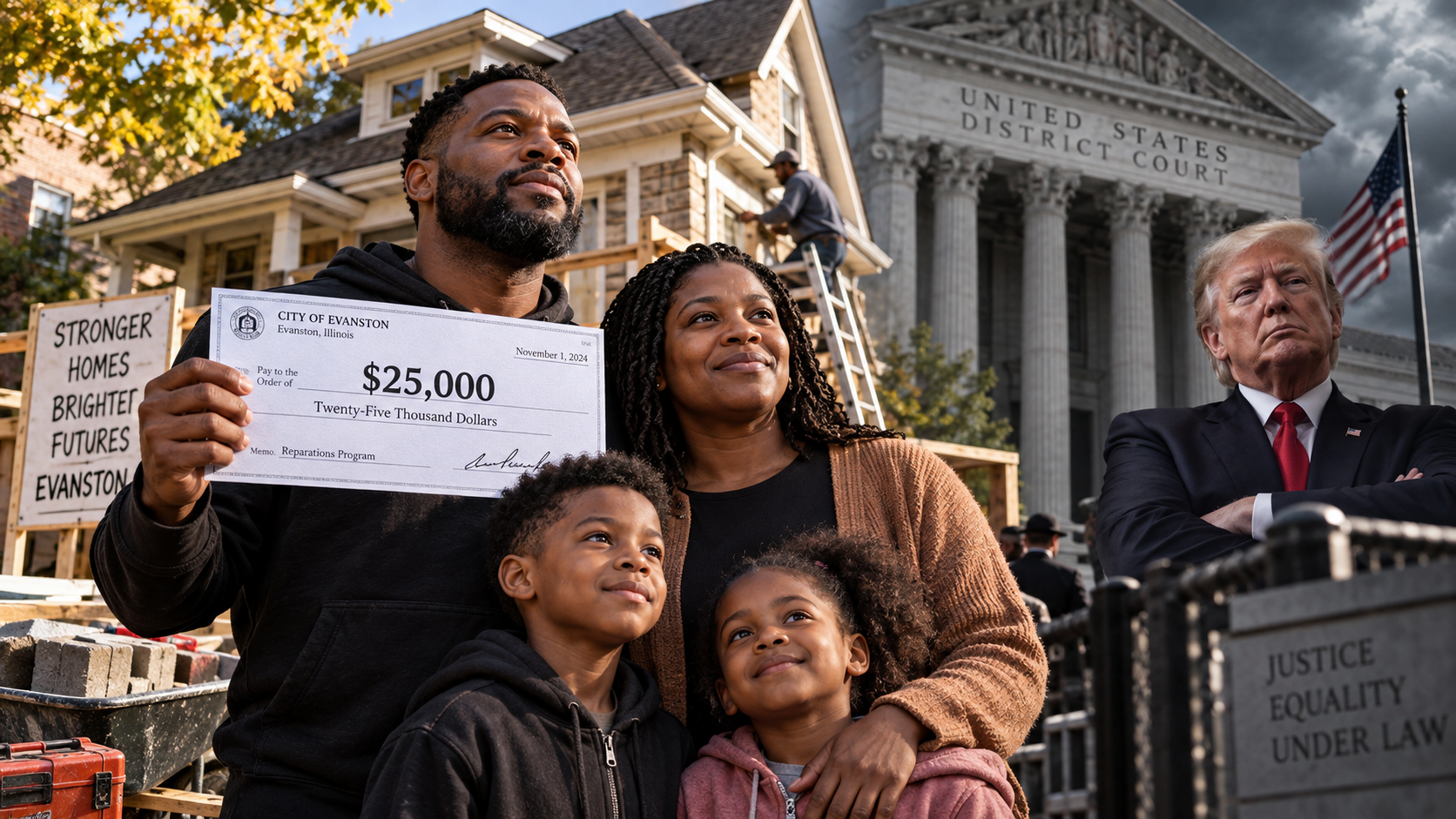
Trump’s Justice Department has stepped into a federal lawsuit challenging how Evanston, Illinois, compensates Black residents and their descendants for decades of discriminatory housing policies. According to the Justice Department, federal officials moved to intervene in Flinn v. City of Evanston on June 16, 2026, arguing that the Evanston reparations program violates the Equal Protection Clause of the Fourteenth Amendment and the Fair Housing Act.
The department argues that Evanston cannot distribute public benefits based on race without meeting strict constitutional requirements. In its announcement, Civil Rights Division chief Harmeet K. Dhillon said, “Simply handing out money based on race, however, is not the answer. It is race discrimination, pure and simple. And it is illegal.” Evanston officials dispute that characterization and maintain that the program was specifically designed to address harm caused by the city’s own policies.
The federal government did not originate the case. According to the Civil Rights Litigation Clearinghouse, Judicial Watch filed the lawsuit in May 2024 on behalf of plaintiffs who do not identify as Black and say they would have been excluded from benefits because of the program’s racial eligibility requirements. On March 27, 2026, U.S. District Judge John F. Kness denied Evanston’s motion to dismiss. That ruling allowed the lawsuit to continue, but it did not decide whether the Evanston reparations program is ultimately constitutional.
The program itself grew out of a much longer local history. According to the City of Evanston, the City Council began its formal reparations process in 2019 after acknowledging racial disparities connected to government policies and identifying housing and economic development as community priorities. The city initially committed $10 million from its cannabis tax, with additional funding later tied to real estate transfer tax revenue. Evanston eventually authorized benefits of up to $25,000 for eligible recipients through home purchases, mortgage assistance, home improvements, or direct cash payments.
According to the city’s own reparations materials, officials focused on housing because historical research documented Evanston’s role in discriminatory zoning and housing practices between 1919 and 1969. Former councilmember Robin Rue Simmons, who helped create the program, told NPR that she connected those policies to the shrinking Black population and longstanding barriers to building property wealth. “And so I knew that we had to have targeted redress,” Rue Simmons said. “As targeted as the harmful zoning that reinforced redlining.”
That connection between a specific government action and a specific remedy now sits at the heart of the legal dispute. According to the Justice Department’s complaint, federal lawyers contend that recipients are not required to prove that they or an ancestor personally suffered unlawful discrimination. Attorney Michael Bekesha, who represents the original plaintiffs, similarly told NPR, “There is no requirement that somebody prove that they were discriminated against or one of their relatives was discriminated against. It’s simply that you lived in Evanston for a certain time period and what the color of your skin is.”
Evanston Mayor Daniel Biss has rejected the idea that the Evanston reparations program is simply distributing money according to race. In an interview reported by NPR, Biss said, “Deliberate decisions were made that sent property values of property owned by white folks up, and property values owned by Black folks down. And that created a wealth gap that is felt today.” He added, “This is a program that is trying to undo the consequences of racial discrimination.” Reuters also reported in June that Evanston officials continued to defend the program after the Justice Department sought to enter the case.
For residents who received payments, the debate is tied to family histories that stretch back generations. NPR reported that Allie Zemtseff recalled watching her Black mother get rejected by landlords while searching for housing in white neighborhoods during the 1960s. Zemtseff later received a $25,000 benefit that she used for a kitchen renovation. Responding to the federal challenge, she told the outlet, “Of course it’s only for Black people, because we were the ones affected by the discrimination.”
Kimberly Holmes Ross described another example to NPR. Her parents bought a home in Evanston’s historically Black 5th Ward in the early 1960s through a high-interest contract after being unable to secure a traditional mortgage. NPR reported that Holmes Ross later used reparations funds for plumbing, electrical work and a porch at her mother’s home, while her son used his benefit to help create an apartment in her basement. Recalling her mother’s insistence that the family apply, Holmes Ross said, “She said it’s not even about the money. It’s about the acknowledgment. The city is acknowledging the harm.”
The fight carries significance beyond one Chicago suburb because Evanston became a model for local governments exploring reparations. The Associated Press reported that multiple states and cities have created commissions or task forces to study reparations, while Evanston went further by actually distributing money. Howard University law professor Justin Hansford told NPR that cities considering similar efforts need detailed records tying government conduct to specific harms. “You have to be able to write a detailed explanation of what took place, what year, what the government did to create the harm,” Hansford said.
For now, Evanston reparations remain active while the constitutional challenge proceeds. The City of Evanston says verified direct descendants will receive funding as revenue becomes available, although available money has not always been sufficient to pay every eligible recipient immediately. With no final ruling yet on the merits of the federal challenge, the case could become an important test of how local governments may attempt to repair documented racial discrimination while operating within constitutional limits.
