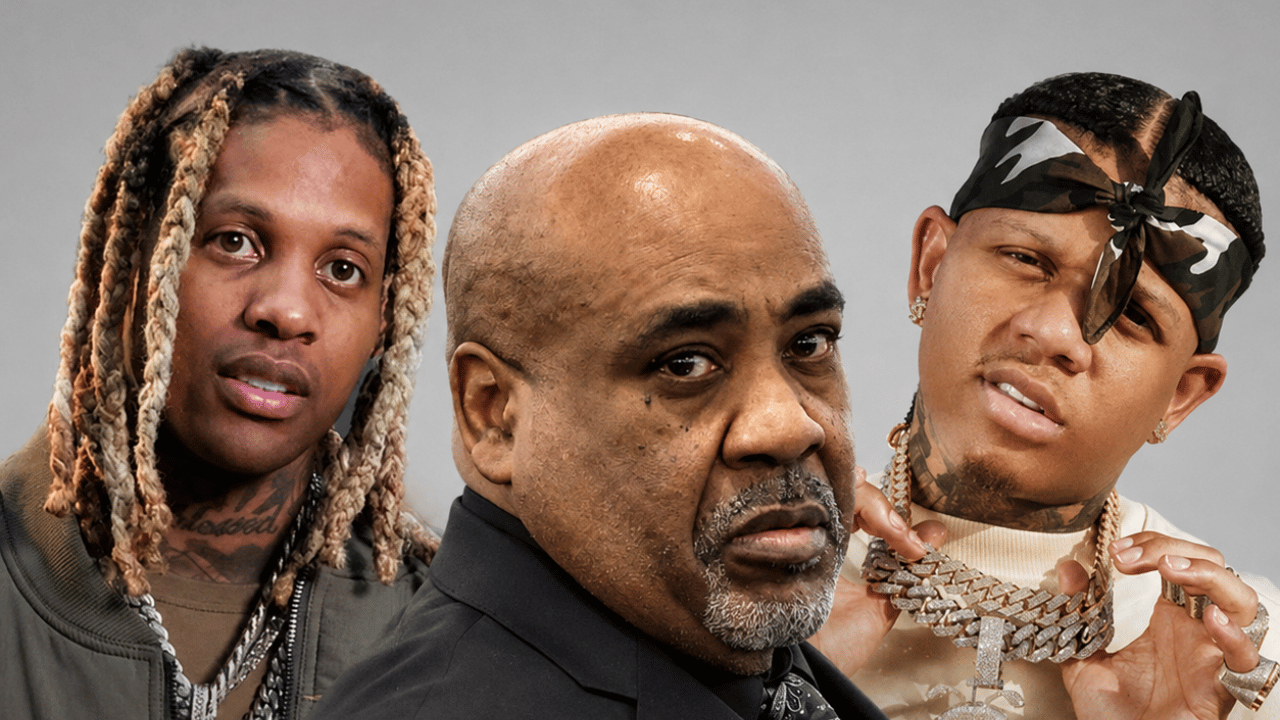
The Interviews Convicted Keffe D: Lil Durk And Yella Beezy Are Next In Line
A Las Vegas jury watched Duane Davis tell the story himself on BET and VladTV, then convicted him in under three hours. Two rappers on trial right now are facing the same kind of evidence.
The Keffe D verdict came down Monday in Las Vegas on a case built largely out of interviews the defendant gave himself. Jurors convicted Duane Davis, 63, of first-degree murder in the 1996 shooting of Tupac Shakur, and it took them less than three hours. Prosecutors never claimed Davis fired the shots. They said he was the shot caller who got the gun into the car. Their proof was mostly him talking, over and over, for sixteen years, to police, to a co-author, to documentary cameras and to hip hop media.
Jurors watched clips from the 2018 BET docuseries “Death Row Chronicles,” where Davis explained why he was finally speaking. “I’m coming out now to tell the story because I got cancer,” he said on camera. They also saw portions of interviews Davis gave to DJ Vlad in July2019 and again in May 2023, plus his appearances promoting his memoir “Compton Street Legend.” Prosecutors put the documentary’s filmmaker on the stand and asked him whether any of it had been scripted. He said no.
The legal turn in that case is worth understanding, because it is the reason a 1996 murder got charged in 2023. Davis first gave his account to LAPD in 2008 under what is called a proffer agreement, an arrangement where a person tells investigators what they know and the government agrees not to use those specific statements directly against them. A detective told him that night that nothing he said could be used against him. That protection covered the room he was sitting in. It did not cover BET, it did not cover VladTV, and it did not cover a book with his name on the cover. Judge Carli Kierny ruled that once Davis took the story public, he gave the protection away. He is scheduled to be sentenced October 13 and has said he plans to appeal.
That same logic is now sitting in two courtrooms with rappers in the defendant’s chair. In Los Angeles, U.S. District Judge Michael W. Fitzgerald cleared DJ Akademiks material for the jury in Lil Durk’s federal murder-for-hire trial. One piece is an excerpt from a 2021 episode of Akademiks’ show Off the Record with 6ix9ine and Wack 100, where 6ix9ine goes off about Durk not retaliating after King Von was killed.
“What is Durk doing? He’s not doing [expletive],” 6ix9ine says. Jurors were also cleared to see four excerpts from Durk’s own 2023 sit down with Akademiks, including a stretch about snitches and rats and one where Akademiks asks him directly about everybody telling him to slide for Von.
Durk, legal name Durk Banks, is charged in the 2022 shooting outside a Los Angeles gas station that killed Saviay’a Robinson, the cousin of Georgia rapper Quando Rondo. Prosecutors say the shooting was retaliation and that public pressure over Von’s death is part of what set it off. The podcast is how they intend to show that pressure was real. They also say a cooperating witness will testify that Durk saw the 6ix9ine episode and was upset that people were saying nothing had been done. Durk’s attorneys told the court he never saw it and that a 2021 conversation cannot explain a shooting a year later. Fitzgerald let it in. On August 30, the defense asked to admit more of the 2023 interview, the part where Durk waves 6ix9ine off entirely and calls the trolling clickbait, under a rule that lets one side add missing context when the other side plays a clip. Both sides are now arguing over which minutes of the same podcast the jury hears.
In Dallas, Yella Beezy is on trial for capital murder in the 2020 highway killing of Mo3, and Judge Chika Anyiam threw out most of the rap lyrics prosecutors wanted to use. She kept his 2019 VladTV interview and cleared it for the jury. The music got cut. The interview got in. That split runs through all three cases, and it exposes a hole in the protections artists spent a decade winning. California passed the Decriminalizing Artistic Expression Act in 2022, the first state law limiting when prosecutors can put an artist’s creative work in front of a jury. Louisiana followed in 2023. Maryland Governor Wes Moore signed the Protecting Artists’ Creative Expression Act in May, effective October 1. The federal RAP Act has been introduced in Congress and has not passed. Every one of them is built around the same two words: creative expression. Lyrics, music videos, album art.
An interview is none of that. A man answering questions as himself is making statements, and prosecutors can offer statements without clearing a single one of those hurdles. The defense of rap lyrics has always been that a man writing in character is not describing his life. There is no character in a podcast chair. There is a person on camera talking about real people, with a timestamp and a view count.
Nobody should stretch this past where it goes. Davis is not a rapper, and his conviction rested on police statements and his own book as much as on any media appearance. Durk and Yella Beezy have not been convicted of anything and both trials are still running. An interview clip is one piece of a case built on witnesses, phone records and physical evidence.
Charlamagne Tha God said on The Breakfast Club that the Davis trial sounded like a VladTV sit down stretched across a courtroom, and he was joking, but a Las Vegas jury heard those tapes and returned a guilty verdict on the first day it deliberated.
The bookings keep happening anyway. The same conversations that promote an album, kill a rumor or set the record straight are sitting on YouTube, permanent and searchable, in a format prosecutors have now demonstrated they know exactly how to use.