
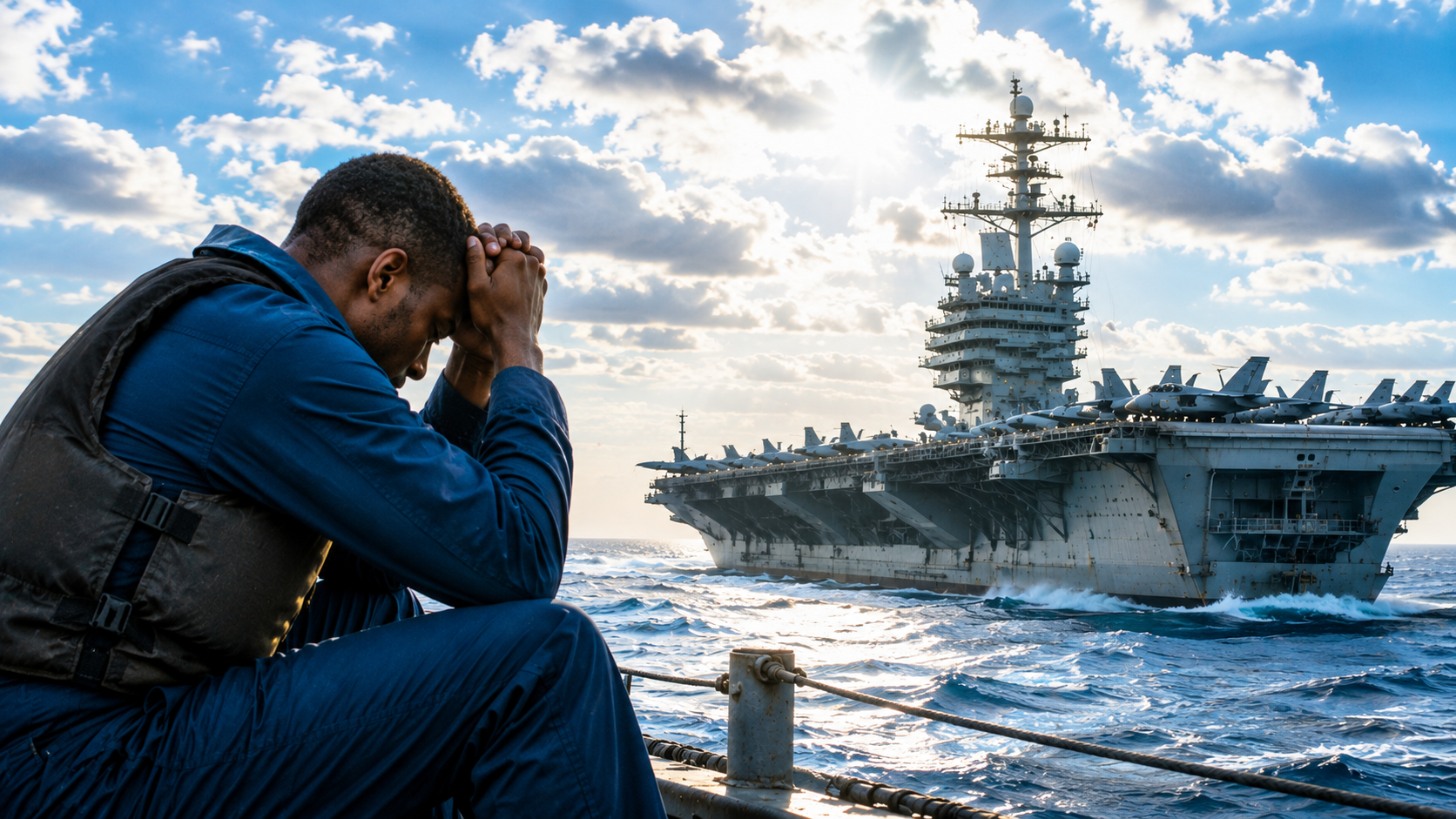
Thousands of sailors aboard the USS Abraham Lincoln are finally headed home after nearly nine months of deployment, according to The New York Times, bringing an end to the carrier’s Middle East assignment after months of combat operations and growing concern about life aboard the ship. The Associated Press reported that the USS George Washington arrived in the region Wednesday and has taken over operations as part of the Navy’s carrier rotation.
According to The New York Times, the USS Abraham Lincoln left San Diego on November 21, 2025, and its deployment had reached 272 days by Thursday. Except for a brief stop in Guam in December and another stop in Oman for supplies, the thousands of sailors and Marines assigned to the ship have spent almost the entire deployment at sea. The carrier now faces a roughly 13,000-mile journey back to San Diego that could require another four to five weeks.
What the crew endured during that deployment has become nearly as significant as the military mission itself. According to Navy Times reporting, family members described multiple incidents involving sailors attempting or preparing to go overboard as the deployment stretched beyond its expected timeline. Annabelle Loma told the outlet that her husband attempted to jump from the carrier after becoming severely burned out and was later placed on medical hold. Navy Times also documented a separate incident in which a sailor on watch reportedly grabbed a shipmate who appeared to be preparing to go overboard and pulled the person back onto the deck.
Another incident was independently reported by CNN. According to CNN’s August 14 report, three U.S. officials confirmed that a USS Abraham Lincoln sailor actually went overboard earlier in August. Two officials said the sailor was quickly rescued, medically evaluated, and transferred from the ship for additional care. One official said the sailor had been wearing a life vest, was not injured, and that the Navy viewed what happened as a mental health episode. CNN also noted the earlier reports of other sailors being stopped from going overboard.
The Navy has not publicly provided an exact number of sailors who attempted to go overboard or engaged in self-harm during the deployment. According to Navy Times, Navy officials said USS Abraham Lincoln leadership has continued evaluating the psychological readiness of the crew and that counselors, chaplains, medical personnel and other mental health resources have remained available onboard. The outlet also reported that more than 200 relatives attended a meeting in San Diego with senior Navy leadership as families raised questions about exhaustion, safety and the impact of the extended deployment.
The mental health concerns developed alongside complaints about basic living conditions. According to The Washington Post’s reporting, families and lawmakers raised allegations involving food shortages, broken toilets, mold in showers, contaminated water, unreliable hot water, and problems getting mail and care packages to the crew. Sen. Richard Blumenthal sent questions to Defense Secretary Pete Hegseth and acting Navy Secretary Hung Cao about the conditions, while Hegseth told reporters that coverage of the situation had been “completely misrepresented.”
Those supply problems unfolded after Iran attacked American military infrastructure in Bahrain earlier in the conflict. According to Defense One, Iranian drones damaged U.S. Navy facilities in Manama on February 28, prompting Naval Forces Central Command to conclude that the surrounding Juffair area was no longer safe for American personnel. The New York Times reported that damage to the Bahrain installation, a critical Navy logistics hub, complicated the USS Abraham Lincoln’s supply network and contributed to problems getting essential items to the carrier.
Navy leadership has pushed back on the idea that the carrier was unable to function. According to reporting published by The Washington Post, acting Navy Secretary Hung Cao said the crew spent more than 200 days in a combat zone, conducted about 10,000 sorties and dropped approximately 1.5 million pounds of ordnance. Cao acknowledged that a small number of mental health cases required treatment and that meal plans were changed when fresh resupply was unavailable. Adm. Brad Cooper, who leads U.S. Central Command, later visited the ship and described many of the previously reported problems as “old news.”
Cooper also made clear that the crew’s assignment was ending. According to The New York Times, he wrote, “Godspeed and enjoy the well-deserved reunion soon,” while discussing the Lincoln’s return. U.S. Central Command separately wished the ship “fair winds and following seas,” the traditional Navy farewell, as attention shifted to the incoming USS George Washington.
According to the Associated Press, the George Washington is now operating alongside other U.S. naval forces in the Middle East as Washington continues military operations connected to Iran. The arrival allows the USS Abraham Lincoln and its exhausted crew to begin the long trip back to California, but homecoming will not be immediate. After nearly nine months away and an extraordinary stretch with almost no time off the ship, the sailors still have thousands of miles of ocean between them and San Diego.