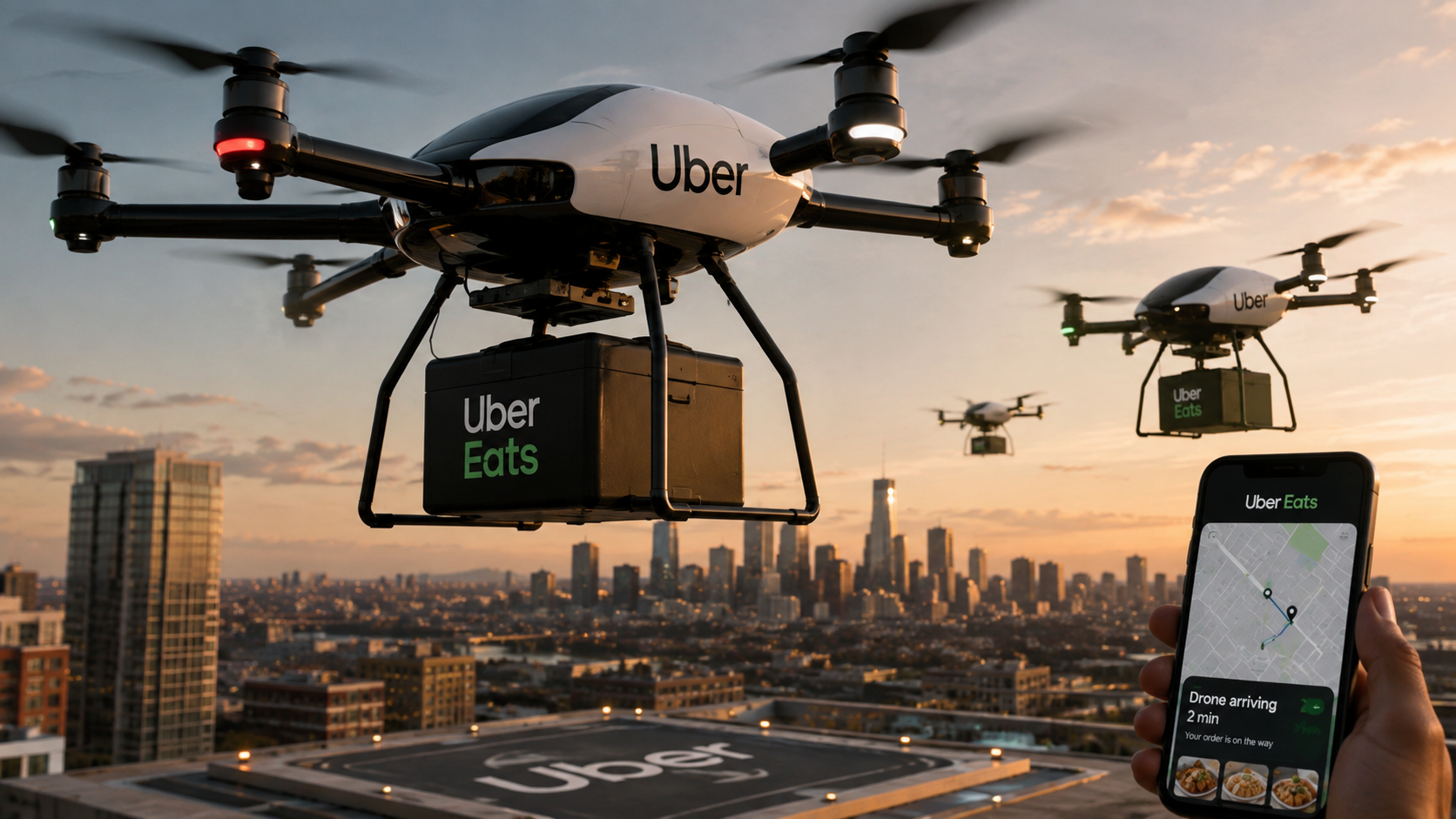
Uber wants to turn drone delivery from a futuristic convenience into an everyday habit, and its latest target makes clear just how big that ambition has become.
According to Uber’s August 17 announcement, the company is partnering with autonomous delivery company Zipline with a goal of reaching one million Uber drone deliveries every day by the end of 2029. The companies said the first Uber Eats deliveries using Zipline aircraft will begin later this year before the service expands into dozens of United States cities.
One million deliveries a day is not a small experiment. If Uber and Zipline maintained that pace for a full year, it would amount to roughly 365 million drone deliveries annually, or about 694 deliveries every minute.
That figure becomes even more striking when compared with Zipline’s existing operation. According to Uber’s announcement, Zipline has completed more than 2.7 million deliveries involving more than 20 million items and currently makes a delivery somewhere in the world about once every 20 seconds. The company operates across four continents and says its autonomous aircraft have flown more than 135 million commercial miles.
At its stated current pace of one delivery every 20 seconds, Zipline would complete roughly 4,320 deliveries in a day. Getting to one million Uber drone deliveries daily would require a pace more than 230 times greater than that figure. That massive jump puts the scale of Uber’s plan into perspective.
Uber is also putting money behind the idea. According to Reuters, the company made a strategic investment in Zipline as part of the agreement, though Uber did not disclose the amount when Reuters asked for financial details. Reuters also reported that the service will begin in Zipline’s existing United States markets before moving into additional cities.
The promise is easy to understand. According to Uber, Zipline’s system is designed to deliver orders in roughly five to 10 minutes, potentially giving customers another option beyond cars, bikes, scooters, and traditional couriers. Uber says it ultimately wants a delivery network that combines people, sidewalk robots, and drones, selecting a transportation method based on the order and location.
But the one million delivery goal also raises questions that become harder to ignore as more aircraft enter neighborhood airspace.
Safety is one of the biggest concerns. According to the Federal Aviation Administration, commercial operators conducting package deliveries beyond the operator’s visual line of sight must meet federal certification requirements, obtain the necessary exemptions or waivers, and receive airspace authorization before operating. The FAA also says package delivery drones generally operate below 400 feet.
A February 2026 report from the U.S. Government Accountability Office shows why that oversight matters. The GAO found that existing technologies do not yet provide full two-way communication between drones and other aircraft, something that could become increasingly important for preventing collisions as commercial drone activity grows. The agency recommended that the FAA establish clearer actions and technical milestones for future drone communication and collision avoidance systems.
Then there is noise. The FAA specifically tells drone delivery operators to consider setback distances from noise-sensitive areas when selecting distribution hubs and notes that local zoning and land use rules may also apply. That issue could become more noticeable if drone delivery moves from occasional flights to hundreds or thousands of trips across the same communities each day.
Privacy remains another concern. A GAO review of drone integration documented community concerns about drones collecting personal information and noted that FAA officials have said the agency does not have authority to regulate drone operations specifically for privacy protection.
There is also a labor question hanging over the expansion. Uber says its long-term model will remain a hybrid network that includes couriers alongside drones and sidewalk robots, but the company’s announcement does not detail what one million daily autonomous deliveries could eventually mean for the human workers who currently move Uber Eats orders.
Uber drone deliveries may soon become far more common, but reaching one million every single day would be more than a technology milestone. It would represent a major change in how goods move through American neighborhoods, and whether communities embrace that future could depend just as much on safety, privacy, noise, and workers as it does on how quickly dinner arrives.