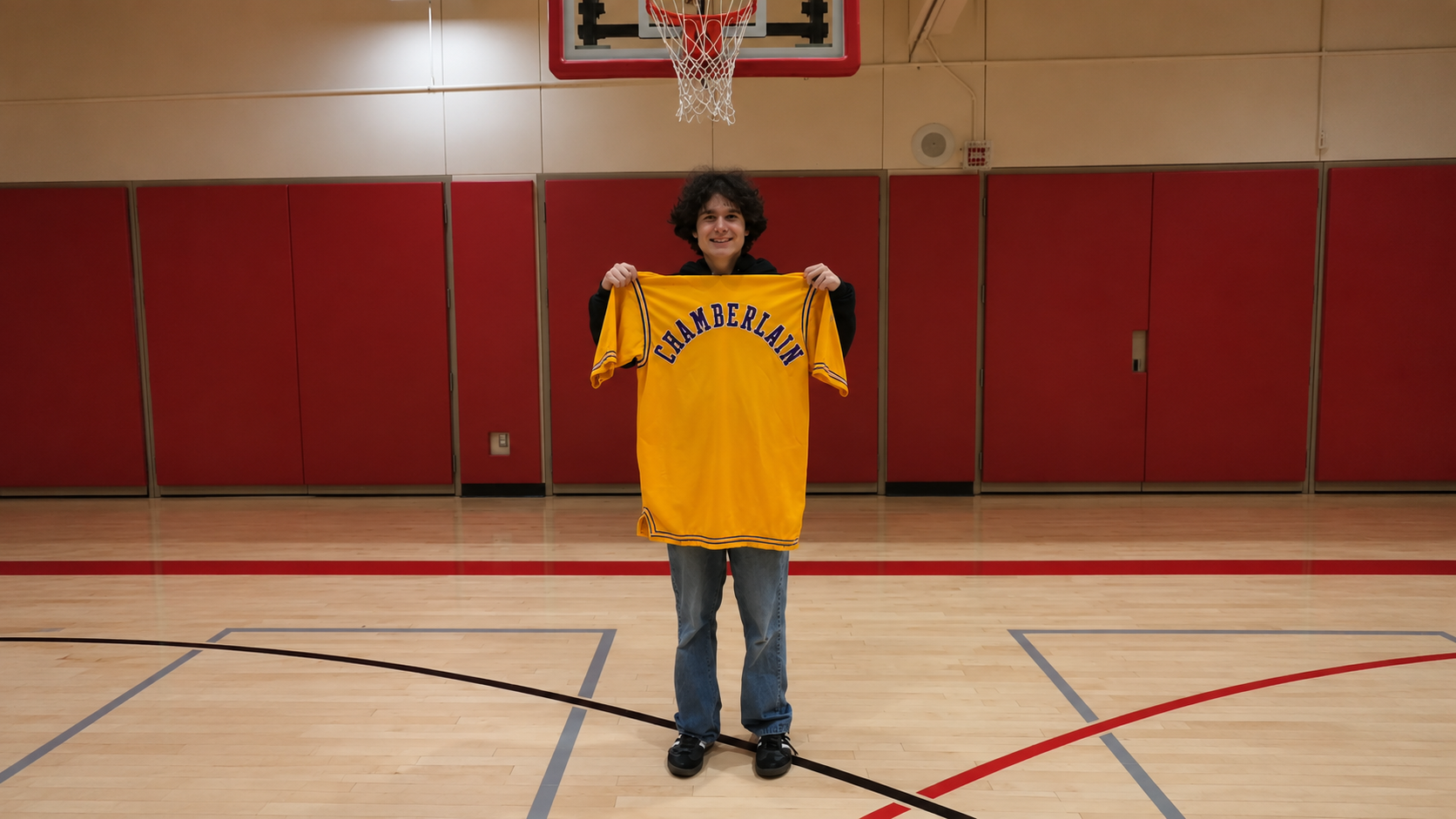
A 19-year-old from Oregon paid $3.07 for a Wilt Chamberlain warm up jacket at a Goodwill outside Portland and sold it Monday at Sotheby’s for $89,600. The short-sleeved yellow Lakers jacket was worn during the 1972 NBA Finals, and the auction drew 48 bids before it closed.
The find itself came down to a few seconds of timing.
Quinn Brown was working a massive bin of clothes at the Goodwill in January when he watched another shopper pick up a Lakers jacket with Chamberlain’s name on it, look at it, and toss it back onto the pile. Brown grabbed it. He has been reselling thrift finds online for three years, which is the only reason his eyes were on that bin in the first place, and the most valuable thing he had ever flipped before this was a Sub Pop Records t-shirt.
Brown did not immediately call an auction house. He spent months trying to determine on his own whether the thing was real, because he could not believe it was. He examined the Lakers patch on the chest and found small stitching details that matched period photographs. He then pulled the measurements of a different jersey worn by Wilt Chamberlain, who stood seven foot one, and found that the jacket’s dimensions nearly lined up. He said he wanted to be sure because it was so hard to believe, and that he had only ever read about finds like this happening to other people.
Sotheby’s came to him. Brown posted a photo of the jacket on social media, the auction house saw it and reached out about consigning it, and an armored van showed up to collect it. Sotheby’s then ran its own photomatch verification and confirmed the jacket was worn by Wilt Chamberlain during the 1972 Finals, the series in which he was named MVP. The listing described it as an extraordinary piece of memorabilia and noted that matching game worn clothing to a specific Finals series for a player from that era is exceptional, in part because so few photomatched Chamberlain items still surface.
The final number was enormous relative to what Brown paid and modest relative to what the house expected. Sotheby’s had estimated the jacket between $150,000 and $250,000. It closed at $89,600, roughly 60,000 short of the low end. That gap is worth understanding rather than ignoring, because it says something about how the memorabilia market prices proximity. A warm up jacket is not a game jersey, and the collectors bidding on 1972 Lakers material know the difference precisely.
The ceiling on that difference is well documented. Wilt Chamberlain’s actual game jersey from the championship clinching Game 5 of the same 1972 Finals sold at Sotheby’s for $4.9 million in 2023, one of the most expensive NBA jerseys the house has ever handled. His rookie season Philadelphia Warriors jersey went for $1.79 million that June. Against that market, $89,600 for a sideline layer reads as a rational price rather than a disappointment, whatever the pre sale estimate suggested.
The 1972 series is why any of this carries weight. The Lakers beat the New York Knicks for the franchise’s first title since the move to Los Angeles, and Wilt Chamberlain played Game 5 with a broken hand, putting up 24 points and 29 rebounds on the way to Finals MVP. He retired the following season. He is a Naismith Hall of Famer, a four time league MVP, and he still holds the single game scoring record with 100 points in 1962, a mark that has stood for more than six decades. He died in 1999 at 63.
How a piece of that ended up in a donation bin in suburban Oregon more than fifty years later is unknown, and neither Sotheby’s nor Brown has offered a chain of custody. Items like this typically move through equipment managers, players, family members, and estate sales before anyone loses track of what they are, and once a jacket stops looking like history and starts looking like used clothing, it travels the way used clothing travels.
Brown said he did not think finding something like this was possible and that he got very lucky. Both are true, and neither one is the whole thing. Somebody else had the jacket in their hands that day and put it down. The difference between that shopper and an $89,600 payday was knowing what the name on the chest meant and then spending several months refusing to take his own guess at face value.