


The 2010s rewired Black culture. Streaming arrived. Black Twitter became the engine room. Visual albums, surprise drops, and viral hashtags replaced press cycles. Three Black women started a movement on Facebook. A Disney movie set in a fictional African nation grossed $1.35 billion. A 4 minute and 4 second music video about American violence won a Grammy for Record of the Year. By the time the decade closed, the gatekeepers everyone was trying to convince in 2010 were either retired, replaced, or working for someone they used to overlook. Below is the timeline. Twenty five moments that ran the 2010s and built the floor for everything we are watching now.
1. LeBron James airs The Decision on ESPN – July 8, 2010: A 27-year-old superstar bought an hour of network time to announce his free agency on live television. Critics called it tone deaf. Sports media called it a watershed. The Decision generated $2.5 million for the Boys and Girls Clubs and confirmed that Black athletes no longer needed permission from sportswriters to control their own narratives. Every player empowerment move of the decade traces back to this hour.
Watch:
2. Jay-Z and Ye release “Watch The Throne” – August 8, 2011: The collaborative album from the two biggest rappers alive opened at number one and produced “N***as in Paris,” the song that defined Black luxury rap for the rest of the decade. The “Watch The Throne” tour grossed $48 million. The Roc Nation and Ye orbits realigned around the project, and the template for billionaire rap was officially set.
3. The killing of Trayvon Martin and the founding of Black Lives Matter – February 2012 to July 2013: Trayvon Martin was 17 when George Zimmerman shot him in Sanford, Florida. When Zimmerman was acquitted on July 13, 2013, three Black women, Patrisse Cullors, Alicia Garza, and Opal Tometi, founded Black Lives Matter. The hoodie became a symbol. The hashtag became a movement. The most consequential Black social movement of the decade was born from a teenager’s death.
4. Beyoncé surprise drops her self-titled visual album – December 13, 2013. No press, no promo, no warning. Fourteen tracks and seventeen music videos appeared on iTunes overnight. The album sold 600,000 copies in three days and 800,000 in a week. The music industry’s release calendar has not recovered. Every surprise drop since traces back to that night.
5. “12 Years a Slave” wins Best Picture – March 2, 2014: Steve McQueen became the first Black director to win Best Picture at the Academy Awards. Lupita Nyong’o won Best Supporting Actress in her debut feature. The win arrived 75 years after Hattie McDaniel’s first Black acting Oscar and confirmed that Black storytelling at the prestige level could no longer be quietly overlooked.
6. Mike Brown is killed in Ferguson, Missouri – August 9, 2014: Brown was 18 when Officer Darren Wilson shot him in the street. The protests that followed turned BLM from a hashtag into a national infrastructure. “Hands up, don’t shoot” became the gesture of the decade. Ferguson became shorthand for the Black political consciousness that defined the back half of the 2010s.
7. “Empire” premieres on Fox – January 7, 2015: Lee Daniels and Danny Strong’s hip-hop family drama opened to 9.9 million viewers and grew every single week, an unheard of pattern in the network era. By its sixth episode it was the highest rated network drama in over a decade. “Empire” proved network TV could still build culture when it centered Black stories with no apologies.
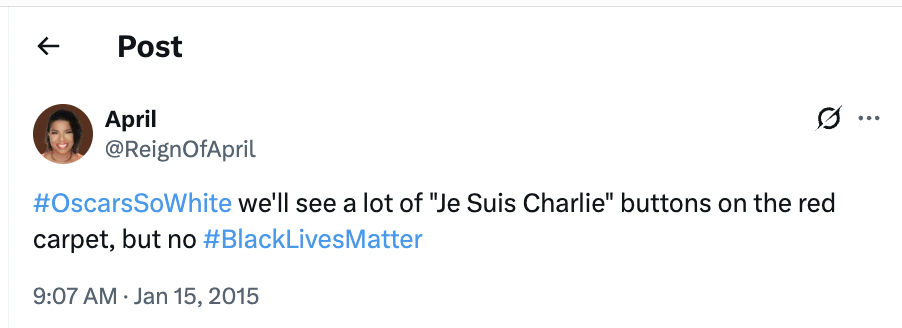
8. April Reign launches the OscarsSoWhite hashtag – January 15, 2015: Reign created the hashtag at her kitchen table after the Oscar nominations dropped without a single Black acting nominee. The hashtag forced industry reckoning, prompted the Academy to overhaul its membership rules, and created the conditions that made “Moonlight,” “Get Out,” and “Black Panther“ possible inside that same institution.
9. Beyoncé performs “Formation” at Super Bowl 50 – February 7, 2016″ Black Panther references, an X formation honoring Malcolm X, and the most explicit Black political art ever performed on the most watched stage in American media. Police unions called for protests of the singer. The performance instead became the moment millions of viewers realized the halftime show had become the most consequential Black cultural platform on television.
10. “Lemonade” premieres on HBO – April 23, 2016: A 65-minute visual album that turned a public marriage crisis into a generational text on Black womanhood, ancestry, and rage. Featuring Serena Williams, Zendaya, Quvenzhané Wallis, and the mothers of Trayvon Martin, Mike Brown, and Eric Garner holding photos of their sons. “Lemonade” made the visual album a literary form and changed what Black women were allowed to say in public.
11. “Atlanta” and “Insecure” premiere within five weeks of each other – September to October 2016: Donald Glover’s surreal FX series and Issa Rae’s HBO comedy launched the era of Black auteur television. Both shows confirmed that Black showrunners no longer needed to translate their work for white audiences in order to land at premium platforms. Both also became the launching pad for a new generation of Black writers, directors, and stars.
12. Solange releases “A Seat at the Table” – September 30, 2016: The album debuted at number one on the Billboard 200, Solange’s first chart topper. “Cranes in the Sky,” “Don’t Touch My Hair,” and the Master P interludes became the Black millennial manifesto. The project also confirmed that Beyoncé and Solange were operating two separate creative empires at the same time, both at the top of their form.
Watch:
13. Colin Kaepernick takes a knee – August 26, 2016. The 49ers quarterback knelt during the national anthem to protest police brutality. By season’s end he was unsigned. He has not played another NFL down. Kaepernick lost his career and became the most consequential Black athlete activist since Muhammad Ali. The kneel itself became one of the most reproduced images of the decade.
14. “Get Out” premieres in theaters – February 24, 2017: Jordan Peele’s directorial debut grossed $255 million on a $4.5 million budget and invented the modern social thriller. Peele won Best Original Screenplay at the Oscars, only the third Black writer to take home the trophy in that category. The Sunken Place entered the cultural lexicon overnight and never left.
Watch:
15. “Moonlight” wins Best Picture in the envelope mishap – February 26, 2017: Barry Jenkins‘ coming of age drama became the first all Black cast film to win Best Picture, and the first LGBTQ themed film to win the top prize. The win came after the most chaotic envelope error in Oscar history briefly handed “La La Land” the trophy. Two firsts and an industry trauma in a single moment.
Watch:
16. Fenty Beauty launches with 40 shades – September 8, 2017: Rihanna disrupted a $400 billion industry overnight. The 40 shade foundation range forced every legacy beauty brand to expand its undertones and depth offerings within 18 months. The “Fenty Effect” became a Harvard Business School case study and the launch generated $100 million in its first 40 days.
17. Tarana Burke’s Me Too goes viral – October 15, 2017. Burke had used the phrase since 2006 to support sexual abuse survivors in her work with Black girls. When actress Alyssa Milano amplified it without initial credit, Burke stepped forward as the founder. The movement went global, the Black woman who started it stayed in the picture, and the cultural conversation about consent permanently changed.
18. Cardi B’s “Bodak Yellow” hits number one – October 7, 2017: Belcalis Almánzar became the first solo female rapper to top the Billboard Hot 100 since Lauryn Hill in 1998. The song held the top spot for three weeks. The Bronx, female rap, and the strip club to platinum pipeline got a generational champion in one summer.
Watch:
19. Time’s Up arrives at the Golden Globes – January 7, 2018: Oprah Winfrey’s speech accepting the Cecil B. DeMille Award became one of the most quoted speeches of the decade. Black actresses including Tarana Burke arrived as guests of nominees. The all black gown protest landed on every front page in the world. Hollywood’s gatekeeping era ended that night, on camera, in formal wear.
20. “Black Panther” opens to $202 million – February 16, 2018. Ryan Coogler’s Marvel film grossed $1.35 billion globally and changed what a Black blockbuster could be in scale, in style, in sound, and in politics. “Wakanda Forever” crossed arms became a global gesture. Hannah Beachler became the first Black woman to win an Oscar for Production Design and Ruth E. Carter became the first Black winner for Costume Design. The afterglow defined the next five years of Black film economics.
Watch:
21. Beyoncé drops Beychella – April 14, 2018: Beyoncé became the first Black woman to headline Coachella and turned her set into a love letter to HBCUs, complete with a marching band, a probate, and full Greek life iconography. The performance was eventually released as Homecoming on Netflix and reset the bar for what a music festival headline could look like.
22. Kendrick Lamar wins the Pulitzer Prize for “DAMN” – April 16, 2018: Kendrick Lamar became the first non classical, non jazz musician to win the Pulitzer Prize for Music. The board cited “DAMN” as a virtuosic song collection. Hip-hop was now a Pulitzer discipline, which meant every academic conversation about American music had to start with a Compton rapper from that point forward.
Watch:
23. Childish Gambino releases “This Is America” – May 5, 2018: The Hiro Murai directed video was a four minute meditation on Black death, distraction, and American violence. The song debuted at number one on the Hot 100 and won all four Grammys it was nominated for, including Record of the Year and Song of the Year. The first hip-hop song to ever win Record of the Year, period.
Watch:
24. “Surviving R. Kelly” debuts on Lifetime – January 3, 2019: Dream Hampton’s six part docuseries finally turned over a decade of accusations into an undeniable case. The series prompted federal and state investigations and contributed directly to the criminal proceedings that would later result in his conviction. It also confirmed that documentary television had become the most powerful accountability tool in entertainment.
Watch:
25. Nipsey Hussle is killed in Los Angeles – March 31, 2019. Ermias Asghedom, known to the world as Nipsey Hussle, was 33 years old and had just released his Grammy nominated debut album Victory Lap. He was shot outside his Marathon Clothing store in his neighborhood. The Marathon Continues stopped being a slogan and became a creed. The decade closed with a community in mourning and a generation of artists committing to the ownership ethic Nipsey had been preaching for years.
