

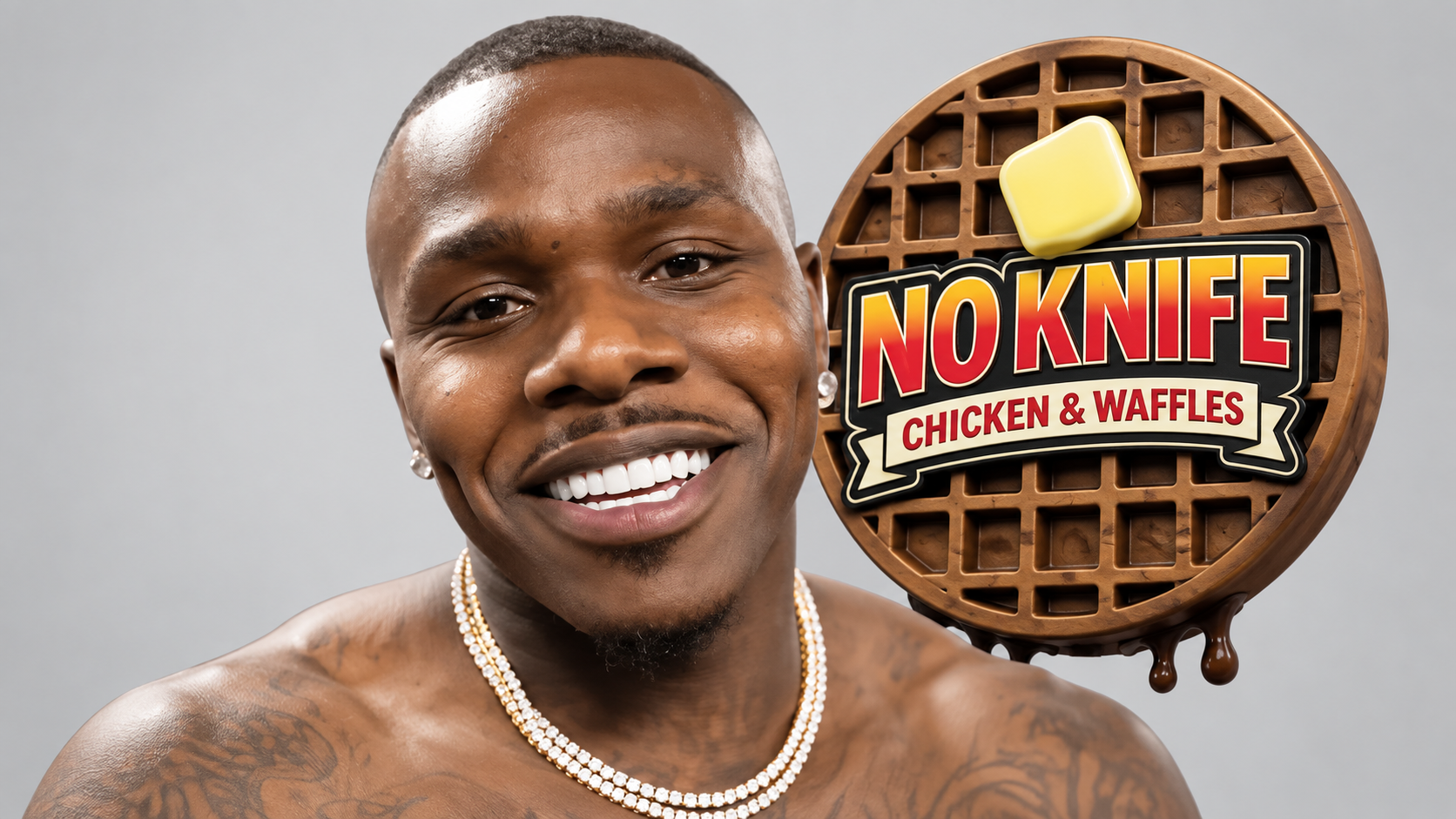
DaBaby’s new Charlotte restaurant has people arguing over a $45 waffle, but the bigger conversation might be about who gets called “too expensive” and who gets called “upscale.”
View this post on Instagram
The rapper’s No Knife Chicken & Waffles opened in Charlotte, North Carolina, and the menu prices quickly became part of the online debate. According to the restaurant’s official menu, a plain waffle costs $15, while flavored options like Banana Pudding, Birthday Cake, Blueberry Lemon, Cookies & Cream, Peach Cobbler, Red Velvet, Strawberry Shortcake, and Sweet Potato are listed at $25. Customers can add six wings to any waffle for $10, which means a flavored waffle with wings lands around $35 before tax, tip, drinks, or delivery fees. The priciest waffle is the $45 Soulfood Cornbread Waffle, which includes collard greens, candied yams, and mac and cheese. No Knife also lists a 9-ounce lobster tail at $40, Lobster & Grits at $32, seafood boil egg rolls at $30, sides at $7, bottled water at $6, and flavored lemonades at $8.
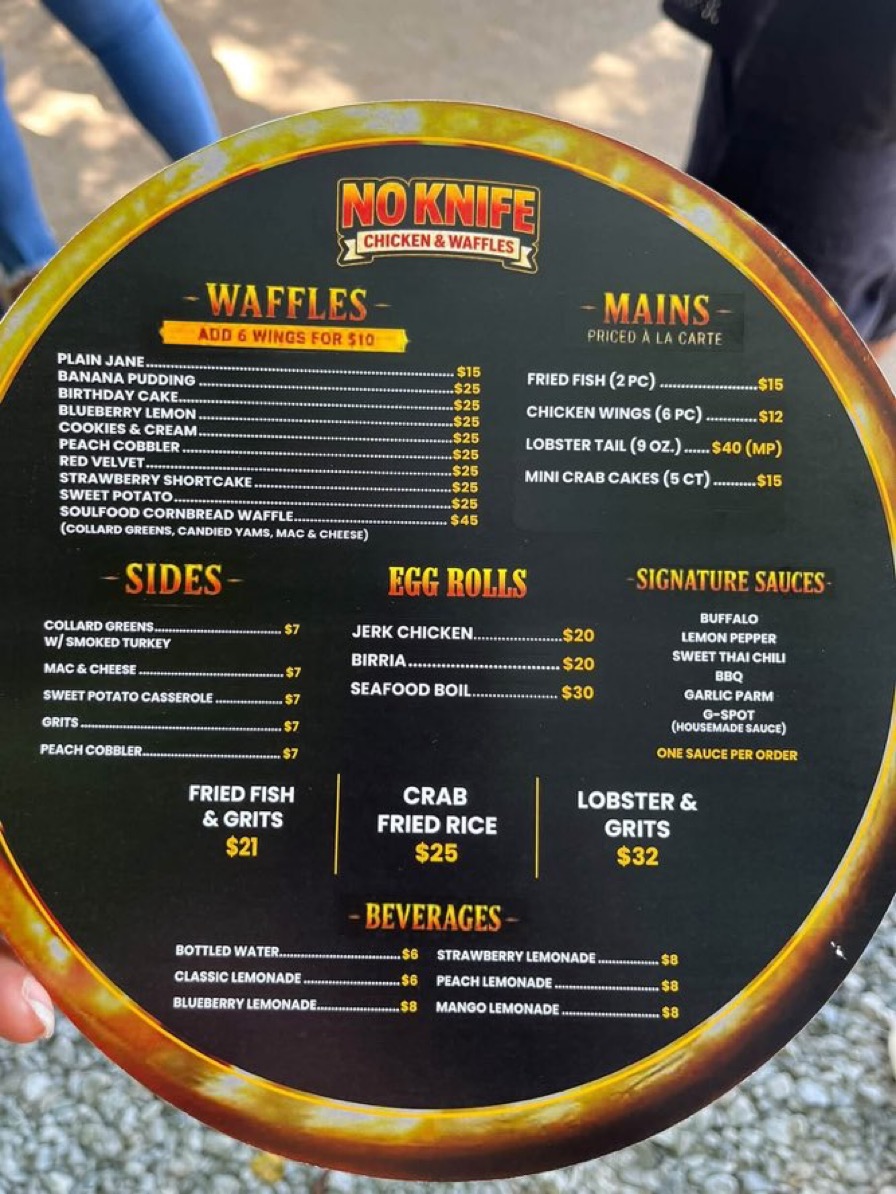
Many social media users questioned the pricing, especially the $45 waffle, $40 lobster tail, and $6 bottled water, despite hundreds of people reportedly lining up for the grand opening. This means folks were dragging the prices online while others were outside trying to taste the food for themselves.
@moniqueontheslay Da baby new restaurant No Knife! #dababy #noknife #foodreview #charlotte ♬ original sound Moniqueontheslay
DaBaby, whose real name is Jonathan Kirk, has been building the No Knife brand beyond music. The Charlotte Observer reported that he previously described “No Knife” as his kitchen alter ego, saying, “No knife is my alter-ego when I’m in the kitchen.” He also called the restaurant “No Knife Chicken & Waffles, brought to you exclusively by me.”
So yes, No Knife’s menu is not cheap. But is it outrageous compared to the wider brunch and Southern comfort food market? That is where the conversation gets a little less simple.
At Yardbird Southern Table & Bar, a mainstream Southern restaurant brand associated with 50 Eggs Hospitality and co-owner John Kunkel, chicken and waffles are listed at $42 on Uber Eats for the Miami location, with DoorDash showing the dish at $46.20. The restaurant’s fried chicken is listed at $36 to $39.60, shrimp and grits at $36, and a Wagyu burger at $35 to $38.50 depending on the ordering platform. Years ago, when a Miami New Times writer questioned Yardbird’s pricing, Kunkel pushed back by explaining that farm-to-table ingredients and scratch cooking were expensive and labor-intensive.
At Hash House A Go Go, a national brunch concept founded by Andy Beardslee and Johnny Rivera, the restaurant lists “Andy’s World Famous Sage Fried Chicken & Waffles” at $28.99 at its Atlantic City location, and the Winter Garden, Florida, Toast ordering page also lists chicken and waffles at $28.99. The dish includes two sage fried chicken breasts stacked on a hickory smoked bacon waffle tower with syrup reduction and fried leeks.
At Jacob’s Pickles in New York, another popular comfort food restaurant with publicly documented owner Jacob Hadjigeorgis, chicken and waffles are listed at $24, while dishes like shrimp and bacon grits are $29, classic mac and cheese is $21, lobster mac is $38, and grilled lamb chops are $42.
Even in Charlotte, Haberdish lists its chicken and waffle at $16, with add-ons that can increase the price. Its official site says the restaurant was created by Jeff Tonidandel and Jamie Brown, who also own several other Charlotte restaurants. That price is clearly lower than No Knife’s $25 flavored waffles with a $10 wing add-on, but it still shows that chicken and waffles are often treated as more than a cheap breakfast plate when restaurants position them as specialty comfort food.
That is the point. No Knife may be pricey, but it is not operating in a world where brunch is still $8.99 across the board. The USDA’s Economic Research Service reported that restaurant and foodservice prices were 3.4% higher in July 2026 than one year earlier and forecast food-away-from-home prices to rise 3.6% for the full year. The Bureau of Labor Statistics also reported that food away from home rose 0.3% in July 2026 alone. Translation: eating out is expensive everywhere, not just at the Black-owned spot people decided to put on trial.
That does not mean customers cannot complain. They can. A $6 bottle of water is going to make people blink, whether it is sold by DaBaby, a hotel lobby, or a rooftop brunch spot with neon signs and a $19 mimosa. Consumers are allowed to decide what feels worth it. Nobody has to spend $45 on a waffle if their spirit says, “Absolutely not.”
But the nuance is this: Black-owned businesses are often expected to be affordable, excellent, culturally validating, community-minded, generous, polished, fast, and flawless at the same time. Meanwhile, similar pricing at mainstream or chef-driven restaurants is often framed as “premium,” “elevated,” or “an experience.” When a Black celebrity or Black entrepreneur charges luxury-adjacent prices, the internet can quickly turn into an audit.
Research shows that bias around minority-owned businesses is not imaginary. A 2020 study published in Frontiers in Psychology found that potential consumers showed bias against common products from minority ventures and offered a lower price for them. At the same time, research in the American Economic Review found that making Black-owned restaurants easier to identify on a platform increased customer engagement, calls, orders, online traffic, and in-person visits, showing there is real demand when consumers can find and support those businesses.
There is also a cost side. Federal Reserve research has repeatedly found that Black-owned firms face greater challenges accessing capital. One Federal Reserve analysis found that creditworthy Black-owned firms experienced greater difficulty raising capital than creditworthy white-owned firms, even after controlling for firm characteristics and performance. Another Federal Reserve report found that white-owned businesses were approved for the full amount of credit they requested at higher rates than Black-owned businesses.
That matters because restaurants are already a tough business. Buildout, rent, equipment, payroll, insurance, ingredients, utilities, marketing, security, repairs, online ordering fees, and delivery app commissions can turn a dream into a spreadsheet nightmare. If Black entrepreneurs face tougher access to affordable financing while also being expected to charge less, the math starts looking real funny.
The fair conversation is not whether every No Knife item is a bargain. Some customers will look at the menu and decide it is too high. That is their right. But if $42 chicken and waffles at one restaurant is called a chef-driven Southern classic, while $35 flavored waffles with wings at DaBaby’s spot becomes a public dragging, it is worth asking whether the issue is really just the price.
The bottom line is simple: No Knife’s prices are part of a bigger conversation about value, branding, race, celebrity businesses, and how quickly Black-owned establishments get judged when they charge like everybody else. Customers can demand quality for their money, but the standard should be consistent. If the waffle is too high, say that. Just make sure the same energy shows up when the upscale brunch spot down the street is charging luxury prices for the same comfort food culture Black folks helped make famous.

These other restaurants are either also too expensive, way better quality, or in way more expensive locations. This is charlotte and you’re eating at a picnic table. This is scamming behavior
RESTAURANT WITH HUMONGOUS FLATSCREEN TELEVISION.
WAFFLES AND SEAFOOD…$45?
SOLD.
THESE PEOPLE WERE GRANTED CHIP CARDS ON EBT NOT TO MENTION TANF HAS BEEN AVAILABLE FOR YEARS ALONG WITH CHILD CARE SUBSIDY AND CHILD CARE TAX CREDIT BONUSES.
EBT LAWSUIT COULD’VE REMAINED BARCODE DEBIT ONLY. ALL I NEEDED WAS COOKWARE AND A MICROWAVE…WITH SOME SOCKS AND UNDERGARMENTS. (PLUS AN EMPLOYMENT INTERVIEW OUTFIT.)